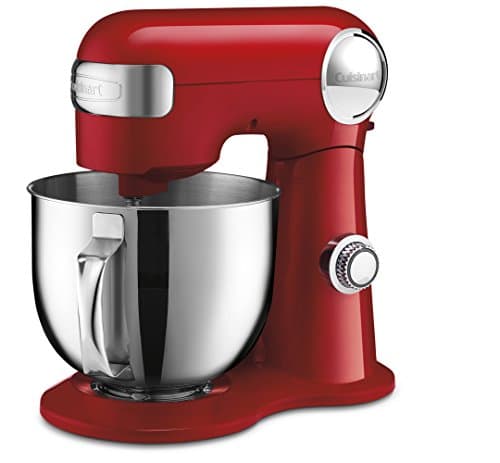
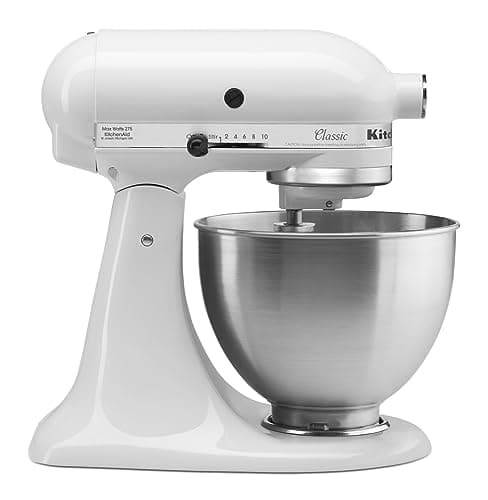
If you want a real tilt-head stand mixer without paying up for the premium models, these are the two you keep landing on: the entry KitchenAid Classic and the Cuisinart Precision Master. On the numbers that describe mixing, the Cuisinart wins on paper; on the things that describe living with the machine for a decade, the KitchenAid pulls ahead. Which matters more is the whole decision.
Look at the spec sheet first. The Cuisinart carries a larger 5.5-quart bowl to the Classic's 4.5, a higher rated motor (500 W vs 275 W), twelve speeds against the KitchenAid's ten, and it ships with a flat beater, dough hook, whisk and a splash guard in the box. The Classic's bowl is the smallest in the KitchenAid line and its rated motor is the weakest of the family. On pure mixing capacity per dollar — creaming butter, whipping cream, kneading a loaf or two — the Cuisinart simply out-specs a same-price KitchenAid, and it often costs less while doing it. Treat the wattage gap honestly, though: rated watts aren't kneading torque, so read it as more headroom, not proof it out-kneads on every dough.
Where the KitchenAid Classicearns its keep is everything around the mixing. It shares the same front PowerHub as every pricier KitchenAid, which means the deepest attachment ecosystem in the category — pasta rollers, grinders, spiralizers, ice-cream bowls — is open to it even at the entry price. KitchenAids also hold resale value and parts availability better than any rival, and the cast build feels a step more refined than the Cuisinart, whose head latch is a little less polished and whose long-term parts support trails. That's the trade in one line: the Cuisinart is more mixer today; the Classic is a better platform over years. Our Classic review and Precision Master review go deeper on each.
Fit and finish deserve a fair hearing on both sides. The Classic is a genuine cast KitchenAid, and it looks and feels like the machine that's been on kitchen counters for decades — that matters if you're buying something to leave out and keep. The Cuisinart isn't as refined at the latch and doesn't have the same resale story, but its build is perfectly solid for the money and the extra half-quart of bowl is real capacity you feel on a double batch. Neither is a compromised machine; they optimize for different things.
The rule:buy the KitchenAid Classic if you want the ecosystem, the resale value and the KitchenAid platform, and your baking is mostly single batches. Buy the Cuisinart Precision Master if you want the most bowl and motor per dollar, you bake bigger or more often, and you don't care about growing into attachments.
Which value tilt-head should you actually buy?
Buy the KitchenAid Classic if…
You want into the KitchenAid world for the least money and you value the platform over raw capacity. The same ten-speed planetary action and the same attachment hub as the pricier models are here, so you're not locked out of pasta rollers or grinders later — the only things you give up versus the Artisan are half a quart of bowl and a little motor. For a single-batch baker who wants the resale value and the parts network behind them, it's the smart budget entry, and the value anchor of our budget roundup.
Who it's not for: anyone who routinely bakes double batches or wants the most capacity for the money. The 4.5-quart bowl gets tight on a full double batch, and the Cuisinart hands you more bowl and motor for less.
Buy the Cuisinart Precision Master if…
You want the most mixing capacity per dollar and attachments don't interest you. The bigger 5.5-quart bowl and higher rated motor are real advantages for pure mixing and kneading, twelve speeds add a useful slow start, and getting the dough hook, beater and whisk in the box adds value a bare KitchenAid doesn't. For a straightforward home baker who just wants a capable machine and the best value, it's the smart-money buy — see the full review for its trade-offs.
Who it's notfor: anyone who might grow into the wider attachment world of pasta rollers and grinders, or who cares about resale value and long-term parts support. That's KitchenAid's home turf, and the Cuisinart can't match it.
How to weigh the wattage and bowl gap
The Cuisinart's 500 rated watts against the Classic's 275 reads as a knockout, but rated watts and kneading torque are not the same thing — gearing and drive design matter as much, and both are planetary tilt-heads with the same basic limits on very stiff dough. Count the bigger bowl as the more decisive real-world advantage, and treat the wattage as a point for headroom rather than proof of superiority. Our wattage guide explains why the number flatters cheaper machines.
The deciding question
Ask whether you'll ever buy an attachment. If yes, the KitchenAid's premium is buying a platform you'll actually use, and its resale value softens the cost down the road. If no — you just want a big, capable bowl for cakes, cookies and the odd loaf — the Cuisinart gives you more mixer for less, and the KitchenAid tax buys you nothing you'll touch. If you're a beginner still weighing where to start, our best-for-beginners roundup frames the same call against a wider field.