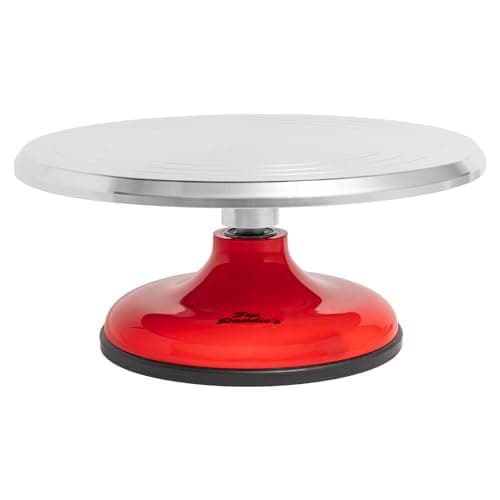
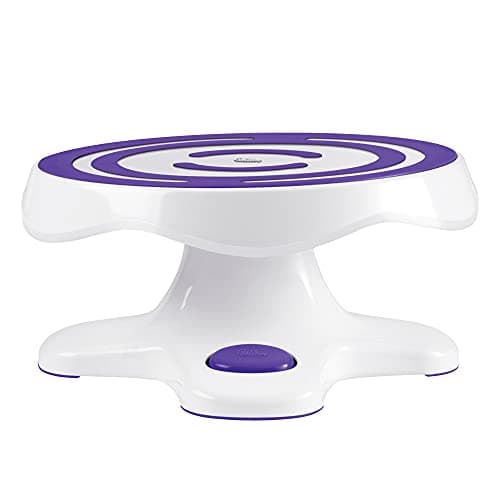
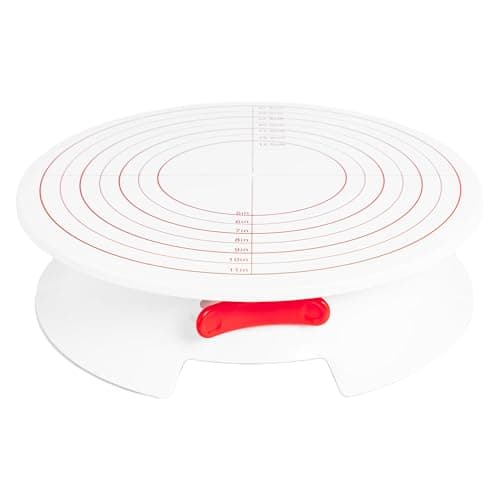
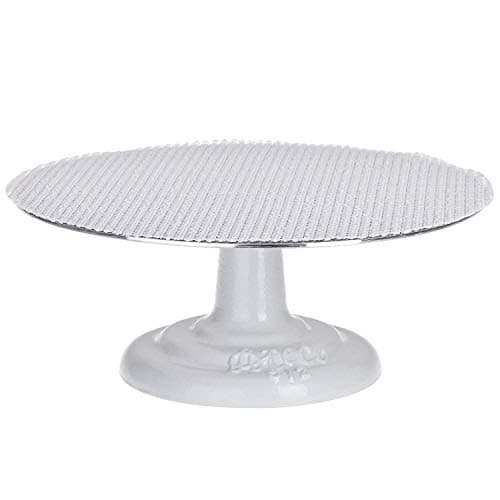
Buy the Ateco 12-inch revolving stand with the cast iron base. It is the bakery default and the only pick here that is not standing on plastic: a 12-inch aluminum platter published at 1/8 inch thick, spinning on ball bearings over a weighted iron base with a non-slip pad, which retailer listings put near 7 pounds with a 200-pound load rating. That mass is the entire product. Take the Fat Daddio's TT-1255 instead for about half the money and two things the Ateco does not have: a locking brake and a centering guide printed on the platter. The Wilton Tilt-N-Turn Ultra publishes 18 locked tilt positions on a 12 x 7-inch platform, which is the real answer to piping the far top edge of a tall cake. The Fat Daddio's TT-123B is the budget pick and keeps the brake and the guide.
The criteria: a turntable is a stability tool, not a spinning tool
Almost every turntable spins acceptably, which is why reviews that rank on “smooth rotation” are measuring the thing that is hardest to get wrong. The job that actually requires a turntable is a flat side on a buttercream cake: you hold a bench scraper or a side scraper still, vertical, against the frosting, and rotate the cake underneath it in one continuous turn. Hold the blade at a fixed radius through 360 degrees and the side comes out flat; let the radius vary by two millimeters and you get a visible wobble in the finish.
That motion pushes the stand sideways. A scraper loaded against a cake is a lateral force applied a few inches above the base, and the stand either absorbs it or slides. So these are the criteria, in the order they matter:
1. Mass and base footprint. Does the stand stay where you put it under a sideways push? Weight in the base is the only real answer; a non-slip pad helps a light stand and cannot save one. This is the spec the price difference on this page buys.
2. Platter rigidity. Does the top flex when you press down and across on one edge? A platter that flexes transmits that flex into the blade angle, and the flex shows up in the finish. A 1/8-inch aluminum plate does not flex. A plastic platter does.
3. Rotation under load. Does the bearing turn smoothly with eight pounds of cake on it, or only when empty? Ball bearings under a metal platter behave the same loaded and unloaded. A plastic bushing does not.
4. Height. How far your hands are off the counter. A 3-inch platform means bending over the cake; a 5 or 7-inch pedestal brings the work up to a comfortable angle. This matters more than it sounds over a one-hour decorating session, and it is a real reason to pay for a taller stand.
5. Features that earn their keep. Two do: a locking brake (so you can pipe a border against a stand that stays still, then release it to smooth) and a centering guide printed on the platter (so a layer goes down concentric rather than eyeballed, which is what stops a tiered cake leaning). A tilt is the third, and it is the only feature here that changes your posture rather than the cake.
Published specifications of the four picks
| Stand | Platter | Base | Height | Brake / guide |
|---|
| Ateco 12 in, cast iron base | 12 in aluminum, 1/8 in thick | Cast iron, non-slip pad | About 5 in (retailer) | Neither |
| Fat Daddio's TT-1255 | 12 in aluminum | Weighted ABS pedestal | 5 in | Both |
| Wilton Tilt-N-Turn Ultra | 12 in plastic | Plastic | 7 in | 18 locked tilt positions |
| Fat Daddio's TT-123B | 12 in ABS | ABS, non-slip | 3.2 in | Both |
Gaps worth naming rather than filling in. The Ateco's weight and load rating come from retailer listings, not from Ateco — one gives about 7 pounds, another a 200-pound rating and a 1/8-inch aluminum top, and retailer heights disagree between 4.9 and 5.125 inches. Fat Daddio's does not publish whether the TT-1255's top is sheet or cast aluminum, and retailers describe it both ways; its weight appears on retailer listings at about 4 pounds. Neither Wilton nor Fat Daddio's publishes a load rating for their plastic stands. And Wilton publishes no dishwasher rating for the Tilt-N-Turn; its care instruction is to wipe with a damp cloth and dry. Where a figure does not exist we say so rather than borrowing one from a sibling product — see how we pick.
Why the heaviest stand wins, and when it is a waste of money
The case for the Ateco is one sentence: it is the only stand here that is unarguably heavier than the force you apply to it. Seven pounds of iron under a 12-inch aluminum plate means the scraper meets a fixed object. You can lean a blade into the side of a cake, rotate with the other hand, and the stand does not creep across the counter, does not tip on the loaded side, and does not transmit anything into the finish. Everything about a smooth buttercream side is downstream of that.
It is also a stand with no features. No brake, so piping a border means holding the platter still with your spare hand. No centering guide, so a layer goes down by eye. Retailers say not to immerse it in water, so cleaning is a cloth-and-care job rather than a rinse. It is two to three times the price of everything else here, and that premium is almost entirely the base.
So the honest version of the recommendation: the Ateco is the right buy if you finish cake sides with a scraper often enough to care how flat they are.If you frost two birthday cakes a year, mostly with a swooped or textured finish rather than a mirror-flat one, the money does not come back and the Fat Daddio's TT-1255 is the better purchase — it has a metal top and sealed radial ball bearings, it is stable enough for ordinary work, and it has both features the Ateco lacks.
The brake and the centering guide: the two features worth paying for
Most turntable “features” are noise. These two are not.
A locking brakesolves a genuine conflict. Smoothing wants free rotation; piping wants the opposite. Running a shell border around the base of a cake, or writing on the top, with a platter that drifts a few degrees under the pressure of the piping bag is how a straight line comes out as a curve. Without a brake you hold the platter with your weak hand, which is also the hand you wanted for steadying the bag. Both Fat Daddio's picks have one; neither the Ateco nor the Wilton does.
A centering guide— concentric circles printed on the platter, in inches on the TT-1255 and in both inches and centimeters on the TT-123B — solves a problem people do not realize they have. A layer set down off-center produces a cake with one thin side and one thick side, which no amount of frosting hides, and on a tiered cake it is how the whole thing ends up leaning. Lining the layer up to a printed ring takes two seconds and removes the judgment entirely. It is also how you cut an even number of equal slices: line the knife up on a diameter.
The third candidate is the tilt, and it is a different kind of feature because it changes you rather than the cake. Wilton publishes 18 locked tilt positions on the Tilt-N-Turn Ultra, which angle the cake toward you. The problem it solves is real: the far top edge of a tall cake is the hardest place on a cake to pipe, because you are reaching across the top and looking down at a surface you cannot see squarely. Tilting brings that edge into view and into reach. If you do a lot of piped detail on tall cakes, it is a genuine ergonomic gain — and it is also a plastic stand that costs more than the aluminum-topped TT-1255 while being less rigid, so you are buying posture, not finish.
Height, and the thing nobody mentions about low turntables
The heights here run from 3.2 to 7 inches, which is a bigger spread than it sounds when the work takes an hour.
A 3.2-inch stand(the TT-123B) sits the cake barely above the counter. Your forearms are low, your wrists are at an awkward angle for a vertical scraper, and you are looking down at the cake rather than at it. It stores flat in a drawer, it fits under a cake dome, and it is the cheapest route into a stand with a brake and a guide — those are real advantages, and the posture is the cost.
A 5-inch stand (the Ateco and the TT-1255) is the standard, and it is the standard because it clears your knuckles and puts the side of an 8-inch cake roughly at eye-and-elbow height for a seated or standing adult at a normal counter.
A 7-inch stand (the Wilton) is tall. On a kitchen counter it brings a tall cake up to chest height, which is excellent for piping sides and slightly awkward for working on the top of a four-layer cake. Combined with the tilt, it is the most ergonomically considered stand here; it is also the least rigid.
The free version of this adjustment: put a shorter stand on an upturned stockpot or a sturdy box. It works, it is ugly, and it is worth trying before you pay for height.
What you actually do with it, beyond frosting a cake
Worth knowing before you decide a turntable is a once-a-year tool. It is the right surface for crumb-coating and chilling (the platter goes in the refrigerator with the cake on it, on the metal picks), for filling and leveling layers, for even sugar or sprinkle coverage, for icing cookies in batches, for piping a dozen cupcakes without rotating each one by hand, and for assembling anything round where concentricity matters — a mousse, a trifle, a cheesecake coming out of a springform pan. It is also the easiest way to glaze a bundt evenly: spin slowly and pour from a jug at a fixed point.
None of which makes it a weekly tool for most people. It is a tool that makes one difficult job possible rather than many easy jobs faster, which is why the budget pick on this page is a legitimate answer and not a compromise.
How to choose and use a cake turntable
Decide from how you finish a cake, not from the price
The decision is three questions. Do you want mirror-flat buttercream sides? Buy the heaviest stand you can justify — that is the Ateco, and nothing else on this page substitutes for the mass. Do you do a lot of piped detail? Buy a brake, and consider the tilt. Are you starting out, or do you finish cakes with a textured swoop rather than a scraped flat? Buy the TT-123B, use it for a year, and you will know which of the other two you actually needed.
The one combination we would not recommend is paying mid-range money for a plastic stand with no brake. If the top is plastic, the features are what you are buying; if the top is metal, the rigidity is.
Twelve inches is the size, and here is why
All four picks are 12-inch platters, which is not a coincidence. A 12-inch top takes a 10-inch cake board with clearance for your fingers underneath, and a 10-inch board is the largest round most domestic bakers make. Smaller platters (the 8- and 10-inch stands sold as “compact”) force you to grip the cake board itself to lift the cake off, which is how a finished side gets a thumbprint in it. Larger platters exist in bakeries and are harder to store. If you are buying one turntable, buy 12 inches.
Use a cake board, always
Never frost directly onto the platter. A cardboard or hardboard round the same diameter as the cake, under the bottom layer, is what lets you lift the finished cake off without touching it — and it is also what you slide onto the serving plate at the end. A dab of frosting under the board glues it to the platter so the cake does not slide while you scrape. This is the single habit that most improves results with a cheap turntable, because it means a light stand only has to resist your scraper, not a cake sliding on a slick metal surface as well.
Scraping a flat side: the actual technique
Hold the scraper vertical, blade flat against the frosting, with your hand braced against your body or the counter rather than floating. The hand holding the scraper should not move at all. Rotate the platter with the other hand in one continuous turn — not a series of short pushes, which is what produces a scalloped side. Keep going past the start point by a few degrees to blend the seam, then lift the scraper away and upward, never outward. Clean the blade and repeat; three light passes beat one heavy one.
If the stand creeps across the counter while you do this, that is the stability criterion in action, and it is not a technique problem.
Chill between coats
Crumb coat, then refrigerate the cake — on the turntable if the platter is metal and your refrigerator has the room — for fifteen to thirty minutes before the final coat. A firm crumb coat is what stops the scraper dragging crumbs into the finish. This matters more than any feature on any stand here. The buttercream itself matters too: ours is made in a stand mixer, and how to make buttercream in a stand mixer covers getting it smooth enough to scrape in the first place.
Cleaning, by material
Cast iron base: retailer guidance for the Ateco is not to immerse it in water. Wipe the platter, wipe the base, dry it. An iron base will develop surface rust if you leave it wet.
Aluminum platter: wipe or wash by hand and dry promptly. Do not put bare aluminum in a dishwasher — detergent dulls and discolors it, the same reason the anodized pans in our uncoated bakeware roundup are hand wash only.
ABS plastic:warm soapy water. Fat Daddio's and Wilton both publish wipe-and-dry care; neither publishes a dishwasher rating, so we would not risk a mechanism in a hot wash.
What we did not feature, and why
Unbranded aluminum-alloy turntablesare the largest group in this category by listing count, usually around 12 inches, usually about the price of the TT-1255, and absent here on purpose. Several publish no platter thickness, no weight, no bearing type and no load rating while using the word heavy-duty in the title. The whole argument of this page is that the numbers are the product, and we rank on published specifications — a claim in a product title is not one.
Turntables sold inside decorating kits (the ones bundled with piping tips, scrapers and spatulas) are priced as if the turntable were free, and it usually is: the stand in a twenty-dollar kit is the thinnest plastic in this category. Buy a stand and buy tips separately.
Marble and glass pedestal cake stands that rotate are serveware. They are heavy, which is the right instinct, and they are not built for lateral load, have no bearing worth the name, and are usually the wrong height.
Lazy Susansfrom the storage aisle rotate and cost less. They also sit nearly flush to the counter, have no non-slip base, and are not flat enough across a 12-inch span to scrape against. If you genuinely only need rotation — for sprinkles, or for glazing — one will do; it is not a decorating stand.