You need a half sheet, and you need two of them. A half sheet is roughly 18 x 13 inches, it is the size nearly every recipe on the internet assumes when it says “a baking sheet,” and it is the largest size that fits a standard domestic oven with room for air to move around it. Two, because cookies bake in batches and dough on a still-hot pan spreads before it sets. After that, the genuinely useful second size is a quarter sheet— half the footprint, fits a toaster oven, right for four cookies or a tray of nuts. A full sheet is a commercial pan and will not go in your oven.
What the names mean
The names come from commercial kitchens and they are fractions of one pan: a full sheet is about 26 x 18 inches, which is sized for a professional convection oven and is wider than the interior of nearly every domestic one. Everything else is derived from it — a half sheet is about 18 x 13, a quarter sheet about 13 x 9, and an eighth sheet about 9 x 6. The exact outside dimensions vary by a fraction of an inch between manufacturers, which matters more than you would think: Nordic Ware publishes its Naturals half sheet at 17.9 x 12.9 inches outside with a 17.1 x 12.1-inch cooking surface, while Caraway publishes its sheet at 18 x 13. Those are not the same pan, and in a tight oven or a tight drawer the difference decides it.
Why a half sheet is the default
It is what recipes assume.“Spread on a baking sheet” almost always means a half sheet. Recipes are written around the pan's area, so using a quarter sheet for a half-sheet recipe crowds the food, which steams it rather than browning it; using a bigger pan than specified spreads it thin and over-bakes it.
It fits with clearance. A pan needs air around it. If a pan is within an inch of the oven walls, hot air cannot circulate past the edges and you get a pan that bakes hotter at the rim than the centre — and an uneven heat-up is also what makes a pan buckle, which is covered in how to keep baking sheets from warping.
It is the shared standard. Half-sheet-size cooling racks, silicone mats, parchment sheets and pan liners are all sold off the shelf. A non-standard pan means cutting parchment to fit for the rest of its life.
Measure your oven before you buy
Two numbers, two minutes, and it settles the question. Measure the interior width of your oven at rack height, wall to wall, and measure the usable depth from the back wall to the inside of the closed door. You want at least an inch of clearance on each side of the pan — so an oven 20 inches wide takes an 18-inch pan comfortably, and one 19 inches wide does not. In a toaster oven or a countertop oven, measure the same way and expect the answer to be a quarter sheet; most will not take a half sheet at all. If you have an RV or apartment oven, measure rather than assume, because those are often several inches narrower than a full-size range.
The sizes, and what each is actually for
| Size | Approx. dimensions | Fits | Best for |
|---|
| Full sheet | 26 x 18 in | Commercial ovens only | Nothing, in a home kitchen |
| Half sheet | 18 x 13 in | Standard domestic oven | Everything. Buy two. |
| Quarter sheet | 13 x 9 in | Toaster and countertop ovens | Four cookies, nuts, small roasts |
| Eighth sheet | 9 x 6 in | Any oven | Specialist; rarely needed |
Approximate dimensions are the commercial-standard nominal sizes; the exact published outside dimensions of the pans we rank are in their specs above and in Sources below. We have not measured anyone's oven — see how we pick for what our figures are and are not.
Which to buy, in order
First purchase: two half sheets
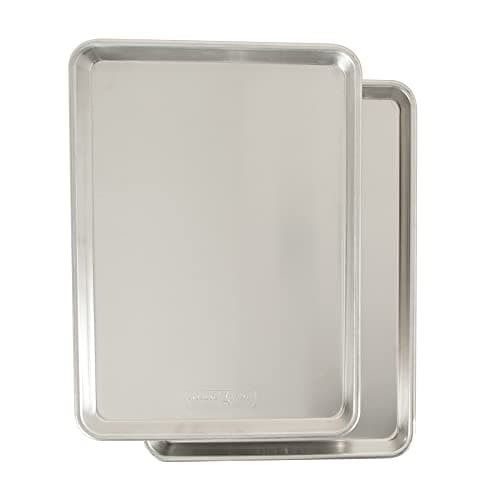
The Nordic Ware Naturals half sheet two-pack is the answer for most people: light bare aluminum browns evenly, the encapsulated galvanized steel rim resists warping, it carries a lifetime warranty, and buying a pair in one go solves the batch-rotation problem immediately. Hand wash only, and plan on parchment, because bare aluminum is not a release surface.
Second purchase: a quarter sheet
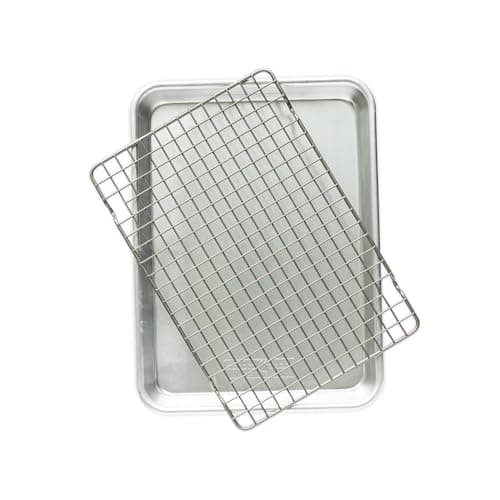
The Nordic Ware Naturals quarter sheet is the same construction at half the footprint, and it covers the jobs a half sheet makes awkward — toasting a handful of nuts, baking four cookies, anything going into a countertop oven where a half sheet will not fit. The included nonstick grid works as an in-pan roasting rack and as a small cooling rack. It is firmly a second pan, never a first one.
If high heat or handles matter
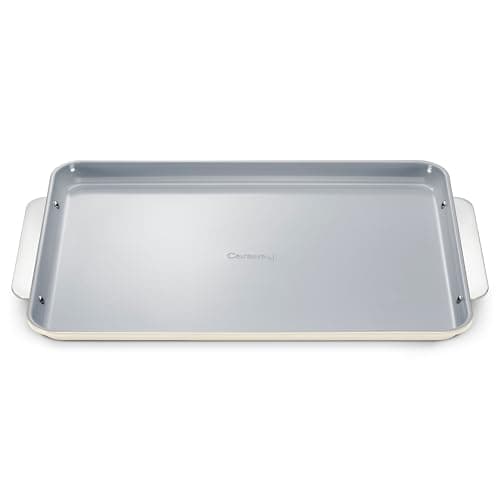
The Caraway sheet is 18 x 13 with integrated stainless handles and a published 550°F ceiling — the highest we rank, and above what the coated USA Pan sheets allow at 450°F. The handles are a real convenience on a hot loaded pan. It is also by a wide margin the most expensive sheet pan here, it is one pan rather than two, and its ceramic coating is a wear item. The full argument is in Caraway vs Nordic Ware.
How many pans is enough?
Two half sheets is the floor for anyone who bakes cookies, because a cool pan and a hot pan bake differently. Three if you bake long batches or cook dinner on sheet pans as well — the third one is where a cheap pan like the Chicago Metallic Professional makes sense, since its job is to keep the rotation going rather than to produce your best bake. Add a quarter sheet once you notice yourself heating a full-size pan for a handful of something. Beyond that you are collecting, not equipping.
Where this fits
Sheet pans are among the cheapest things in a baking kitchen to get right and the most used, which is why they sit near the front of our baking essentials starter kit. Once the size is settled, the next two decisions are surface and construction: the coating question is in aluminum vs nonstick baking sheets, the full ranked field is the best baking sheets, and the cookie-specific cut is the best baking sheets for cookies. Loaf pan sizing works on exactly the same principle — the pan the recipe assumes — and is covered in how to choose a loaf pan.