If you mostly bake cakes, cupcakes and quick breads, the spec that sells stand mixers — raw kneading power — is almost beside the point. A cake batter is light and aerated. The job is to cream butter and sugar into a pale, fluffy base, beat in eggs without splitting them, and fold in flour just until it disappears. What decides how well a mixer does that is even planetary coverage, a beater that actually reaches the whole bowl, and a genuinely gentle low speed — not a motor that could crush bagel dough.
That changes the ranking. The heavy-dough winners on this site aren't automatically the best for cakes, and some of the cheaper tilt-heads are excellent at exactly this work. Every machine below has enough motor for batter with room to spare, so we're ranking them on the things that actually shape a crumb: how completely the beater sweeps the bowl, how slow and controllable the lowest speed is, and how easy it is to keep the batter from climbing the sides.
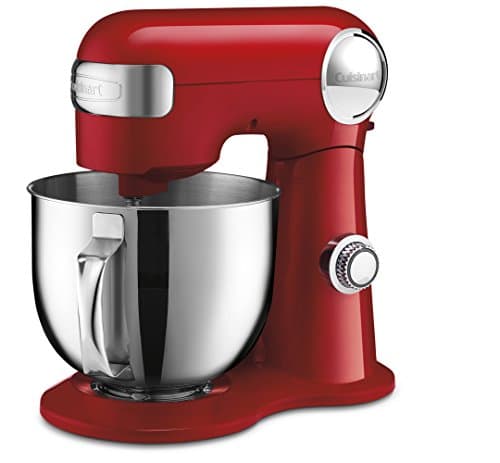
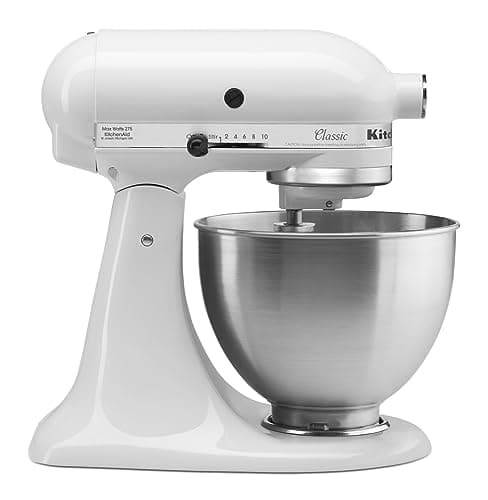
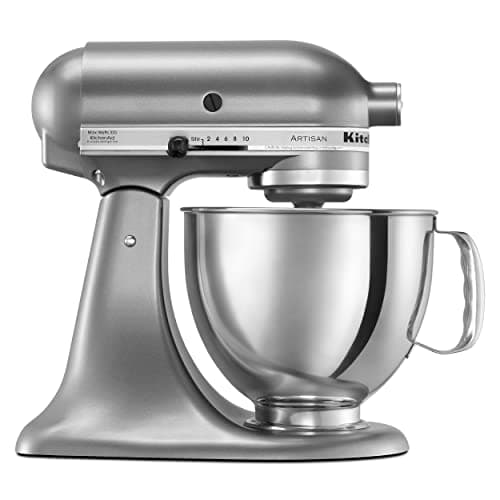
Our pick for most cake bakers is the KitchenAid Artisan. Its 10-speed planetary action and 5-quart bowl are a natural fit for creaming and mixing, and — crucially — it's the platform with the deepest accessory range, so you can drop in a flex-edge beater that scrapes the bowl as it turns. Behind it, the Cuisinart Precision Master brings a bigger 5.5-quart bowl and a genuinely useful slow start speed, and the KitchenAid Classic is the cheapest way to get the same planetary action for single-batch baking. None of them is a wrong answer; the ranking is about which trade-offs suit which baker.
KitchenAid Artisan — our pick.A 5-quart tilt-head with 10 planetary speeds, it creams and mixes cake batter beautifully, and it's the one platform where you can add a flex-edge beater to solve the bowl-scraping problem for good. Its rated 325-watt motor is only mid-pack, but that never shows on batter, which is light work. The honest cons for cake use are small: the stock flat beater leaves a ring of creamed butter and sugar on the bowl wall, so you'll scrape by hand unless you upgrade the beater, and the tilt-head can flex on very stiff dough — a real limit for bread, but irrelevant to a cake batter.
Cuisinart Precision Master — the value pick with the best low speed.Its 12-speed dial has a genuinely gentle start speed, a touch slower than a KitchenAid's stir setting, which is exactly what you want for folding flour in without a dust cloud or a tough crumb. You also get a bigger 5.5-quart bowl, a higher rated motor, and a flat beater, whisk and splash guard in the box. The honest cons: its first-party attachment range is a fraction of KitchenAid's, its resale value and long-term parts support trail KitchenAid, and the head latch feels a step less refined.
KitchenAid Classic — the budget entry.The cheapest genuine KitchenAid keeps the same 10-speed planetary action and the same front attachment hub, so it creams and mixes a single-batch cake exactly like the Artisan does. The honest cons are the ones you'd expect from the entry model: its rated 275-watt motor is the weakest in the line, the 4.5-quart bowl gets tight on a full double batch, and it comes in fewer colors and bowl options. For an occasional cake baker, none of those limits ever surface.
What actually makes a stand mixer good at cake batter
Cake batter is forgiving on power and unforgiving on technique. The mixer's contribution is coverage and control, so buy for those before you look at wattage.
Planetary coverage and the flat beater matter most
A planetary mixer spins the beater one way while orbiting it around the bowl the other way, which is what lets a single beater reach almost the whole bowl. All three picks here are planetary, so the differences are small — but the stock flat beater on any of them still leaves a ring of butter and sugar clinging to the bowl wall, which is why you stop to scrape. On a tilt-head KitchenAid you can fix that permanently with a flex-edge beater, whose silicone wing wipes the bowl as it mixes. For creaming and cake batter specifically, that is the single most useful upgrade you can make.
A gentle low speed keeps the crumb even — and the flour in the bowl
Two moments in cake-making need a slow, controllable speed: starting the creaming so sugar doesn't fly out, and folding in flour so you don't knock the air back out or build gluten. This is where the Cuisinart Precision Master earns its place — its 12-speed dial has a genuinely slow start speed, a little gentler than a KitchenAid's stir setting, which helps with the flour cloud. If you want to understand where each number on the dial belongs, our stand-mixer speeds guide maps them to jobs.
Bowl size: match it to your usual cake, not your biggest
The Classic's 4.5-quart bowl is plenty for a standard two-layer cake or a dozen cupcakes; the Artisan's 5-quart and the Cuisinart's 5.5-quart give you headroom for a double batch or a tall layer cake. Bigger isn't automatically better here — creaming a single stick of butter or whipping a couple of egg whites gets lost in an oversized bowl, and the beater can ride above a small amount of batter. Size to your typical bake.
The mistake a mixer can't save you from: overmixing
The most common cake failure isn't a weak motor, it's too much of a strong one. Once the flour goes in, a stand mixer will happily beat the batter into a tough, dense crumb in seconds. Cream thoroughly, beat the eggs in fully, then drop to the lowest speed and mix only until the flour disappears — or finish by hand. The technique that does most of the work here is the creaming step; our how-to-cream-butter-and-sugar guide walks it through start to finish.
Where power still matters a little
You don't need dough torque for cakes, but a stiffer batter — a dense pound cake, a heavily loaded carrot cake — does ask a bit more of the motor than a sponge. All three picks have the headroom for that. It's only if your baking leans toward bread and stiff dough as well that you'd weight the decision differently; the best-for-home-bakers roundup is the better starting point for a do-everything machine.
Whisk or beater? It depends on the cake
Most everyday cakes — butter cakes, pound cakes, boxed-style layer cakes — are made with the flat beater, because the method is to cream fat and sugar and then mix gently. But a few cakes invert that: a genoise or a classic sponge gets its rise from eggs whipped to a foam, and that is a job for the wire whisk on a higher speed. Knowing which style you're baking tells you which attachment to reach for, and it's why a mixer that comes with both — as all three picks do — matters more than one big number on the box.
Room-temperature ingredients do half the work
A mixer can only aerate a batter well if the ingredients cooperate. Butter at cool room temperature creams properly where cold butter stays lumpy; room-temperature eggs and dairy emulsify into the batter smoothly instead of splitting it. None of that is about the machine, but it's the difference between a light cake and a dense one on any mixer, so it's worth building into your routine before you blame the hardware.
Use the pouring shield — and don't overfill
Cake batter is splashy and flour is dusty, so the splash guard or pouring shield that ships with these mixers earns its keep: it channels additions into the bowl and keeps the counter clean. Just as important, keep the batter well below the bowl's rim. Overfilling makes the beater ride over the top of the mix, so the batter never combines evenly, and it's a common reason a big-batch cake bakes unevenly. If your recipe pushes a 4.5-quart bowl to its limit, split it or step up to a bigger bowl rather than fighting an overfull one.
When a hand mixer is honestly enough
If cakes are the only thing you bake and you make them a few times a year, you may not need a stand mixer at all — a decent hand mixer creams butter and sugar and whips egg whites perfectly well for occasional baking. The stand mixer earns its counter space when you bake often enough that hands-free creaming, a steadier bowl and the option to knead the odd loaf pay back the price. Be honest about your habit before you spend; a stand mixer bought for two cakes a year is a lovely appliance doing very little.
Don't forget the frosting
A cake mixer is usually a frosting mixer too, and the same qualities that matter for batter matter for buttercream: even bowl coverage, a gentle low speed to start (so a cloud of powdered sugar doesn't coat your kitchen) and a flat beater that creams butter smooth. All three picks handle American and Swiss-style buttercreams comfortably, and the flex-edge beater upgrade that helps with creaming helps just as much here, keeping the frosting off the bowl walls so it whips evenly. If your cakes usually wear a thick layer of buttercream, factor that in — it's another vote for a machine that scrapes as it mixes and starts genuinely slow.
Bowl size, one more time, for layer cakes
The single most common cake job is a two-layer 8- or 9-inch cake, which fits any of these bowls with room to spare. It's only when you scale to a tall three-layer cake, a big sheet cake or a double batch of cupcakes that the Classic's 4.5 quarts starts to feel tight and the Cuisinart's 5.5 quarts pulls ahead. Picture your most ambitious cake, not your average one, and size to that — a bowl that's a little too big costs you nothing on a small cake, while a bowl that's too small forces you to split every big batch.