Mashed potatoes are the one job where a more powerful mixer can actually make things worse. Potato is packed with starch, and the more you beat cooked potato, the more of that starch you break out into a stretchy, gluey paste. So the danger here isn't a motor that's too weak — any capable hand mixer has more than enough power to mash a pot of potatoes. The danger is over-mixing. That flips the usual buying advice on its head: for potatoes, a gentle low speed and fine, well-spaced control matter far more than raw watts.
That's why we rank these three the way we do. All of them will mash potatoes, and none of them will struggle with the load. What separates them is how much control they give you at the bottom of the speed range, whether they can ramp up smoothly instead of lurching, and what they cost. If you want to understand the technique before you buy — because with potatoes, technique is most of the battle — our how to use a hand mixer guide covers starting low and building up, which is exactly what saves a batch here.
Our pick for most people is the Cuisinart Power Advantage Plus 9-Speed. Nine well-spaced speeds give you the low-end control that potatoes reward, it comes with a whisk and dough hooks in a storage case, and it's the value leader of the group. Behind it, the Braun MultiMix 5 is the choice if you regularly mash a big holiday-sized pot and want the most powerful motor here with a smooth ramp-up, and the Hamilton Beach 6-Speedis the cheapest capable option — genuinely all most kitchens need for potatoes a few times a month.
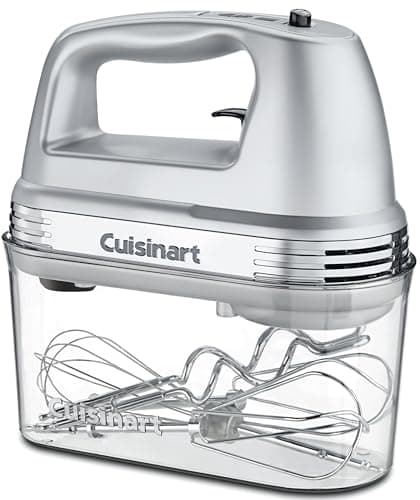
Cuisinart Power Advantage Plus 9-Speed — our pick.For potatoes, the thing that matters most is a controllable low speed so you can bring the potatoes and butter together gently without whipping them into paste, and nine speeds give you finer steps to feather that than a six-speed does. It ships with a whisk and dough hooks in a storage case, its 220 W rated motor has real headroom for the money, and it's usually the best value in the group. The honest cons: Cuisinart's speed 1 is a touch fast for the very gentlest folding, so ease onto the trigger rather than committing to it, and the storage case is bulky in a shallow drawer. Neither is a dealbreaker for mashing. See the full Cuisinart Power Advantage review for the detail.
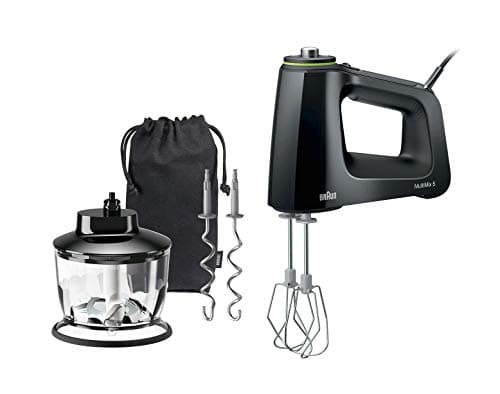
Braun MultiMix 5 — the most power, best for big batches.If you mash a large, holiday-sized pot, the Braun is the pick: its 350 W rated motor is the highest here, and its SmartMix ramp brings the beaters up to speed smoothly instead of lurching, which helps you stay in control even with a full bowl. It comes with a whisk and a chopper attachment, so it does more than just beaters. The honest cons: the European-styling controls take a moment to learn, and the beaters are a single-piece design some people find less familiar than the twin-wire look. If your potato pot is usually small, that extra power is headroom you won't use — but for a crowd it earns its place. The Braun MultiMix 5 review goes deeper.
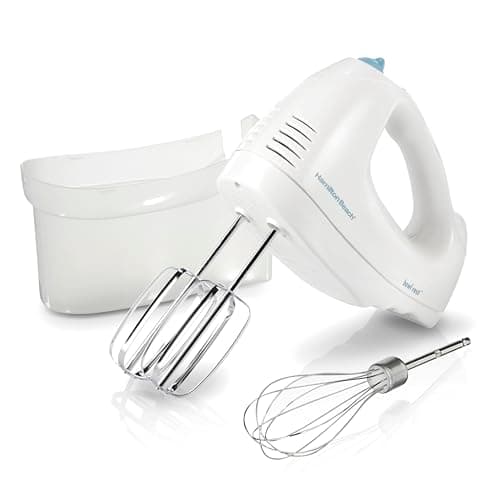
Hamilton Beach 6-Speed — the cheapest capable option.You do not need to spend much to mash potatoes well, and the Hamilton Beach proves it. Six speeds, a QuickBurst button for a quick blast of power, a bowl-rest feature that parks it mid-recipe, and a snap-on case for the beaters and whisk — at consistently one of the lowest prices for a capable mixer. It's light and easy to hold for the couple of minutes a mash takes. The honest cons: it has no dough hooks (irrelevant for potatoes), and six speeds give you less fine control than the nine-speed rivals, so you have to be a little more careful easing onto the low end to avoid over-mixing. For potatoes a few times a month, it's all most kitchens need. The full Hamilton Beach 6-Speed review has more.
What actually makes a hand mixer good for mashed potatoes
Potatoes invert the normal mixer-buying logic. Instead of buying for power, you buy for control, because the whole skill is stopping before you overwork the starch. Here's what matters, and the technique that matters even more than the machine.
Control beats power — every capable mixer has enough motor
Cooked potato is soft. Any of the three mixers here has far more than enough power to move it, so you are not shopping for watts — you are shopping for the ability to go gently. A gentle, controllable low speed lets you fold butter and warm milk into the potatoes without flogging them, and well-spaced speeds let you creep up only as far as you need. This is why the nine-speed Cuisinart and Braun edge out the six-speed Hamilton Beach for potatoes specifically: more steps at the bottom of the range means finer control over the one thing that ruins a mash.
The over-mixing trap: why potatoes turn to glue
Potatoes are full of starch granules. Gentle mashing breaks the potato apart and lets those granules swell with butter and liquid into a smooth, fluffy mash. But keep beating — especially at high speed — and you rupture the granules and pull long chains of starch out into the mix, which turns the potatoes stretchy, sticky and gummy. There is no undoing gluey potatoes once you've gone too far. That's the single most important thing to know here: the failure mode is doing too much, not too little, so the mixer's job is to help you stop in time, not to power through.
Start low, and stop early
The technique is simple and it's most of the win. Start on the lowest speed to break the cooked potatoes down, add your warm butter and warm milk or cream, and mix on low just until it comes together and looks smooth. Only nudge the speed up briefly at the end if you want them a little lighter, and stop the moment they look fluffy — the temptation to give it "just a few more seconds" is exactly what tips a good mash into a gluey one. Because you're working at the low end, a mixer with a genuinely gentle first speed and a smooth ramp (the Cuisinart's nine steps, the Braun's SmartMix ramp) makes staying in control easier than a machine that jumps.
Warm ingredients and the right potato help more than any mixer
Two things outside the machine do a lot of the work. First, use starchy potatoes like russets or a Yukon Gold blend, which mash fluffier than waxy varieties. Second, add butter and dairy warm, not cold — cold liquid firms the fat and makes you mix longer to combine, and longer mixing is the enemy. Drain the cooked potatoes well and let the steam escape so they aren't watery, then bring in warm butter first and warm milk or cream second, mixing as little as possible between additions. Do that and even the budget Hamilton Beach turns out an excellent mash.
When a masher or ricer beats a mixer
Here's the honest part a lot of roundups skip: for the fluffiest, most foolproof mashed potatoes, a hand-held masher or a potato ricer can genuinely beat a mixer. A ricer presses the potato through small holes into fine, even strands with almost no risk of over-working the starch, which is why many cooks reach for one when they want cloud-light results. A mixer is faster and easier, especially for a big pot, and it makes lovely potatoes when you keep it gentle — but it's also the tool most likely to make them gummy if you get carried away. If you already own a ricer or masher, don't feel you have to buy a mixer for this job alone. If you want the speed and you'll be careful on the low speed, a mixer is a fine choice.
Batch size: match the mixer to your pot
The main reason to consider the more powerful Braun is volume. A weeknight pot of potatoes for two is nothing for any of these mixers, and the value Cuisinart or the budget Hamilton Beach handles it easily. But a large holiday-sized batch is a heavier, more resistant load, and there the Braun's higher rated motor and smooth ramp make it more comfortable to work through without straining or losing control. Be honest about how much you actually mash at once: for most kitchens the Cuisinart is the right amount of mixer, and the Braun is the upgrade for a crowd.
Comfort and hold time
Mashing takes a couple of minutes of holding the mixer at a slight downward angle into a heavy pot, so weight and grip matter a little. All three here are comfortable for a short job; the lighter Hamilton Beach is especially easy to hold, while the Cuisinart and Braun are a touch heftier but still fine for the minute or two a mash needs. If you have a bowl-rest or park feature — the Hamilton Beach has one — it's handy for setting the mixer down mid-recipe to add butter without making a mess.
What potatoes don't need: dough hooks and huge attachment ranges
For this job specifically, the accessories barely matter. You mash with the standard beaters; the dough hooks that come with the Cuisinart and the chopper that comes with the Braun are nice for other tasks but do nothing for potatoes. That means you can buy purely on control and price for mashing, and treat the attachments as a bonus for the rest of your baking. If you want a mixer that does everything well, the best overall hand mixer roundup weighs the whole picture, and the best budget hand mixer page is the place to start if price is the priority.
Do you even need a hand mixer for this?
If you own a stand mixer, its flat beater mashes potatoes on a low speed just as well — and KitchenAid's own 9-speed hand mixer is another gentle-start option if you want to step up in the hand-held world. But you don't need to spend up: a capable hand mixer, or even a plain masher, makes restaurant-quality mash. If you're still deciding between hand and stand, our stand mixer vs hand mixer guide lays out who each suits, and the two nine-speed picks here settle the value question in the Cuisinart vs Hamilton Beach comparison.