Your first hand mixer should do one thing above all else: make baking feel easier, not more complicated. A beginner doesn't need the most powerful motor or the deepest attachment set — they need something light, simple and cheap enough that it isn't a big decision, so it gets pulled out of the drawer instead of being left in the box. The good news is that this is the one appliance category where the entry-level option is genuinely good: even the cheapest capable hand mixer whips cream and mixes cake batter beautifully, so starting small costs you almost nothing in results.
That's why our ranking runs the way it does — from the simplest, most affordable starting point up to a mixer with real power for a beginner who already knows they want it. All three are easy to live with; what changes is how much you grow into. If you've never held a hand mixer before, read our how to use a hand mixerguide alongside this one — the machine is only half the battle, and a few basics (start low, keep the beaters in the mixture, don't over-mix) make any of these feel effortless from day one.
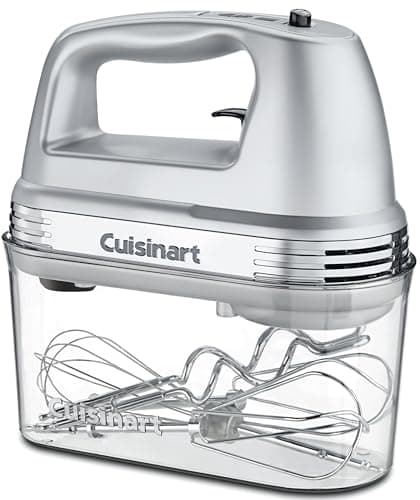
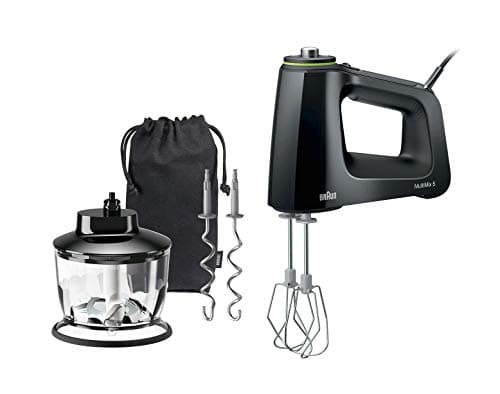
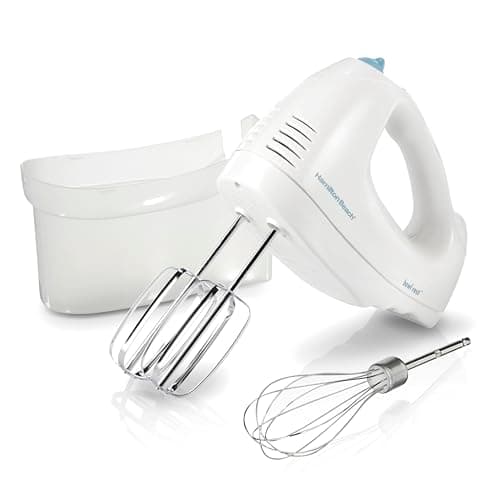
Our pick for most beginners is the Hamilton Beach 6-Speed: it's the cheapest, simplest, least intimidating way to start, and it does the everyday jobs well. A step up, the Cuisinart Power Advantage Plus 9-Speedis the one to buy if you suspect you'll catch the baking bug — more speeds for finer control and dough hooks to grow into. And the Braun MultiMix 5 is for the beginner who already knows they want power on tap. If part of you is wondering whether to skip the handheld entirely, our stand mixer vs hand mixer comparison is the honest place to settle that before you spend.
Hamilton Beach 6-Speed — the simplest way to start.For a first mixer, less is more, and this is the least intimidating tool in the group. Six clearly-labeled speeds, a QuickBurst button when you want a quick blast, a bowl-rest that parks it while you add ingredients, an included whisk and a snap-on case at consistently one of the lowest prices for a capable mixer. It's light, so a nervous beginner can hold it steadily over the bowl without their arm tiring. The honest cons a beginner should know: it has no dough hooks, so it isn't a bread tool, and six speeds give slightly less fine control than a nine-speed. Neither matters for whipping cream, creaming butter or mixing batter — the jobs you'll actually start with. The full Hamilton Beach 6-Speed review has more.
Cuisinart Power Advantage Plus 9-Speed — a little more to grow into.If you have a hunch that baking is going to stick, this is the smarter first buy. Nine well-spaced speeds give you a gentler start and finer control than a six-speed, its 220 W rated motor has real headroom, and — the part that matters for a beginner — it ships with dough hooks and a whisk in a storage case, so the day you want to try a simple dough or a proper whipped cream, the tool is already there. The honest cons: speed 1 is a touch fast for the very gentlest folding, so ease onto the trigger, and the case is bulky in a shallow drawer. For a beginner who plans to keep going, it's the value sweet spot. See the Cuisinart Power Advantage review for the detail.
Braun MultiMix 5 — for a beginner who wants power.Some people start out knowing they want the confident option, and if that's you, the Braun is the pick. It's the most powerful hand mixer here on paper, with a 350 W rated motor and a SmartMix ramp that eases up to speed — genuinely beginner-friendly, because that gentle start is what stops the flour cloud that catches new bakers out. It comes with a chopper and a whisk, so it does more than mix. The honest cons for a first-timer: the European-style controls take a moment to learn, and the single-piece beaters look unfamiliar. If you'd rather spend less to start, the budget route is laid out in our best budget hand mixer roundup. The Braun MultiMix 5 review goes deeper.
What a beginner actually needs from a first hand mixer
It's easy to be talked into features a first mixer doesn't need. Strip the marketing away and a beginner really only needs three things to be right: a gentle, controllable low speed; a weight and shape that's comfortable to hold; and the one or two attachments that cover the jobs you'll actually do. Get those and everything else is a bonus. Here's what each one means in practice.
Speeds: fewer, gentler steps beat a big number
The speed count on the box matters far less than how gentle the lowest speed is. That first speed is the one that keeps a cloud of flour or powdered sugar in the bowl when you start, and it's the setting a beginner will use most for folding dry ingredients in and starting egg whites. A mixer with three speeds and a harsh low end is more frustrating than one with six well-judged ones. More speeds mainly buy finer control between low and high — handy later for meringue and frosting — but for your first weeks of whipping cream and mixing batter, five or six is plenty, and even a nine-speed only helps if the extra steps are at the bottom of the range where you need them. Don't pay up for a big speed number; pay attention to how soft the start is.
Weight and comfort: you hold it the whole time
Because you hold a hand mixer the entire time it runs, comfort matters more than for almost any other appliance — and it's the spec a beginner is most likely to overlook. On a quick job any mixer is fine, but the first time you cream butter for a few minutes or whip a meringue, a heavy or awkwardly balanced mixer starts to tire your hand and wrist. For a beginner, a lighter mixeris usually the friendlier choice: it's easier to hold steady over the bowl and less daunting to control, which is a real point in the Hamilton Beach's favor. Look for a handle that sits comfortably in your grip and controls you can reach with your thumb without shifting your hold. If you have any wrist or grip issues, weight this heavily — it's the thing you'll feel every single time.
Attachments: a whisk first, dough hooks if you'll grow
A first mixer doesn't need a drawer full of attachments, but the right ones change what it can do. The wire whiskis the one to insist on: it's what makes whipped cream and egg whites quick instead of a slog, and a beginner who tries to whip cream with the standard beaters often decides, wrongly, that their mixer is weak. All three picks here include a whisk. Dough hooksare worth having if you think you'll try bread or pizza dough later — the Cuisinart and Braun include them, the Hamilton Beach doesn't — but they're a stopgap for small, soft doughs, not a stand mixer. Beyond that, a storage case that keeps the set together is genuinely useful for a beginner, because loose beaters are the ones that get lost. Buy for the jobs you'll actually start with, and let the mixer grow with you.
Ease of use: the little things that build confidence
A few features quietly make a beginner's life easier. A one-touch beater-eject buttonpops the attachments out without you touching the sticky ends — nearly every model has one, but confirm it. A bowl-restfeature, like the Hamilton Beach's, lets you park the mixer mid-recipe while you add ingredients, which takes some of the juggling out of your first bakes. A swivel cord keeps the cable from dragging through the bowl or fighting your hand. And clearly-labeled speeds you can read at a glance beat a row of identical unlabeled buttons. None of these is essential, but together they lower the learning curve, which is exactly what a first mixer should do.
Do you even need a hand mixer, or a stand mixer?
It's worth answering this honestly before you spend, because the wrong category is a more expensive mistake than the wrong model. A hand mixeris the right first buy for the vast majority of beginners: it's cheap, stores in a drawer, and handles whipping, creaming and batter with ease. A stand mixeris the better start only if you already know you'll bake bread regularly or in big batches, since it kneads and whips hands-free — but it costs far more and claims permanent counter space, which is a lot to commit to before you know how much you'll bake. Our stand mixer vs hand mixer comparison walks through who each suits; for most first-time bakers, a hand mixer is the low-risk, high-reward way in.
Common beginner mistakes a good mixer helps you avoid
A few missteps catch nearly every new baker, and knowing them upfront saves a lot of frustration. The most common is starting on too high a speed, which sends flour and powdered sugar across the counter and can splatter batter — the fix is simply to begin on the lowest speed every time and climb from there. The second is over-mixing: beginners often assume more is better and beat batter until it's tough, or whip cream straight past soft peaks into grainy near-butter, when the right move is to stop the moment the mixture looks right. A third is reaching for the wrong attachment — trying to whip cream with the standard beaters and concluding the mixer is weak, when the wire whisk would have done it in a fraction of the time. And a fourth is lifting the running beaters out of the bowl, which flings mixture everywhere; keep them down in the bowl and switch off before you lift. None of these is the mixer's fault, and a model with a gentle low speed and clear, readable settings makes every one of them easier to avoid.
How long a first hand mixer should last
A common worry for a first-time buyer is whether a cheap mixer is a false economy. In practice, a capable hand mixer from an established brand, used within its limits, lasts for years of normal home baking — the thing that shortens its life is overloading it, not its price tag. The fastest way to wear out any hand mixer, budget or premium, is pushing it through heavy, stiff dough or running it on high under load for long stretches until the small motor overheats. Treat a first mixer kindly — keep batches sensible, start low, and give the motor a rest on long jobs — and even an entry-level model will serve you well past the point where you've decided whether baking is a keeper. If you find yourself constantly pushing a hand mixer to its limit on dough, that isn't a sign you bought the wrong one; it's a sign your baking has outgrown the category, and a stand mixer is the next step.
Starting off on the right foot
Whichever you choose, a good first experience is mostly technique, not machine. Start every job on the lowest speedand climb only as fast as the mixture lets you; keep the beaters down in the bowl so batter doesn't fly; move the mixer slowly around the bowl to reach everything; and stop the moment the mixture looks right, because over-mixing is a more common beginner mistake than under-mixing. Those habits — laid out in our how to use a hand mixerguide — make even a budget mixer feel capable, and they're the difference between a tool you trust and one you fight. Buy the mixer that matches how much you'll bake, learn those few basics, and a first hand mixer is one of the most satisfying small buys in the kitchen.