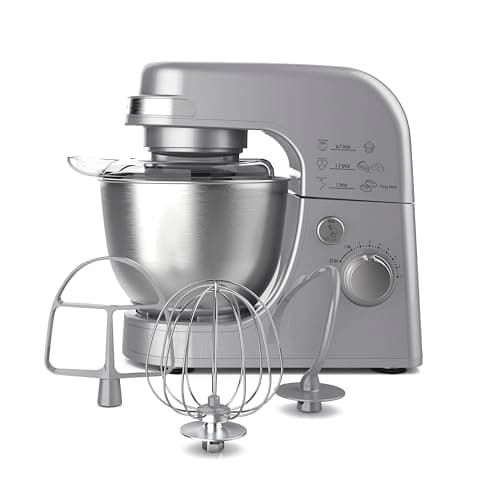
The Hamilton Beach 4-quart is the honest floor of the stand-mixer category — the cheapest machine here that's a genuine stand mixer rather than a toy. It's a tilt-head with seven speeds and a planetary mixing action, and it ships with a dough hook, flat beater and whisk in the box. For a lot of kitchens, that's all a stand mixer ever needs to be, and this review is about being clear on exactly where that's true and where it isn't.
Start with what it genuinely does well, because it's more than the price suggests. For batter-based baking — cake batter, brownies, muffins, quick breads — and for the everyday jobs of whipping cream and beating eggs, it works cleanly and hands-free. The tilt-head tips back so you can scrape the bowl and swap attachments easily, the seven speeds cover the range most home baking needs, and having the whisk and dough hook included means you can do meringue and a soft dough on day one without buying anything extra. As a machine to free up your hands for light-to-medium baking, it earns its keep.
The honest cons are real, and they're all about where the corners were cut to hit the price. The build is plastic-forward — it doesn't have the cast heft or the planted feel of a KitchenAid, and it can shimmy on the counter when it's working a thicker mixture. The 4-quart bowl is the smallest here, which is fine for a single batch but tight for the double batches a busier baker makes. The motor is happiest with batter and standard cookie dough; push it into a full loaf of stiff bread dough and it labors, warms up and wants a rest. And there is effectively no first-party attachment ecosystem — what comes in the box is what you get, so this isn't a platform you extend with pasta rollers or grinders later.
None of that makes it a bad buy — it makes it a specific one. This is the mixer for someone who wants to stop mixing by hand without spending much, whose baking is mostly cakes, cookies and whipping, and who isn't planning to knead bread every week. Judged as the cheapest real stand mixer you can buy, it does the job it's priced for. Judged as a lifetime workhorse, it isn't trying to be one, and it's fairer to everyone not to pretend otherwise.
Who should buy it — and who should spend more
Buy the Hamilton Beach if…
Your baking is mostly batter, cookies and whipping, you bake occasionally rather than weekly, and you want to stop doing it by hand without a big outlay. It's also the right pick if you're genuinely unsure you'll use a stand mixer much and want to test the habit before committing — it's the lowest-commitment entry in our beginner roundup. For that baker, the included whisk and dough hook mean it does everything you'll ask of it.
Spend more if…
You bake bread regularly, make double batches, or want a machine that lasts a decade and grows with an attachment ecosystem. A step up to the KitchenAid Classic buys a sturdier build, the front attachment hub and strong resale value; the Cuisinart Precision Master buys a bigger 5.5-quart bowl and more motor for not much more money. If bread specifically is your goal, the bread-dough roundup points to machines built for sustained kneading.
Be realistic about the build and the bowl
The plastic-forward housing and the 4-quart bowl are the two things you feel most in daily use. The build means it can walk a little on the counter under a heavy mixture — keep a hand near it on thicker doughs — and the smaller bowl means big batches come in two loads instead of one. Neither is a dealbreaker for light baking; both are exactly why a heavier baker outgrows it. Our KitchenAid vs Hamilton Beach guide lays the trade out side by side.
The bottom line
The Hamilton Beach is the cheapest real stand mixer, and it's an honest one: capable with batter, cookies and whipping, out of its depth on heavy dough, and not built to be extended. Buy it for what it is — a low-cost way to bake hands-free — and it delivers. Ask it to be a KitchenAid and it can't, which is the whole reason a KitchenAid costs what it does.