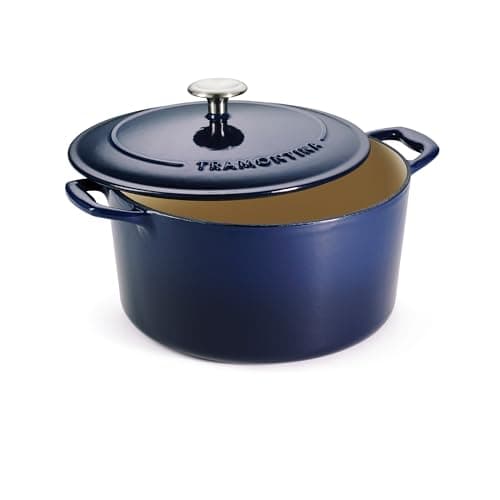
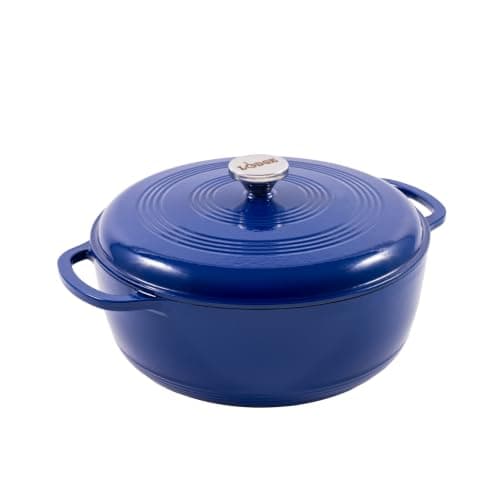
If you are buying the pot to bake bread, buy the Lodge 6-quart Essential Enamel. Lodge publishes a 500°F oven-safe ceiling for it, and that single number clears the 475 to 500°F preheat that most no-knead and sourdough recipes specify. The Tramontina Bestow 6.5-quart is the better buy for braising and the cheaper pot overall— half a quart more volume, a PTFE- and PFOA-free porcelain enamel interior, and a price that is usually the lowest here from a company that actually publishes a spec sheet. Its catch is real and it is not a quibble: Tramontina rates it to 450°F. Exceeding a published rating on enameled cast iron is how enamel crazes and fails, so the rating, not the price, should decide this one.
The two pots, by their makers' published numbers
| Lodge 6-qt Essential Enamel | Tramontina Bestow 6.5-qt | Lodge 7.5-qt Essential Enamel |
|---|
| Capacity | 6 qt | 6.5 qt | 7.5 qt |
| Published oven ceiling | 500°F | 450°F | 500°F |
| Knob | Stainless steel | Not published as stainless | Stainless steel |
| Interior enamel | Enamel | Off-white porcelain, PTFE/PFOA-free | Enamel |
| Induction ready | Yes | Yes | Yes |
| Dishwasher | Hand wash to be safe | Listings disagree — treat as hand wash | Hand wash to be safe |
| Best loaf size | Standard 500 g boule | Large boule, at a lower temperature | Up to roughly 1 kg |
Those figures come from the manufacturers' own published material, cited in Sources. We did not measure a pot, and we are not reporting a test — see how we pick for exactly what our scores are and are not.
Why 50°F decides a bread purchase
Dutch-oven bread works because a preheated, lidded pot traps the dough's own steam, letting the loaf expand before the crust sets. The hotter the vessel at the moment the dough goes in, the more aggressive that oven spring is. That is why the canonical no-knead recipe asks for 475°F and plenty of sourdough recipes ask for 500°F.
A 450°F rating does not mean the Tramontina explodes at 475°F. It means the manufacturer is not standing behind the pot above 450°F, and enamel is the part at risk — enamel is a glass layer fused to iron, and repeated thermal stress beyond what it was rated for is what makes it craze, then chip. A chipped interior on an enameled pot cannot be repaired. So you have two honest options with the Tramontina: bake at 450°F and accept slightly less spring, or buy the pot Lodge rates for the temperature your recipe asks for.
For context on what the temperature actually buys you, enameled vs bare cast iron for bread explains why bare iron has no equivalent ceiling, and what size Dutch oven for breadcovers the other spec that changes your loaf's shape.
What the Tramontina is genuinely good at
Everything that happens at or below 450°F, which is most cooking. Braised short ribs, a chili, a stew, a pot of soup, chicken and rice — none of that goes near 450°F, and for those jobs the Tramontina is a lot of enameled cast iron for the money. Its 6.5-quart volume is more generous than the Lodge's 6 quarts, and Tramontina specifically lists the porcelain interior as made without PTFE or PFOA, which matters to a lot of buyers. The light interior also lets you see how a fond is developing, which a dark interior hides.
Two cautions worth knowing. Enamel on budget cast iron is typically a thinner layer and chips more readily than Lodge's or Le Creuset's, so it wants slightly more care around knocks and dropped lids. And Tramontina's own listings disagree with each other about dishwasher safety, so the safe reading is hand wash.
When to size up to the Lodge 7.5-quart instead
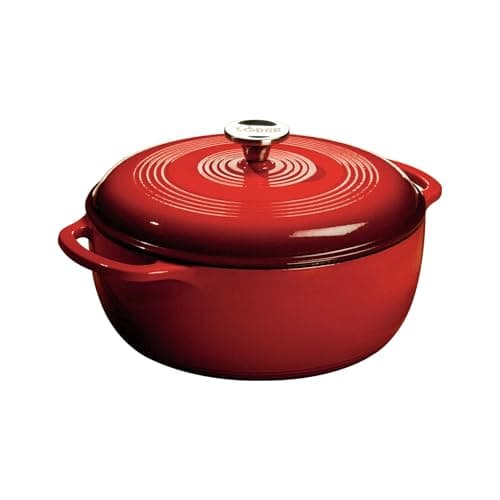
If you bake 1 kg loaves, or you want one pot that is also the household's main braiser, the 7.5-quart version of the same Lodge is the pot to get. Same 500°F ceiling, same stainless knob, another quart and a half of headroom. The catch is the one people do not expect: a small loaf in a big pot spreads sideways rather than climbing, so if your loaves are standard 500 g rounds the 6-quart gives you a taller loaf. Bigger is not better here; it is just bigger.
Our Lodge enameled Dutch oven review covers the 6-quart in full, and Lodge vs Le Creuset is the comparison to read if you are weighing the step up to a French-made pot rather than down to a budget one.
The decision rule, in one line each
Bread at 475°F or above: Lodge 6-quart. The published ceiling is the whole reason.
Bread at 450°F plus a lot of braising, on the tightest budget: Tramontina 6.5-quart. You give up some oven spring and gain half a quart and some money.
1 kg loaves, or one pot for bread and the family braise: Lodge 7.5-quart.
Four things to check on any enameled pot before you buy
- The published oven ceiling.Not a reviewer's claim — the manufacturer's number. It is the one spec that can make a pot unsuitable for the job you bought it for, and it is routinely buried.
- What the knob is made of.A stainless knob is rated to the same temperature as the pot. A phenolic or plastic knob often is not, and on some pots it is the component that caps the whole vessel's rating. Both Lodge pots here publish a stainless knob.
- Capacity against your actual loaf. 6 quarts suits a standard 500 g boule; 7.5 quarts suits 1 kg. Too much volume means a flatter loaf, not a safer one.
- How the handles feel loaded. Enameled loop handles get fully as hot as the pot and there is no silicone grip, so you are using two dry mitts to move eight or nine pounds of iron in a hot oven. If your wrists object to that, it is worth knowing before the pot arrives.
Living with enamel so it lasts
Enamel is tough but brittle at the edges. The failures people actually have are chips at the rim from a lid set down carelessly, and crazing from thermal shock — a hot pot into cold water, or a cold pot into a blasting oven. Preheat with the pot in the oven as it comes up to temperature rather than putting a cold pot into a hot one, let it cool before washing, and keep the lid off the rim when you set it down. Do that and either pot will outlast a decade of weekly baking.
If a seasoning routine does not bother you, note that bare cast iron sidesteps this entire category of problem: there is no enamel to chip and no published ceiling to respect. Combo cooker vs Dutch oven covers the bare-iron vessel most bread bakers end up recommending.
What a cheaper pot does not cost you
Worth saying plainly, because enamelled-cookware marketing implies otherwise: within the published ratings, a budget enameled pot bakes a loaf most bakers could not distinguish from one baked in a pot costing five times as much. Heat capacity comes from the iron, and the iron is the same. What you pay more for is finish quality, enamel thickness, handle balance, warranty and the number of years before a chip appears — not a better loaf. Lodge vs Le Creuset makes that case at the top of the market, and it holds at the bottom too.