The sheet pan is the most-used pan in almost every kitchen and the one people think about least. It bakes the cookies, roasts the vegetables, holds the scones, catches the drips under a pie, and goes under a loaf pan to steady it. It is also the pan most likely to be a warped, scorched, dark-coated thing that came free with something else — and that matters, because two of the most common baking complaints trace directly back to it. Cookies burnt on the bottom while pale on top is a pan problem. The bang from the oven as a tray buckles, tipping oil off one corner, is a pan problem too.
Both have the same explanation. A sheet pan's color and thickness decide how much radiant heat reaches the underside of your food: dark, thin steel absorbs heat aggressively and sets a hard brown bottom before the top has caught up, while light, heavy aluminum spreads heat gently and evenly. And warping is a construction question, not bad luck — a pan with a steel rim rolled into its edge stays flat through hundreds of hot cycles, and one without it does not. Neither of those costs much money to get right, which is the good news on this page: the best sheet pan for most people is also among the cheapest.
How we picked
Our scores are judgments made from documented research — published manufacturer specifications, published baking guidance and aggregated owner reports — not lab measurements. We do not run a lab, and how we pick says so in those words. For sheet pans, five criteria decided the list.
Material and color, because they set how the bottom browns. Bare aluminum and light aluminized steel conduct heat fast and brown gently; dark nonstick carbon steel absorbs more radiant heat and browns harder and faster. For cookies, pastry and anything with sugar on the underside, light and heavy wins, and that is why our top pick is uncoated aluminum. If your current pans burn cookie bottoms, this is the variable to change, and dropping the oven 25°F is the stopgap until you do.
Rim construction, which is the whole warping story. Look for an encapsulated or rolled rim with a steel wire or rod inside it. Nordic Ware states plainly that its encapsulated steel rims prevent warping when pans go into a hot oven from room temperature, and USA Pan builds reinforced rims for the same reason. A pan that rocks on the counter is not merely annoying — part of its base has stopped touching the rack, so it bakes unevenly from then on. Gauge matters too: heavier metal resists warping and evens out oven hot spots, at the cost of a slightly longer preheat.
The published oven ceiling, because coatings have one. This is where nonstick pans and bare pans genuinely diverge, and it is easy to miss. USA Pan rates its half sheets to 450°F. Caraway publishes 550°F for its ceramic-coated sheet. Bare aluminum has no coating to degrade at all. If you roast vegetables at 500°F or slide a pan under the broiler, a 450°F-rated pan is the wrong tool and exceeding the rating is how a coating fails early. We treated these numbers as hard facts rather than suggestions.
Coated or uncoated, treated as a fork rather than a ranking. A nonstick surface releases sticky bakes and cleans up fast, and every coating is a consumable that will eventually dull, scratch or blister. An uncoated pan has nothing that can fail and asks for parchment or a silicone mat instead. Both are defensible, so there are picks for each, and we have not pretended one is simply better.
Then size, warranty and price. The half sheet — roughly 18 x 13 inches — is the size nearly every recipe assumes and the size that fits a standard oven with air space around it. Both US-made picks here carry lifetime warranties, which is a realistic ask at this price rather than a luxury. We link every pick through to the live Amazon price rather than quoting a number, because bakeware discounts move constantly.
The picks, and who each is for
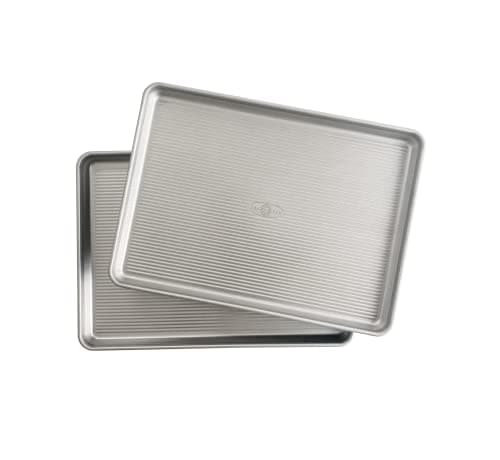
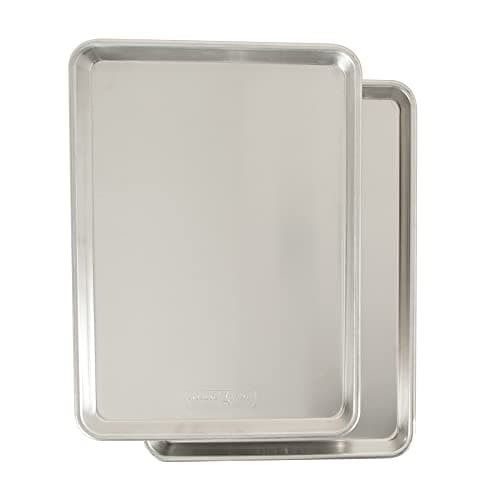
Nordic Ware Naturals half sheet, two-pack — the one to buy. This is the pan professional kitchens actually use, sold two at a time for less than many single pans cost. Bare aluminum, 17.9 x 12.9 x 1 inches outside with a 17.1 x 12.1-inch cooking surface, an encapsulated galvanized steel rim that will not rust, made in the USA and backed by a lifetime warranty. Light aluminum is exactly what cookies and pastry want: it browns gently and evenly rather than setting a dark bottom crust, and the rim is the specific feature that stops the mid-bake bang. Two pans is also the right number rather than a sales tactic — one bakes while the other cools, which is how you get through a batch without waiting. The honest cons: there is no nonstick coating at all, so parchment or a silicone mat is effectively mandatory; Nordic Ware says hand wash, because the dishwasher permanently discolors bare aluminum; and the pans darken and mottle with age, baking exactly the same but never looking new. If you refuse to use parchment, buy the USA Pan instead.
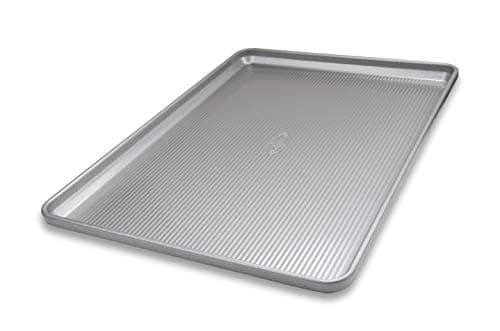
USA Pan half sheet, set of two — the nonstick answer. If you want a release surface but not PTFE, this is the pick. Heavy aluminized steel with USA Pan's fluted surface, which lifts the bake a fraction off the pan and improves airflow underneath, finished with the Americoat silicone coating made without PTFE, PFOA or BPA. The baking surface is 17.25 x 12.25 x 1 inches, the rims are reinforced, it is made in the USA and it carries a lifetime warranty — also sold in pairs. The catches are specific and worth knowing. It is rated to 450°F, which is below the 475-500°F that a lot of vegetable-roasting and pizza recipes call for, so it is a baking pan more than a high-heat-roasting pan. Hand wash is recommended, so it does not go in the dishwasher. And the fluting prints faint ridge lines on the underside of thin cookies and rolled pastry, which is cosmetic but visible.
USA Pan Heavy Duty half sheet — if your pans keep warping. The thicker-gauge version of the pan above, and the fix for one specific complaint. Same aluminized steel, same PTFE-free Americoat surface, same 450°F ceiling, in a heavier body with more rim reinforcement. The extra mass is the single best defense against warping and it also evens out oven hot spots, so a single tray of cookies bakes more uniformly front to back. Buy it if you have had cheap sheet pans buckle on you or you bake a lot at the top of the temperature range. The cons are the predictable ones: it is sold as one pan for close to the price of the two-pack above, the extra mass means a longer preheat and a heavier pan to lift one-handed, and the heavier gauge buys durability, not temperature — the 450°F ceiling is unchanged. If your current pans are not warping, the two-pack is better value.
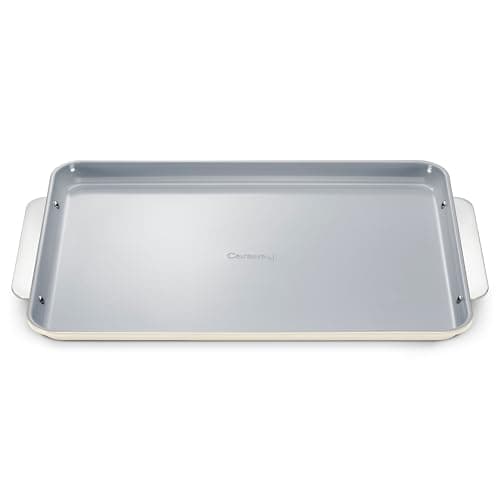
Caraway ceramic-coated 18 x 13 — the PTFE-free, high-heat option. The pick for anyone who wants a slick surface and nothing from the fluorochemical family, and the only pan here that goes to high roasting temperatures. Aluminized steel under a ceramic coating, integrated stainless handles, about 4 lb, and a published 550°F ceiling — the highest on this page by 100 degrees. Caraway lists it free of PTFE, PFOA, PFAS, lead, hexavalent chromium, phthalates, cadmium and mercury, and the stainless handles genuinely do make a hot, loaded pan easier to pull out of the oven. Now the cons, which are substantial: it costs several times a two-pack of the pans professional kitchens use. Ceramic coatings generally lose their slickness sooner than PTFE ones, so this is a wear item with a shorter runway than its price suggests. And it is hand wash only — Caraway does not list it as dishwasher safe. Buy it for the 550°F ceiling and the coating chemistry, not for value.
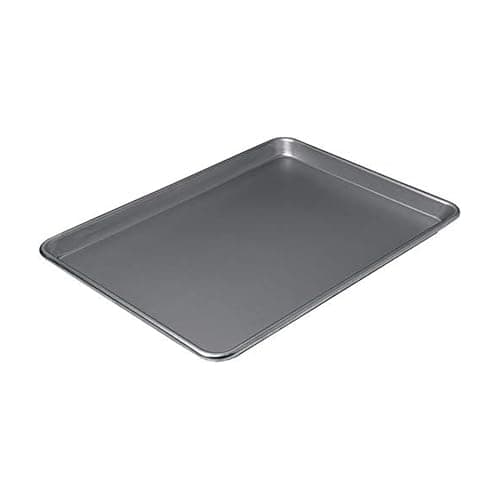
Chicago Metallic Professional nonstick, 17 x 12.25 — the cheap extra. A standard half-sheet footprint with a nonstick surface from a bakeware brand with a professional line, usually for less than a bag of good flour. As a third or fourth pan for cookie rotations, or a dedicated pan for the sticky bakes you do not want touching your good ones, it is hard to argue with, and the nonstick surface means you can skip parchment for well-greased cookies. Three honest caveats. It is a lighter gauge than anything above it, so it is the pan here most likely to warp or flex. We could not find a published oven-temperature ceiling for it, so treat high-heat roasting as unverified rather than assuming it matches the others. And the coating is a consumable — scratch it or scour it and the pan's useful life is over. If this would be your only sheet pan, spend slightly more on the Nordic Ware two-pack, which will outlast several of these.
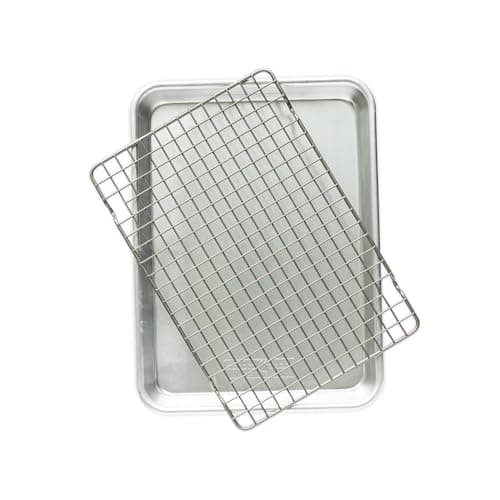
Nordic Ware Naturals quarter sheet — for small batches and toaster ovens. Half the footprint of a half sheet, which makes it the pan for four cookies, a tray of nuts to toast, a handful of vegetables, or anything going into a toaster oven or compact countertop oven where a half sheet simply will not fit. Same Naturals construction as our winner — bare aluminum, encapsulated steel rim, lifetime warranty — and the included nonstick grid works as an in-pan roasting rack and as a small cooling rack. The cons are inherent to the size: it is too small for a real batch, so this is a supplementary pan and never a first one; it carries the same bare-aluminum caveats of hand washing and discoloring; and the grid is nonstick, making it the one wearable part of an otherwise coating-free pan. Buy it second, not first.
How to choose a baking sheet
The short version: buy a light, heavy, rimmed half sheet with a steel-reinforced rim, buy two of them, and spend the money you saved on parchment. Everything below is why.
Get the size right first — and know the names
The sizes come from commercial kitchens and the names are worth knowing because recipes use them. A half sheet is roughly 18 x 13 inches and is the size nearly every home recipe assumes; the Nordic Ware measures 17.9 x 12.9 inches outside and the USA Pan has a 17.25 x 12.25-inch baking surface, which is the same class of pan. A quarter sheet is half that footprint, for small batches and countertop ovens. A full sheet is 26 x 18 inches and does not fit a standard domestic oven at all, so ignore it. Check your own oven before you buy: you want air space around the pan on all sides, because a pan that nearly touches the walls blocks circulation and bakes unevenly.
Rimmed, always — not a flat cookie sheet
A rimmed sheet pan does everything a flat, rimless cookie sheet does, plus it contains rendered fat, catches syrup, holds a brine and can be lifted without food sliding off. The one thing the flat sheet does better is let you slide cookies off without lifting, which is a convenience most people will trade away instantly. If you are buying one pan, buy the rimmed one. There is no good argument for the reverse.
Light and heavy beats dark and thin
This is the rule that fixes burnt cookie bottoms. Color controls how much radiant heat the underside of your food absorbs, and thickness controls how evenly that heat spreads. A dark, thin pan is the worst combination: it absorbs hard and conducts unevenly, so you get scorched bottoms and hot spots. Bare aluminum and light aluminized steel in a heavy gauge are the opposite. If you already own dark pans and are not ready to replace them, drop the oven 25°F and check early — that is the standard correction, and it works.
Check the coating's temperature ceiling against what you cook
Most people never look this up, and it is the most common way a good pan dies young. USA Pan rates its half sheets to 450°F. Caraway publishes 550°F. Bare aluminum has no coating to damage. So if you roast vegetables at 500°F, blast a pizza, or use the broiler, a 450°F pan is genuinely the wrong tool, and repeatedly exceeding the rating is how a coating blisters and loses its release. Match the pan to your hottest regular recipe, or keep one uncoated pan for high-heat work and a coated one for baking. That two-pan split is what most serious home kitchens end up doing anyway.
Coating or parchment: pick your trade
A nonstick coating releases cleanly, cleans fast, and suits sticky, high-sugar bakes. It is also a consumable with a temperature limit, a no-metal-utensils rule, and usually a hand-wash instruction. An uncoated panhas nothing that can fail, which is why bakeries use them and why both uncoated picks here carry lifetime warranties — the cost is that you line it every time. In practice parchment is cheap, takes five seconds, gives better release than any coating, and lets you lift a whole batch of cookies off the pan at once to cool. A silicone mat does the same job reusably, though it insulates slightly and browns bottoms a touch less. Our guide to greasing and lining is written for loaf pans but the technique transfers.
Buy two, and buy them matching
This is the piece of advice people skip and then wish they had taken. Cookies are baked in rotations, and a sheet pan needs to be cool before the next batch goes on — dough placed on a hot pan spreads before it sets, which is a common and confusing cause of flat, greasy cookies. One pan means waiting; two means a continuous rotation. Matching pans also matter: two identical pans bake identically side by side, while a heavy light pan and a thin dark one give you two different batches from one recipe. That is exactly why the two best-value picks here are sold in pairs.
What actually kills a sheet pan
Four habits, all avoidable. The dishwasher is the main one: it permanently discolors bare aluminum, and detergent plus heat shortens the life of any coating, which is why both Nordic Ware and USA Pan steer you to a sink. Thermal shockis the second — running cold water over a pan straight out of the oven is how metal warps, so let it cool first. Metal utensils end a coating in one stroke; use a thin silicone or nylon turner. And exceeding the rated temperature, especially under a broiler, damages coatings and can buckle lighter gauges. Do those four things and a good sheet pan is a decades-long purchase, warranty or not.
What a sheet pan will not fix
Worth saying, because a new pan is a satisfying thing to buy and not always the real problem. If your cookies spread too thin, the likely causes are warm dough, soft butter or a hot pan, not the pan's material — chill the dough and use a cool pan. If your bakes are inconsistent batch to batch, the culprit is almost always flour measured by volume, which is why a scale leads our baking essentials starter kit. If cookie dough is a struggle to mix in the first place, the bottleneck is the mixer — see best stand mixers for cookies or the hand mixer equivalent. And once the tray is out of the oven, getting the bakes off it promptly matters as much as the pan did; our cooling rack guide covers why.
How many pans do you actually need?
For most kitchens, two matching half sheets cover essentially everything, and that is a genuinely cheap place to land. Add a quarter sheet if you have a toaster oven or often bake tiny batches. Add a dedicated high-heat pan — uncoated, or the 550°F ceramic — only if you roast hard or bake pizza regularly. Add the heavy-duty pan only if warping has actually been your problem. Beyond that you are buying duplicates. If you are building out a baking kitchen from scratch, sheet pans and a good loaf pan are the two bakeware purchases that earn their place first, and for bread specifically the Dutch oven roundup covers the vessel that changes a loaf most.
Nordic Ware or USA Pan, if it comes down to those two
They are the two brands that take the top of this page, and the decision between them is narrower than it looks: both are US-made, both sold in pairs, both carry a lifetime warranty and both have the reinforced rim that stops a pan warping. It resolves to whether you want a coating and whether you ever bake above 450°F — Nordic Ware vs USA Pan baking sheets settles it, and the same two brands on loaf pans reach a different answer for a different reason.