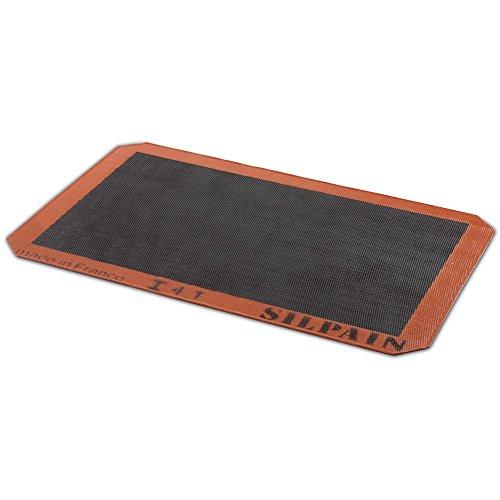
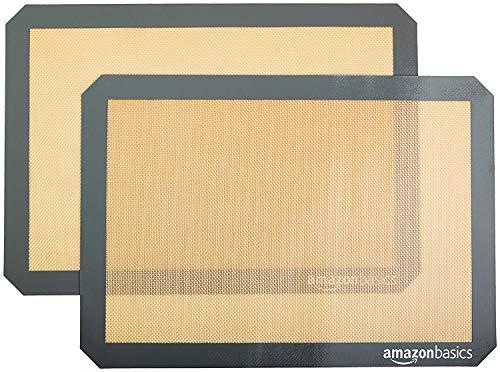
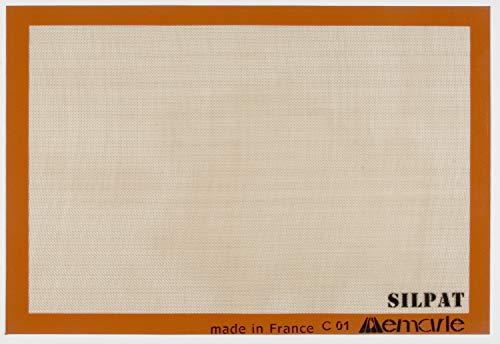
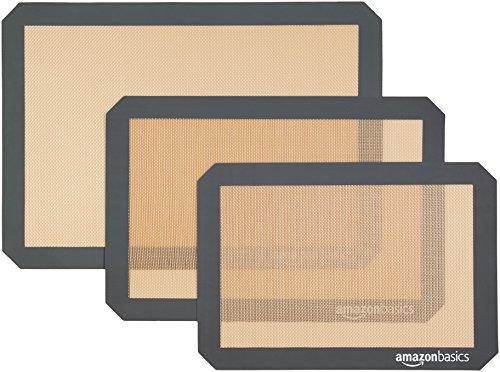
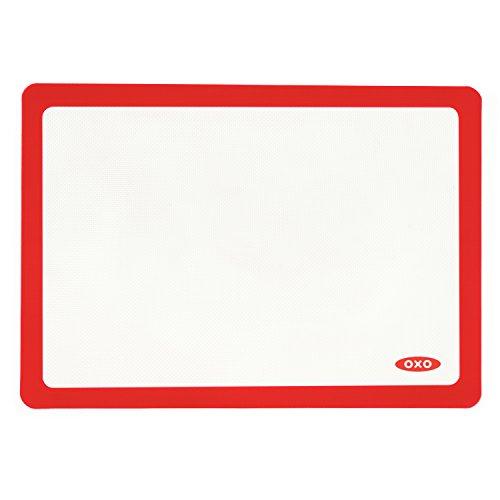
Buy the OXO Good Grips Silicone Baking Mat.Not because it is the most advanced mat on this page — it is not, the Demarle mats are better made — but because it is the only one that publishes both numbers a buyer actually needs. It states its dimension, 11.5 x 16.5 inches, and it names the pan it is cut for, a standard half sheet. Retailer listings and a reply from an OXO representative put its ceiling at 450°F. Everything else here publishes one of those two figures and leaves the other blank. Take the Demarle Silpain instead if you bake bread, because it is perforated and that fixes the one thing solid silicone gets wrong. Take the Amazon Basics 2-pack if you bake cookies, because two mats is a rotation and one mat is a wait. And read the Silpat AE520315-36 entry carefully before you buy it: it is the French original, and at 20-1/2 inches long it does not fit a US half-sheet pan.
The criteria: this category has two specs, and most listings give you one
Silicone baking mats look like the simplest purchase in a kitchen store. A rubbery sheet, a few brands, a price range from under five dollars to over fifty. The reason the fifty-dollar one exists is not marketing, and the reason people end up with a mat that creases up the side of their pan is not bad luck. It is that the two things which decide whether a mat works are frequently not printed on the listing at all.
1. The dimension, in inches, against the pan you own.This is the one that causes most returns. A “half sheet” mat has to be smaller than the interior floor of a half-sheet pan, not smaller than its outside edge. A US half sheet is nominally 13 x 18 inches on the outside, and its usable flat interior is roughly 11.5 x 16.5 — which is exactly the OXO's published size, and that is not a coincidence. A mat that is even an inch over rides up the sloped walls, and a mat riding up a wall channels fat and syrup into a pool at one end. Several of the most-sold mats on Amazon publish no dimension anywhere. Several others publish a European size in inches, which looks reassuringly specific and fits nothing in an American kitchen. Our fourth pick is one of those, and we have ranked it fourth for that reason alone.
2. The published temperature ceiling.Silicone does not have one universal limit; a mat's ceiling depends on the grade of silicone, whether there is a fiberglass core, and what the maker is willing to stand behind. The figures published across the six picks here run from 450°F (OXO, retailer-stated) to 480°F (Mrs. Anderson's, in the listing title) to 480–500°Ffor the Demarle Silpain depending on which foodservice retailer you read. Two of the six — both Amazon Basics packs — say heat resistantand no number. “Heat resistant” is not a specification. It is an adjective.
That ceiling matters on this site more than on most, because bread is a 450–500°F proposition. Our Dutch ovens for bread page is organized entirely around published oven-safe ceilings for the same reason. If you bake a boule at 475°F, a mat rated to 450°F is being asked to work above its stated limit every time.
3. Construction: molded sheet or coated cloth.There are two genuinely different products sold under one name. The cheap ones are molded silicone — a sheet of rubber, flexible, light, prone to creasing and to a permanent fold if stored badly. The professional ones are silicone-coated fiberglass: a woven glass mesh with silicone bonded onto it. The mesh is why a Silpat lies flat on a pan after years, does not stretch, and costs what it costs. Both Demarle picks here are coated fiberglass. The OXO and the Amazon Basics mats are molded.
4. Solid or perforated. Almost nobody explains this and it is the most consequential choice on the page for a bread baker. See the next section.
5. Published care and certification. Dishwasher ratings, FDA or NSF marks, a stated country of manufacture. These are secondary, but they correlate strongly with whether a maker publishes anything else. A listing with a certification usually has a dimension too.
What a mat actually does to the bottom of your bake
A silicone mat is not a neutral surface. It is a layer of rubber between your dough and a hot sheet of metal, and rubber is an insulator. That single fact explains everything people like and everything they complain about.
What you gain is a gentler, more even base. A cookie that browns too fast underneath on bare dark metal before its middle has set — the classic burnt-bottom chocolate chip cookie — is fixed by a mat, and fixed more completely than by parchment, because silicone is the thicker insulator of the two. The same is true of anything sugary, where the sugar in contact with hot metal caramelizes and then burns while the interior is still raw. For cookies, macarons, meringues and delicate pastry, the insulation is the entire point.
What you lose is browning and crispness where you wanted them. A mat will give you a paler cookie bottom than a bare pan, which most people prefer, and it will give you a pale, soft bread base, which almost nobody prefers. It also traps moisture: steam coming out of the underside of a loaf has nowhere to go, so it condenses between the dough and the silicone and the base of the bread ends up slightly damp. That is the problem perforated mats exist to solve.
A perforated mat — Demarle's Silpain is the original, and the holes are the whole product — is a mesh rather than a sheet. Air moves through it and steam escapes through it, so the base of a loaf sees something much closer to the hot pan it would have sat on, while still releasing cleanly. This is why serious bread bakers own one and why it costs three times a solid mat. It is also why you should not buy one for cookies: soft dough settles into the perforations, and you get a dimpled, textured cookie bottom and a mat that is harder to clean.
The honest summary is that a mat is a cookie and pastry tool, a perforated mat is a bread tool, and if you want maximum crust on the bottom of a loaf the answer is neither — it is a preheated surface, which is what baking in a Dutch oven gives you.
Mat or parchment? The part nobody says out loud
We have a whole page on this at parchment paper vs silicone baking mats, and the short version worth having here is that the two are not interchangeable and the choice is not about cost.
Parchment is thinner, so it insulates less and browns more. It is disposable, so there is no cleaning and no smell to manage. It can be cut to fit any pan, folded into a sling, used to line a loaf tin or a cake pan, and crumpled to fit a round. Most parchment publishes a ceiling around 420–450°F, which is often lowerthan a good mat's.
A mat insulates more, lasts years, costs nothing per use after the first, and cannot be cut to fit anything — cutting a coated-fiberglass mat exposes the glass mesh and ruins it. It also absorbs odor and, over time, a faint tackiness from fat, which is the real reason mats get thrown out.
So: mats for repeated sheet-pan baking of the same thing, parchment for cake pans, loaf tins, slings and anything you want browner. Most kitchens that bake regularly end up with both, and anyone telling you a mat replaces parchment has not lined a round cake pan lately.
Why the published temperature figures disagree
This deserves its own section because it is the single most frustrating thing about researching this category, and because the honest answer is that the numbers genuinely conflict and we are not going to pretend otherwise.
Take the Demarle Silpain, our second pick. It is one product, with one part number, made by one company. A US foodservice retailer publishes its range as -40°F to 500°F. A second US retailer publishes a maximum heat resistance of 480°F. An Australian stockist of the same line publishes -40°C to +280°C, which is about 536°F. Three sellers, three ceilings, 56 degrees apart, for the same mat.
The Silpat line is the same story in a different key: figures vary by retailer, and the two Amazon listings we feature publish no temperature at all. Sasa Demarle does maintain a technical sheet for its mats, and that document — not a product page — is what any retailer figure ought to trace back to. We have linked it in the sources so you can check your own mat against it.
We have printed those conflicts in the picks rather than averaging them into a single confident number, because averaging published figures that disagree is how a specification becomes a guess. The practical advice that follows from the conflict is simple and conservative: treat the lowest published figure you can find for your mat as its working ceiling, and if your recipe runs hotter than that, use parchment or a bare pan instead. A mat used above its rating does not dramatically fail — it degrades: it gets tacky, it discolors, it starts to smell, and it stops releasing. That is a slow, annoying failure rather than a dangerous one, and it is entirely avoidable.
How to choose and look after a silicone baking mat
Measure the inside of your pan first, not the outside
Put a tape measure on the flat floor of the pan, inside the sloped walls. That number, not the pan's nominal size, is what the mat has to be smaller than. On a standard US half-sheet pan you will get something close to 11.5 x 16.5 inches, which is why that figure recurs. If you own a quarter sheet, an 18 x 13 commercial pan or a European tray, measure it — the sizes are not interchangeable and the mats are not trimmable. Our guide to baking sheet sizes lists the common pan dimensions if you want to check before you measure.
Buy two if you bake cookies
A cookie batch is pan-bound, not oven-bound. With one mat you bake a tray, wait for the pan and the mat to cool enough that the next round of dough does not start spreading on contact, and then load again. With two mats you load the second while the first is in the oven. It is the cheapest speed improvement available in cookie baking, and it is why the two-pack and three-pack picks are ranked as highly as they are despite publishing less than the OXO.
Never cut one, and never use a knife on one
On a coated-fiberglass mat, cutting exposes the woven glass core and the mat is finished. On a molded mat, a cut becomes a tear the first time you flex it. The same goes for scoring dough, chopping anything, or scraping with a metal bench scraper on the mat rather than on the counter. Scrape dough off a mat with a plastic bowl scraper or your fingers.
Store it flat or rolled, never folded
A fold in a silicone mat becomes a permanent crease, and a crease is where fat collects and where dough catches. Roll it and slip it inside a kitchen roll tube, lay it flat in a drawer, or leave it in the pan it belongs to. The last option is the one people actually do, and it is fine.
Wash it before the fat polymerizes
The way mats die is not wear, it is a sticky film. Fat left on silicone and then reheated polymerizes into a tacky varnish that no longer releases, and once it has built up over several bakes it is very hard to remove. Wash the mat after each use while the fat is still fat. All six picks here publish a dishwasher rating, and a dishwasher is genuinely better than a sponge at this because of the detergent and the water temperature.
If a mat has already gone tacky, the standard rescue is a soak in hot water with dish soap and a scrub with a soft brush, repeated. A paste of baking soda and a little water helps. What does not help is anything abrasive, which scratches the silicone and gives the next film more to hold onto.
Do not put one under the broiler, on a grill, or on the oven floor
Every failure story in this category is a mat exposed to direct radiant heat or to a surface far hotter than the oven's set temperature. A broiler element is dramatically hotter than 550°F at the mat's surface. The floor of a gas oven above a lit burner is hotter than the thermostat reads. A mat is for a rack, inside a pan, in a conventionally heated oven.
Check whether you need a mat at all for bread
If bread is most of what you bake, the honest ranking is: a Dutch oven first, a baking steel or stone second, a perforated mat third, and a solid silicone mat last — it is actively working against the crust you want. Our best Dutch ovens for bread page covers the first option, and the Silpain pick above is the third.
What we did not feature, and why
Unbranded multi-packs with no published dimension. This is the largest group in the category by listing count and the hardest to rank honestly. Many publish no size, no temperature and no material; many reuse identical photography across unrelated storefronts. The argument of this page is that the dimension and the ceiling are the product, and a listing with neither cannot be compared against one that has both. That does not make them bad mats. It makes them unrankable.
Printed mats with measurement guides and circle templates.Macaron circle mats and pastry mats with inch rules printed on them are a real and useful category — but they are a different purchase, the printing is the feature, and the printing is also the first thing to wear off. If you pipe macarons regularly, buy a dedicated circle mat; do not buy one as your general-purpose mat.
Silicone bakeware— molded loaf pans, muffin trays, cake forms — is a separate argument with a separate answer, and ours is on silicone vs metal loaf pans. The short version: a mat sits on metal and benefits from it; silicone bakeware replaces the metal and loses what the metal was doing.
Oven liners sold for catching spills are a related product that is often the same material, and we would not use one as a baking mat or a baking mat as one. A liner on the oven floor obstructs airflow and, in a gas oven, sits over a burner.