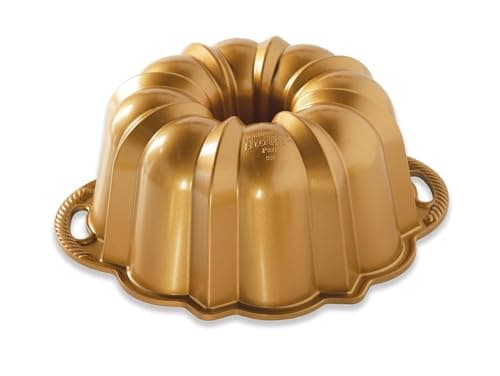
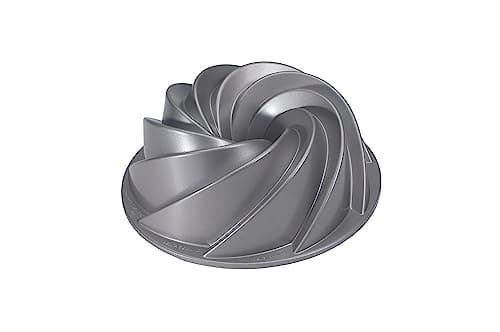
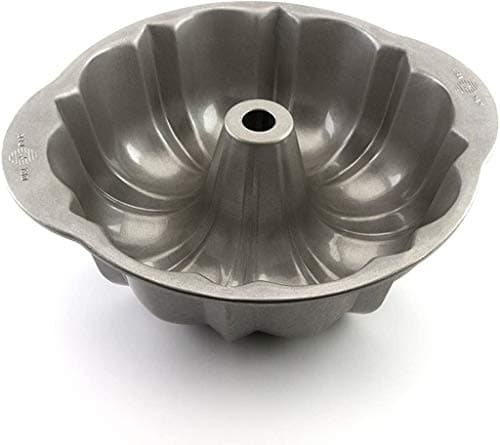
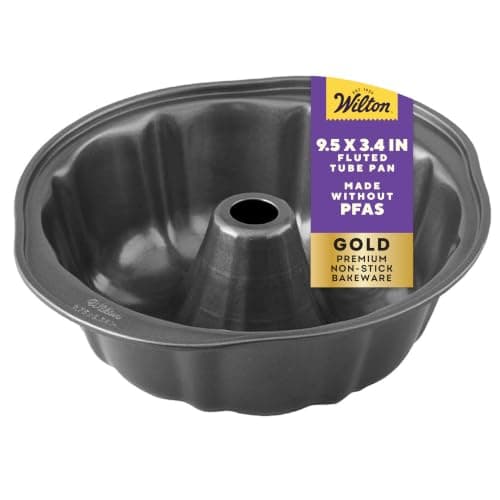
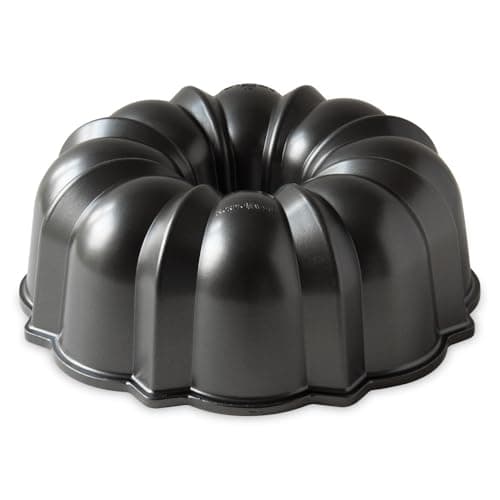
Buy the 12-cup Nordic Ware Original Bundt. Cast aluminum is thick and slow to give up heat, which is what prints a sharp fluted edge instead of a soft one; 12 cups is the capacity the overwhelming majority of bundt recipes are written to; Nordic Ware publishes a 425°F ceiling and makes the pan in Minneapolis. Buy the 15-cup Anniversary instead only if your recipe needs the volume — Nordic Ware publishes it as a 10-to-15-cup pan under a lifetime warranty, and a 12-cup batter in it bakes low and loses the silhouette you paid for. The 10-cup Heritage is the pan for a cake that needs nothing but powdered sugar, at a published 2 lb of cast aluminum. The USA Pan fluted tube pan is the aluminized-steel alternative: a published 450°F ceiling, the highest here, and the most forgiving release in the group. The Wilton Gold fluted tube costs about a third of a cast pan and gives up pattern definition for the money, honestly.
First, the naming, because it explains the whole category
“Bundt” is a registered trademark. Nordic Ware has owned it since 1950, when the Minneapolis company made a heavy cast-aluminum ring pan for a group of Minnesota bakers and then kept the name. That is why every other manufacturer sells the identical shape as a “fluted tube pan” — not coyness, just trademark law. It is also why the category looks like a one-brand category when you search for it, and why three of the five picks below are Nordic Ware pans: the company that invented the shape makes the largest range of it, in the heaviest material, with the longest warranties.
We have deliberately included two non-Nordic picks, because a fluted tube pan in aluminized or formed steel is a genuinely different proposition rather than a knock-off. Steel heats faster, releases more readily, and publishes a higher temperature ceiling. What it cannot do is hold a crisp sculpted edge the way two pounds of cast aluminum does.
Capacity is the spec that decides it
Fluted tube pans come in three common capacities and they are not interchangeable: 10 cups, 12 cups and 15 cups. Nordic Ware publishes the figure on every pan, and it is the first thing to read.
12 cups is the default. Nearly every bundt recipe in an American cookbook or on a recipe site assumes a 12-cup pan and a batter that fills it roughly two-thirds to three-quarters full. That headroom is not decoration: a cake rises, and a fluted pan has almost no flat rim for batter to climb onto if it runs out of room. Overfill a 12-cup pan and the overflow bakes onto the outside of the pan and the oven floor.
15 cups is for recipes that say so.Pound cakes, doubled batters, and the older generation of recipes written for a larger pan. Nordic Ware publishes the Anniversary as 10–15 cups, which is an honest way of saying it works across a range. The failure mode runs the other way here: a 12-cup batter in a 15-cup pan does not spill, it just bakes short and wide, and the tall sculptural shape that justified the pan disappears.
10 cups is a real size, not a small one. Plenty of European and older American recipes are written for it, and a 10-cup pan bakes a tighter, taller cake from a modest batter. It is the size to own if you bake for two to four people, and the size that will frustrate you if your recipe folder is full of 12-cup cakes.
If you do not know your pan's capacity, measure it: fill it to the brim with water from a measuring cup and count. That is the only number that matters, and it takes a minute.
Cast aluminum or steel
The material decision is a trade between pattern definition and release, and it is worth understanding rather than guessing at.
Cast aluminum(the three Nordic Ware picks) is poured into a mold rather than pressed from sheet, so the walls are thick — the Heritage publishes 2 lb, the Anniversary 1.9 lb, the Original 1.8 lb — and the detail in the mold transfers to the metal. Thick metal also evens out an oven's hot spots and holds temperature when cold batter goes in, which is why a cast pan prints a crisp edge on every flute instead of a rounded approximation. The costs: cast aluminum nonstick is published to 425°F rather than 450, it is hand-wash, and a 2 lb pan full of batter is genuinely heavy to invert one-handed.
Aluminized steel(USA Pan) is sheet steel with an aluminum-silicon bond, pressed into shape and coated. It heats faster, weighs less, publishes 450°F, and USA Pan's Americoat releases a fluted cake more readily than a cast nonstick does — which matters, because sticking is this category's characteristic failure. The pattern comes out slightly softer: a pressed pan cannot carry the undercut detail a cast mold can.
Formed steel with a dark coating(Wilton) is the budget construction. Thin, light, 450°F published, PFAS-free coating, and visibly shallower flutes. At roughly a third of the price of a cast pan this is a sane purchase for an occasional baker, and it is the wrong pan for a cake that has to look like the photo.
Published specifications of the five picks
| Pan | Published capacity | Material | Oven ceiling | Warranty |
|---|
| Nordic Ware Original, 12 cup | 12 cups | Cast aluminum, 1.8 lb | 425°F | 10 years (graphite listing) |
| Nordic Ware Anniversary, 15 cup | 10–15 cups | Cast aluminum, 1.9 lb | 425°F | Lifetime |
| Nordic Ware Heritage, 10 cup | 10 cups | Cast aluminum, 2 lb | 425°F | Lifetime |
| USA Pan fluted tube, 10 in | Not published (10 in x 3.75 in deep) | Aluminized steel, Americoat | 450°F | Lifetime limited |
| Wilton Gold fluted tube | Not published (9.25 in x 3.37 in) | Formed steel, PFAS-free coating | 450°F | Limited lifetime |
Two things in that table are worth saying out loud. The steel pans publish dimensions but not capacity, which is the less useful of the two numbers for matching a recipe — if you buy one, measure it with water before you bake. And Nordic Ware publishes a 10-year warranty on the graphite Original where the Anniversary and Heritage carry lifetime terms; it is the same cast pan in a different finish, and we have quoted what each listing says rather than averaging them.
How to choose and use a bundt pan
Greasing is the whole game, and spray is the wrong tool
A fluted pan has many times the surface area of a round cake pan and every crevice is a place for cake to grip. The method that works is soft fat applied with a brush, into every groove, followed by flour: a pastry brush and softened shortening or butter, then a spoonful of flour tipped round the pan and the excess knocked out. Bakers often use a paste of equal parts flour, oil and shortening for the same reason.
What does not work reliably is aerosol cooking spray, and both USA Pan and Nordic Ware advise against it. Spray goes on thin, misses the undercuts, and the propellants and emulsifiers in it polymerize into a sticky varnish on nonstick that is worse than no coating at all. A pan that has been sprayed for years is a pan that has started sticking for a reason.
Ten minutes, then invert — not longer
The second common failure is timing the turn-out. Straight from the oven the cake is too fragile and will tear; left in the pan to cool completely, the sugars set against the metal and glue it in place. Ten to fifteen minutes on a rack, then invert. Our how to use a cooling rack page covers why the rack rather than the counter matters here: a cake cooling on a solid surface steams its own base, and a bundt is mostly base.
The center tube is doing real work
The hole is not styling. It puts oven heat in the middle of the batter as well as around the outside, which is how a dense, high-fat batter — pound cake, sour-cream coffee cake, a chocolate bundt — cooks through before the outside overbakes. That is also why a bundt recipe does not transfer cleanly into a loaf or round pan: the same batter with no center tube needs a longer bake at a lower temperature, and the middle is the part that suffers.
A bundt pan is not an angel food pan
They look related and they are opposites. An angel food cake needs an ungreased pan with straight sides and (usually) a removable bottom, because the batter climbs the walls by gripping them, and the cake cools upside down hanging in the pan. A greased, fluted, one-piece bundt pan gives that batter nothing to climb and no way to hang. If angel food is why you are shopping, buy a two-piece tube pan instead.
Decorative patterns cost you release, and that is the deal
The more intricate the mold — the Heritage's tight scalloped spiral is a good example — the more places a cake can hold on. That is not a defect; it is the reason the cake looks the way it does. The practical response is to match the pattern to the batter: an intricate pan wants a fat-rich, stable batter (pound cake, butter cake) rather than a lean, sticky one, and it wants the greasing done properly rather than quickly. A plain-fluted pan is the forgiving choice for a first bundt.
What we did not feature, and why
Silicone bundt molds release easily and bake badly: silicone insulates rather than conducting, so the crust that gives a bundt its edge never really forms, and a floppy mold full of batter needs a tray under it anyway. Same trade as silicone vs metal loaf pans.
Novelty-shape cast pans— castles, wreaths, cathedrals — are mostly made by Nordic Ware too and are genuinely well made. They are a second or third pan. A first bundt pan should be a shape you will bake in ten times a year, and the capacity should match the recipes you already own.