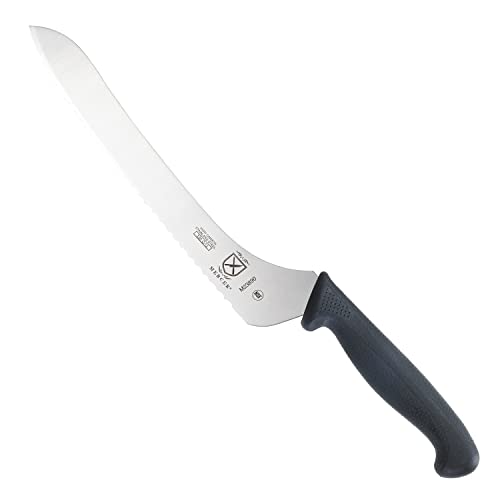
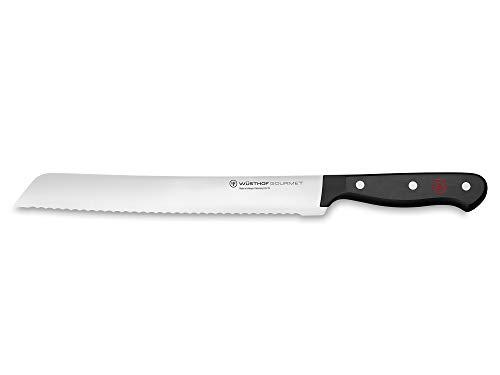
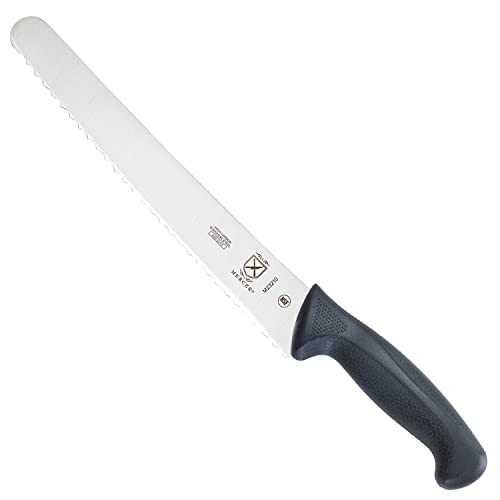
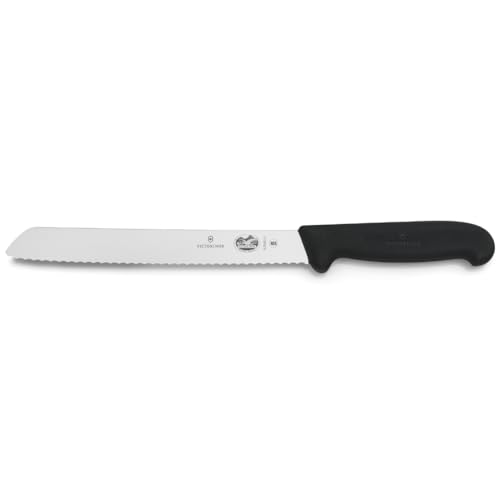
Buy the Victorinox Fibrox 10.25-inch serrated bread knife. It is the knife that cuts a hard-crusted sourdough without crushing the crumb, and the reason is length: at 10.25 inches it crosses a full boule in a single draw, so the blade is always slicing rather than sawing and you never push down. The blade is a thin stamped high-carbon stainless, and the handle is Victorinox's published non-slip Fibrox, which grips when your hands are floury. If your loaves are sandwich loaves, buy the Mercer Millennia 9-inch offset instead — the handle sits above the blade so your knuckles clear the board on the last slices, and it costs a third as much. The Wusthof Gourmet 9-inch is the German upgrade with a published lifetime warranty, bought for fit and balance rather than for a better cut. The budget pick is the Mercer 10-inch wide wavy edge: a full ten inches of blade for under twenty dollars, with no offset.
Length does the work, not pressure
This is the one thing that matters and almost nobody is told it.
A serrated edge cuts by dragging its teeth through the crust. If the blade is longer than the loaf is wide, you can start the cut at the heel of the blade and pull it through in one continuous stroke, and the loaf barely moves. If the blade is shorter than the loaf, you have to saw — back and forth, pressing down a little harder each pass to make progress — and every one of those passes compresses the crumb. On an open, airy sourdough with a brittle crust, that is the difference between a clean slice with visible holes and a flattened wedge with a torn face.
A standard home boule is 8 to 9 inches across. A 10-inch blade clears it. A 9-inch blade clears a sandwich loaf, a batard and most tins, and starts sawing on a round loaf. An 8-inch blade is a cake and bagel knife that people use on bread.
The second-order effect is that a thin, light blade is better than a thick, heavy one here, which is why stamped knives are genuinely good bread knives and why we have not ranked a heavy forged blade first. Weight helps a chef's knife push through a squash. On bread it just invites you to press.
Offset or straight
An offset bread knife has its handle raised above the spine on a Z-shaped neck, so your hand sits a couple of inches higher than the blade. The point of it is knuckle clearance: as you cut the last slices of a flat-bottomed loaf, a straight knife brings your hand down onto the board before the blade finishes the cut, and you end up angling the knife and tearing the slice. With an offset you cut flat and square to the end of the loaf, every time. It is why sandwich shops and delis use them.
A straight knife is better on a tall round loaf, where you are cutting down through the middle and there is no board in the way until the very end, and it is better for everything a bread knife gets borrowed for — a sheet cake, a melon, a tomato.
If you bake tin loaves and sandwich bread, buy the offset. If you bake round sourdough, buy the long straight one. If you do both, the offset Mercer is cheap enough to own alongside the Victorinox.
Pointed, wavy or double serrations
Three edge patterns, and the differences are smaller than the marketing suggests.
Pointed serrations — sharp individual teeth — bite aggressively into a hard crust and tear a soft one. Wavy or scalloped edges, which both Mercer picks publish, are a continuous rolling edge rather than separate teeth; they are gentler on soft bread and still handle a crust. Double serrations — small teeth cut into larger ones, which Wusthof publishes on its Classic line — are the aggressive option for very hard, blistered crusts.
All three work. What does not work is a dull one, and the awkward truth about serrated knives is that you cannot sharpen them at home. A honing rod does nothing for a scalloped edge, pull-through sharpeners wreck it, and sharpening the individual gullets needs a tapered rod and patience. In practice a serrated bread knife is either sent to a service or replaced, which is a strong argument for the Mercer at under twenty dollars and the reason we have scored the expensive Wusthof down on value rather than up.
Where this sits in the bake
Slicing is the last thing that happens to a loaf and the step most likely to undo the rest. Upstream of it: a dough you judged in a straight-sided proofing container, shaped with a bench scraper, scored and baked in a Dutch oven or a loaf pan.
And one thing that is not about the knife at all: let the loaf cool. A hot loaf is still setting its crumb, and cutting into it drags gelatinised starch across the face and reads as gummy no matter how sharp the knife is. On a cooling rack, right way up, two hours minimum for a lean sourdough. That is free, and it fixes more bad slices than any knife.
How to choose and use a bread knife
Measure your loaf, then buy a longer blade
Round sourdough: 10 inches or more. Tin loaves and batards: 9 inches, offset. Only buy an 8-inch serrated knife if what you mostly cut is bagels, rolls and cake. Everything else about a bread knife is secondary to having enough blade to cross the loaf in one pass.
Draw, do not press
Rest the heel of the blade on the crust, start the cut with a gentle sawing motion just to break the surface, then pull the knife through in one long draw using almost no downward force. If you find yourself leaning on the knife, either it is dull or it is too short. The crust should crackle; the crumb should not compress.
Cut a round loaf in half first
A boule gets unstable as it gets smaller, and the slices get shorter and more awkward. Cut it straight down the middle, turn each half cut-face down, and slice from the middle out. You get full-width slices and the loaf never rocks under the blade.
Cool it completely, and store it cut-face down
Two hours on a rack for a lean loaf before the first slice. Afterwards, stand the loaf on its cut face on a board, or keep it in a paper or linen bag — not plastic and not the fridge, which stales bread faster than the counter does.
Hand wash it, immediately
All four of these knives will survive a dishwasher; none of them should go in one. Detergent dulls edges, the handles get battered by other items, and a serrated edge you cannot sharpen is not an edge to abuse. Wipe it, wash it, dry it, and keep it in a block or a guard rather than loose in a drawer.
Accept that it is a consumable
A serrated edge cannot be honed at home. You can send it to a sharpening service, which is worth it for a Wusthof and not worth it for a Mercer. Plan to replace a budget bread knife every few years rather than fighting a dull one — a dull serrated knife is the main cause of the squashed slices people blame on their dough.