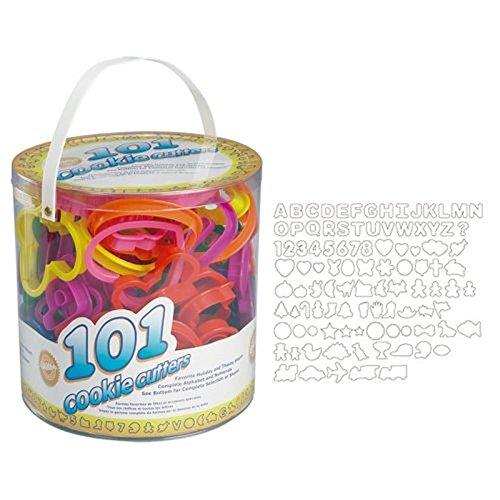
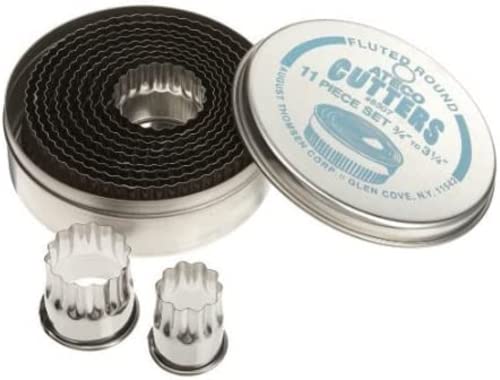
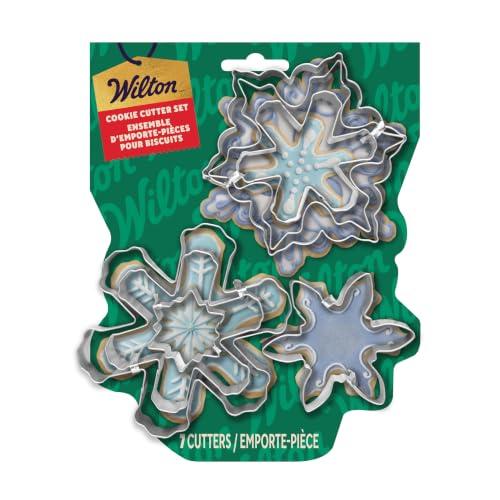
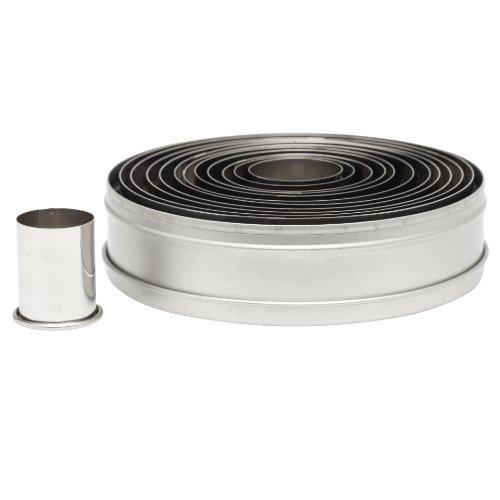
Buy the Ateco 5457 Plain Edge Round Cutters, 12-Piece. Retailers publish it as twelve graduated stainless rounds from roughly 7/8 inch to about 4 3/8 inch, 1 1/4 inch tall, nesting into one storage tin — and that is a tool you will use most weeks of the year rather than one week in December. Biscuits, scones, doughnuts, English muffins, dumpling wrappers, tart bases and plain sugar cookies are all round. If you want letters and numbers, nothing metal provides them and the Wilton 101-piece does; buy it knowing Wilton's own catalog lists that set as plastic, which the Amazon listing title does not mention. The Ateco 5307 fluted set is the crimped edge for scones and jam tarts. The Wilton snowflake 7-piece is the one holiday set we would actually buy, because it is seven sizes of one shape rather than one of seven shapes. And the Fox Run stainless star set is five graduated stars for pocket money.
The criteria: metal first, depth second, shapes last
A cutter is a shaped rim you press through dough. There is less to it than almost anything else in a kitchen, which is exactly why the few specs that exist decide everything.
1. What the metal is. This is the spec, and it is usually the one not published. Stainless steel can be left wet in a sink, washed hot, and pressed back into shape. Tinplate— steel with a thin tin coating, which is what most inexpensive novelty cutters are — rusts the moment the coating is scratched or the cutter is put away damp, and that rust is on the surface that touches food. Aluminumis soft and goes permanently oval. Plastic cannot be sharpened, cannot be re-rounded, and does not cut chilled stiff dough cleanly. Both Ateco sets here publish stainless and so does Fox Run; the Wilton snowflake set publishes “metal” with no grade, and the Wilton 101-piece is plastic.
2. Cutting depth. The height of the rim decides what you can cut in one press. A buttermilk biscuit rolled to three-quarters of an inch needs a cutter taller than that or the dough folds over the top edge instead of being cut, which seals the layers and costs you the rise. Ateco publishes 1 1/4 inchon the 5457 rounds. Almost no novelty cutter publishes a height at all, and most are closer to half an inch — fine for a rolled sugar cookie at an eighth of an inch, wrong for a biscuit.
3. Whether the sizes are a published ladder.A graduated set is worth several times a random assortment, because the useful answer to “this cutter is slightly too big” is the next one down. Ateco publishes its ranges, with the caveat below. Wilton publishes 1 to 3.75 inch on the snowflake set. Fox Run publishes nothing on its own listing, and we have attributed the approximate figures to the retailers they came from.
4. How it stores. Nesting sets that come with a tin stay a set. Loose cutters in a drawer get crushed, and a crushed cutter cuts a crushed shape forever. Three of the five picks here nest into a tin; it is a bigger quality-of-life feature than it sounds.
5. Shape complexity, which cuts both ways.Intricate cutters make better looking cookies and release worse. Needle-thin points tear on the way out, and fine interior detail disappears as the cookie spreads. The sweet spot is a recognizable silhouette with no feature narrower than about a quarter inch — which is roughly where the snowflake set sits.
The published figures we could not settle
Three of the five picks have a specification that is published two different ways, and since this page ranks on published figures, it should say which.
The Ateco 5457 plain round set's top diameter.One retailer lists the range as 0.75 to 4.38 inches, another as about 0.88 to 4.4 inches, a third as 7/8 to 4 2/5 inches. The upper figures are the same number rounded three ways; the lower ones genuinely differ by an eighth of an inch. We could not reach an August Thomsen spec sheet to settle it, so the entry says “approx. 7/8 to 4 3/8 in” rather than asserting a precise ladder.
The Ateco 5307 fluted set's top diameter. Several foodservice retailers publish 3/4 inch to 3 1/4 inch; others publish 0.75 to 3.5 inch for the same 11-piece set. That is a real quarter-inch disagreement on the largest cutter, which is the one you would buy the set for if you cut full-size scones. If the biggest cutter is the reason you are buying, the plain 5457 set publishes a larger top size by every reading.
The Wilton 101-piece's material and care.Wilton's own product page lists the 101-piece cookie cutter set as a plasticset. The Amazon listing title names the contents — alphabet, numbers, holiday — and no material. Wilton's care instruction is to wash in warm soapy water and dry thoroughly; several third-party listings for the same set call it dishwasher safe. We would follow Wilton, because a dishwasher's drying cycle is exactly how thin plastic cutters warp.
Rounds are the set that earns its space
This is the argument of the page, so it is worth making properly rather than asserting.
A graduated round set is the only cutter purchase that gets used outside of a holiday. Buttermilk biscuits and scones are cut rounds — and cut, not twisted; twisting seals the edge and the biscuit rises lopsided. Doughnuts are a large round and a small one. English muffins are rings. Tart and pie bases are rounds sized a half inch wider than the tin. Dumpling and empanada wrappers are rounds. Sandwich cookies need two matched rounds. Crumpets and savory galettes are rounds. A twelve-size ladder covers all of that, and the reason to own the ladder rather than two cutters is that a half inch either way changes how many you get out of a sheet of dough.
Shape sets are different. They are bought for an occasion, used for an evening, and stored for a year. That is not a criticism — decorated holiday cookies are one of the real pleasures of this hobby, and our piping bags and tips page is the other half of that purchase. It is an argument about order: buy the rounds first, then buy the shapes you have an actual plan for. The most common cutter-buying mistake is a hundred-piece assortment where four shapes get used and ninety-seven live in a pail.
The honest exception is letters and numbers. No metal set we found includes them, they cannot be improvised, and a name or an age on a tray of cookies is the whole point of the tray. That is why the Wilton 101-piece is ranked second despite being plastic with a conflicting care instruction: it does something nothing else here does.
Where cutters sit in the cookie workflow
Cut cookies and scooped cookies are two different recipes, which trips people up. A rolled, cut cookie needs a dough stiff enough to hold an edge and chilled enough not to spread — a sugar-cookie or shortbread dough. A soft drop dough cannot be cut at all, and that is what our cookie scoop roundup is for. If the dough is sticking to the cutter and tearing, the dough is too warm; if the shapes spread into blobs in the oven, the dough was too warm when it went in.
Roll on a lightly floured surface or between parchment with a rolling pin that gives you even thickness, cut as close together as you can manage, and bake on a flat, heavy sheet. A silicone mat is worth using here specifically because cut cookies are thin and a dark, thin sheet will color their bottoms before the tops set.
How to choose and use cookie cutters
Buy one graduated stainless round set, then shapes with a plan
If you are buying once, buy the rounds. If you are buying for a holiday, buy a graduated set of oneshape rather than one of each — it is the difference between a tray that looks composed and a tray that looks like a drawer. Buy stainless whenever the listing names the metal, and treat an unnamed metal as tinplate until proven otherwise.
Chill the dough, then chill it again
Nearly every cutter problem is a temperature problem. Dough at room temperature sticks to the cutter, tears on release and spreads in the oven, and no cutter fixes any of that. Roll, cut, then chill the cut shapes on the sheet for fifteen minutes before they go in the oven; that second chill is what keeps a snowflake's points sharp through the bake.
Press straight down, and never twist
Press firmly straight down until you feel the board, then lift straight up. Twisting is the habit to break: on a laminated or biscuit dough it seals the cut edge and the layers cannot open, which is the real reason home biscuits come out shorter than they should.
Dip in flour for intricate shapes, not for rounds
A light dip of the cutting edge in flour between presses stops sticking on detailed shapes — stars, snowflakes, anything with a point. Rounds generally do not need it, and extra flour on a sugar cookie shows as a pale dusty surface after baking. Tap the excess off.
Cut from the outside in, and re-roll scraps only once
Start at the edge of the sheet of dough and work inward, cutting as close together as possible — every gap is a scrap. Re-rolled scraps are tougher because of the extra working, so gather them once, chill, roll and cut, and accept that the second batch bakes a little firmer. A bench scraper is the tool for lifting cut shapes without stretching them.
Dry them immediately, and store them nested
Dry every cutter fully before it goes away, even stainless ones, and particularly any cutter whose metal is not named on the listing. Tinplate rust starts at a scratch in the coating and goes straight through. Store nesting sets in their tin and loose cutters in a rigid box — a cutter that has been crushed under a cast iron pan cuts a crushed shape for the rest of its life, and you cannot press a shape back to true the way you can a plain round.
What we did not feature, and why
The large unbranded shape assortments— 18, 24 and 30-piece stainless sets of mixed shapes — which dominate search results here. Several are probably fine, and some publish 18/8 stainless, which is genuinely good. We left them off because none we checked published a size ladder or a cutting depth, the brands have no continuity so a replacement is not orderable, and “30 mini shapes” is a variety claim rather than a specification. If you buy one, buy the one that names its steel grade.
Plunger and stamp cutters (spring-loaded cutters that eject a fondant or cookie shape with an embossed pattern). A real category and a different purchase, aimed at fondant work rather than dough.
3D-printed custom cutters.Available in any shape imaginable, and the material question is unresolved enough — layer lines are hard to clean and most filaments are not rated for repeated hot washing — that we are not ranking one as a primary cutter.
The Wilton Holiday Metal Cutter Set of 3, which is live and cheap. Three cutters is not a set in the sense this page means, and the graduated snowflake set does the same job better for a couple of dollars more.