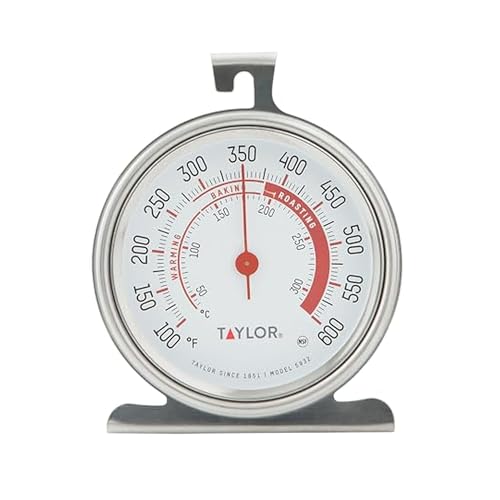
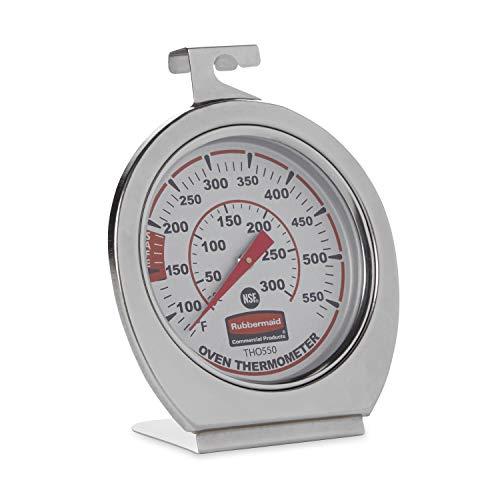
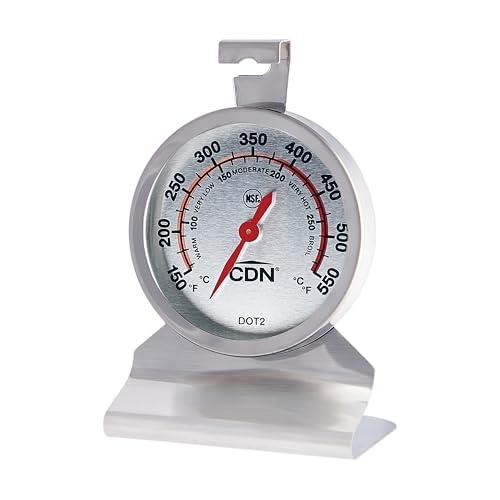
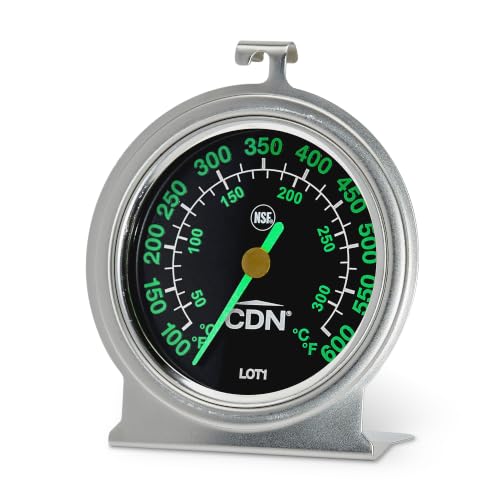
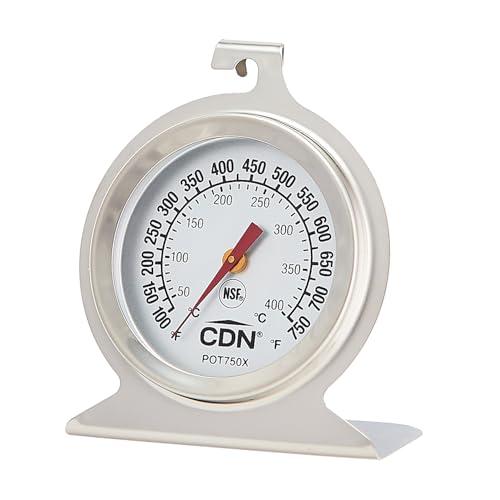
Buy the CDN ProAccurate High Heat Oven Thermometer (POT750X). Its 100–750°Frange is the only one here that puts a 500°F bread preheat in the middle of the dial rather than near the top, which is where a mechanical gauge is most trustworthy, and CDN publishes more about it than anyone else publishes about anything on this page: NSF certification, a laboratory glass lens, a 2-inch dial and a 5-year limited warranty. Take the Taylor 3-inchinstead if your priority is simply reading the thing through the oven door — it is the biggest dial here for the least money. Take the Rubbermaid Commercial if you proof dough in the oven, because its 60°F floor is the only one on this page that can read a proofing box at all. The CDN DOT2 is the budget pick and has the most complete published spec sheet here. And before you buy any of them, read the next section, because this category markets itself on the one number that matters least.
The criteria: accuracy is the spec everyone looks at and the least useful one
Here is the fact that reframes this whole purchase. The CDN DOT2 publishes its accuracy as plus or minus 25°F. That is not a criticism of CDN — quite the opposite, CDN is the only brand here honest enough to print a figure at all, and it is the figure that is normal for a bimetallic dial thermometer. But think about what it means. People buy an oven thermometer because they suspect their oven is running 25 degrees off. The tool they buy to confirm it has a stated tolerance of 25 degrees.
Worse, the published figures for the same brand conflict in a way that tells you how loosely this spec is handled. For the POT750X, a foodservice retailer lists accuracy ±25°F, while a CDN technical sheet hosted elsewhere lists 25°F / 10°C as the resolution— the size of the dial graduations, which is an entirely different specification. Nobody is lying; the two numbers just are not the same thing, and the listings treat them as interchangeable.
So we do not rank on claimed accuracy, and we would not encourage anyone to buy on it. What we rank on, in order:
1. The shape of the range, not its width. A bimetallic coil is least reliable at the extremes of its travel, so what matters is whether yourbaking temperatures sit in the middle of the dial. If you bake bread at 475–500°F, a 550°F gauge is working at the edge of its scale and a 750°F gauge is working comfortably. If you proof dough at 80°F, a thermometer whose scale starts at 150°F cannot help you at all — the needle sits below the first mark. This is why the picks here are ordered by range shape: the POT750X for high heat, the Rubbermaid for the low end, the DOT2 bracketing ordinary baking tightly and nothing either side.
2. Dial size and legibility through glass.Underrated, and the reason the Taylor is ranked second. You read an oven thermometer through a pane of glass, often two panes, frequently with a reflection in it, in a dark cavity, from a crouch. Every time you open the door to read it instead, you lose 25–50°F out of the oven and the measurement you came for. A 3-inch dial you can read standing up is worth more in practice than a 2-inch dial with a tighter tolerance.
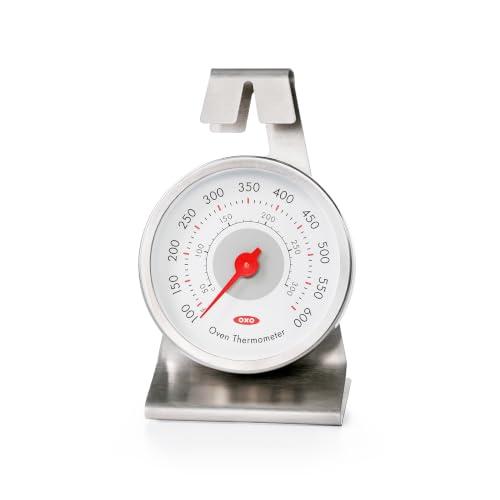
3. What the maker actually publishes. Range, accuracy, steel grade, lens material, certification, warranty. CDN publishes most of these. Taylor publishes its range and NSF listing in the title. OXO, strikingly, publishes no temperature range at all for its oven thermometer — for an instrument whose only job is to report temperature, that is a strange thing to leave out, and it is why that pick scores lowest here on published specs despite having the best mounting on the page.
4. The mounting.A thermometer that falls off the rack onto a tray of cookies is a thermometer you stop using. A single hook can pivot and drop; OXO's two-point hook cannot, which is the real argument for that pick. A wide, genuinely angled base matters if you stand it on a stone or a steel.
5. Construction, because these live at 400°F. A laboratory glass lens (both CDN picks publish one) will not haze or yellow the way plastic does after a hundred cycles. 304 stainless (published for the DOT2) will not discolor the way plated steel does. These are the differences between a gauge you still trust in five years and one you throw away.
Offset or swing? This is what the tool is actually for
If accuracy to the degree is not what you are buying, what is? Something more useful, and almost never explained: an oven thermometer lets you tell two different problems apart.
An offset is a constant error.You set 350°F and the oven stabilizes around 325°F, every time, at every setting. This is the common case, it is usually a thermostat calibration drift, and the fix is free: set the dial 25 degrees higher, or use your oven's calibration-offset function if it has one. You find an offset by letting the oven preheat fully — a genuine 30 to 40 minutes, not the 10 minutes until the beep — and then reading the thermometer at several points over the following 20 minutes and taking the middle of the readings.
A swing is a cycling error.Your oven's thermostat is not a dimmer, it is a switch: the element comes on full, the cavity overshoots, the element goes off, the cavity drifts down, and the element comes on again. On a domestic oven that cycle routinely covers a 30 to 50 degree band around the setpoint. The average can be perfect while the actual air temperature is rarely at the number on the dial. You find a swing by watching the needle for 15 minutes after the oven is fully preheated: if it wanders up and down, that is the cycle, and it is normal.
The two problems have completely different fixes, which is why telling them apart is the point. An offset is solved by turning the dial. A swing is not solved by any thermometer— it is solved by putting thermal mass in the oven. A baking steel, a stone, or a preheated cast-iron Dutch oven absorbs heat during the element's on-phase and releases it during the off-phase, which flattens the cycle that reaches your bake. That is a large part of why baking bread in a Dutch oven works as well as it does, and it is the single most useful thing an oven thermometer can tell you to go do.
It is also worth knowing that a dial thermometer's thermal mass makes it a slow instrument, and that is a feature here. It averages the cycle rather than chasing it, which is closer to what your dough experiences than a fast digital probe reading would be. The cost is that it takes several minutes to settle after any change, so a reading taken 30 seconds after you shut the door means nothing.
Where this sits next to the other thermometer you need
These are not the same tool as the thermometer you put in a loaf, and owning one does not replace the other.
An oven thermometer measures air, stays in the oven permanently, and answers “is this oven at the temperature I asked for?” An instant-read or probe thermometer measures the food's interiorand answers “is this bread done?” — which for bread is a figure, not a guess, and our bread thermometer page covers the target temperatures and the probes that read them. A loaf that comes out gummy in the middle is an internal-temperature problem; a loaf that is pale on top and burnt on the bottom is an oven problem. Two tools, two questions.
If you are buying one of the two and you bake bread, buy the instant-read first. Doneness is the error that ruins loaves. Oven calibration is the error that ruins batches — which matters next, and matters permanently, because an offset you have identified stays identified.
Dial or digital?
Every pick on this page is a mechanical dial, and that is deliberate rather than nostalgic.
A dial oven thermometer has no battery, no display to fail, nothing in it that minds being left at 450°F for years, and it is readable the moment you glance at it. The cheapest here costs less than a bag of good flour. Its weaknesses are the ones described above: coarse graduations, a wide tolerance, slow response, and eventual drift.
Digital oven thermometers — the kind with a wired probe through the door seal and a unit on the counter — read faster and finer, log minimum and maximum, and some will alarm. They are genuinely better instruments. They also cost several times as much, run on batteries you will discover are dead at the wrong moment, and put a cable through your oven door. More to the point: once you have found your oven's offset and learned the shape of its swing, you do not need finer resolution. You need a gauge that lives in there and tells you at a glance that nothing has changed. That is a dial's job.
The one case for digital is if you are chasing a specific curve — a long low bake, a proofing schedule, a wood-fired oven coming down through a temperature band. For ordinary baking in a domestic oven, a six-to-fourteen-dollar dial is the right instrument, and the money saved is better spent on the thermal mass that actually fixes a swing.
How to choose and use an oven thermometer
Buy for the range you bake in, with the reading mid-dial
Write down the hottest and coolest things you actually bake. If the answer is 325–425°F cakes and cookies, any pick here works and the biggest dial wins. If bread at 475–500°F is in the list, buy the POT750X so the needle sits mid-scale rather than crowding the end. If you proof dough in the oven with the light on, you need the Rubbermaid's 60°F floor, because every other pick here starts at 100°F or 150°F and the whole proofing band is off the bottom of their scales.
Put it where the food goes, not where it is convenient
Oven cavities are not uniform. The back is usually hotter than the front, the top hotter than the bottom in a conventional oven, and the area directly over a gas burner hotter than anything. A thermometer clipped to the side of the top rack is measuring a place you never bake. Hang or stand it in the middle of the rack you use, at the height your pan sits.
If you want to map the oven — and it is worth doing once — move the thermometer between four or five positions across a couple of bakes and note the differences. That map is what tells you which corner to rotate a tray out of, which is the same reason our baking sheets for cookies page keeps insisting on a rotation.
Preheat properly before you believe anything
The beep is not the preheat. Most ovens signal when the air at the sensor reaches the setpoint, which is long before the walls, the racks and the door have come up to temperature — and those surfaces are radiating at your bake too. Give an empty oven 30 to 40 minutes; give an oven with a steel or a stone in it closer to an hour. Readings taken before that are measuring a transient, not your oven.
Take several readings and use the middle
Because of the cycling described above, one reading is a snapshot of wherever the cycle happened to be. Read the needle four or five times across 20 minutes of a fully preheated oven, note the highest and lowest, and use the midpoint as your oven's real temperature at that setting. The spread between the highest and lowest is your swing, and it is useful information in itself.
Check it at more than one setting
A thermostat's error is often not constant across its range — an oven can be accurate at 350°F and 40 degrees cool at 450°F. If you bake across a wide range, check at the bottom, the middle and the top of the range you use and write the three offsets on a sticky note inside a cupboard door. It takes one afternoon and it is good for years.
Leave it in there
Every pick here is rated to live in the oven. A thermometer in a drawer is a thermometer that never catches the day the thermostat starts to drift. The exception is the self-clean cycle: pyrolytic cleaning runs far above every published ceiling on this page, so take the thermometer out before you run it — along with the racks, if your manual says so.
Expect drift, and sanity-check it
A bimetallic coil loses calibration slowly, and faster with hard high-temperature use; owner reports of exactly that on high-heat gauges are common and are not a defect so much as the nature of the mechanism. You cannot recalibrate most oven dials at home. What you can do is sanity-check one against a second instrument: put an instant-read probe in the oven air next to it for a minute and compare. If the two disagree by more than the dial's stated tolerance, and they keep doing so, the dial has drifted and it costs under fifteen dollars to replace.
Do not use one in a broiler, over a burner, or on a grill it is not rated for
A broiler element radiates far above the air temperature at the gauge face, which is a different and much harsher exposure than a conventional bake. Only the Rubbermaid pick here publishes a grill and smoker rating. The POT750X's 750°F ceiling buys headroom for high-heat baking, not for direct radiant heat.
What we did not feature, and why
Unbranded dial thermometers with no published certification.This is the largest group in the category, often two or three dollars, frequently with a 50–300°C scale and nothing else stated — no accuracy, no steel grade, no lens material, no warranty. Some of them are fine. None of them can be ranked against a gauge that publishes NSF certification, a steel grade and a five-year warranty for six dollars, which the CDN DOT2 does. At that price the branded option is not a premium, so the unbranded one has no argument.
Leave-in meat thermometers and dial meat probes.These appear in oven-thermometer search results constantly and they are a different instrument: they measure the interior of food, not the oven air, and their scales top out around 200–220°F. Useful, and covered on our bread thermometerpage — not a substitute for this.
Wireless and app-connected oven probes. Genuinely good instruments for someone running a long smoke or a complex bake, and the wrong tool for the question this page answers. You are trying to learn a fixed fact about your oven once. A permanent dial does that for the price of a coffee.
Infrared surface thermometers. These read a surfacetemperature, not air, which makes them useful for checking whether a baking steel is up to heat and useless for checking whether an oven is at 350°F. Different measurement, different question.