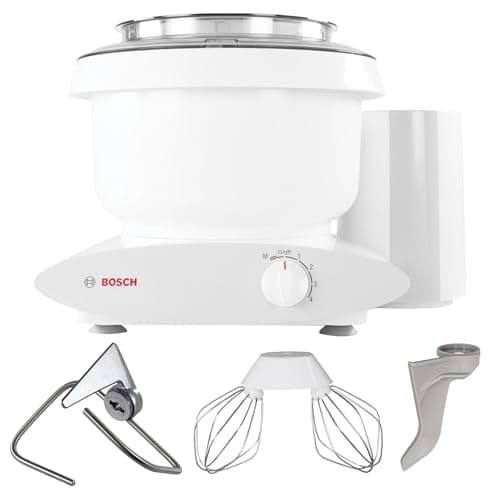
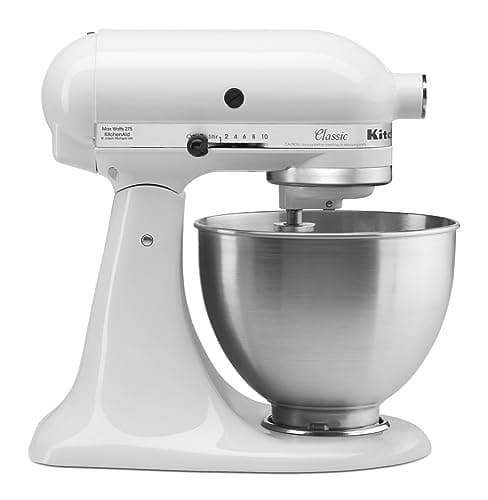
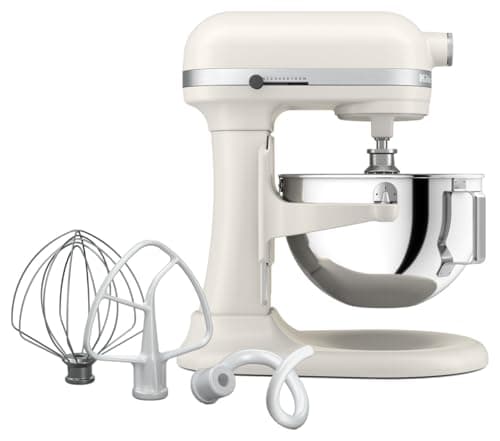
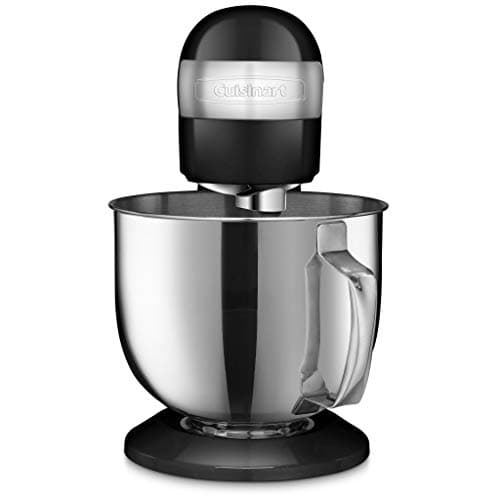
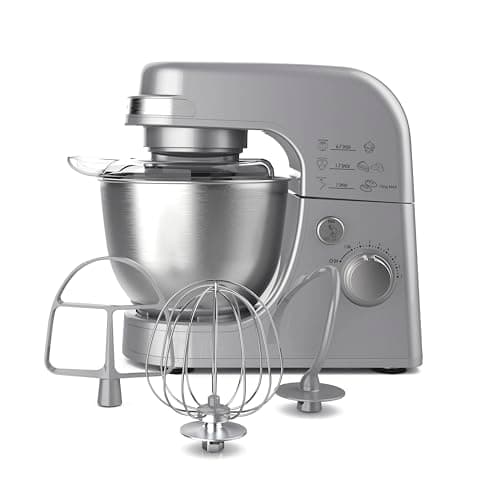
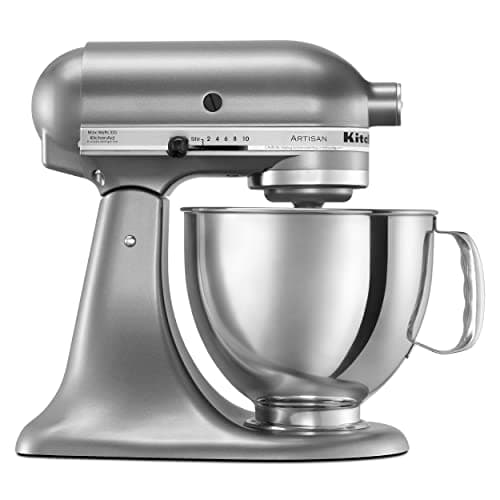
Buy the KitchenAid Artisan (KSM150)if you bake a bit of everything — cookies, cakes, frosting, a loaf or two a week. It is the most useful mixer in this band because the 5-quart bowl and the front PowerHub port cover the widest range of jobs. If you bake bread in quantity, buy the Bosch Universal Plus instead: a bottom-drive motor and a 6.5-quart bowl take the dough loads that make a tilt-head flex, and Bosch is the only maker here that publishes a dough capacity at all. And the budget pick is the Hamilton Beach 4-Quart— the cheapest mixer here that still creams butter and sugar properly, for an occasional baker. Every price on this page comes from the live price layer and is stamped with the date it was fetched in the Quick picks table above; check it before you buy, because a price-band page is only ever as good as the day's prices.
What $500 actually buys in this category
This is the band worth understanding, because it is almost the whole category. The best-known home stand mixers cluster in the low hundreds through to around $500 at list, which means a $500 ceiling is not really a budget constraint — it is the line above which you are paying for capacity, a commercial pattern or a design statement rather than for a better mixer for home baking. All six picks here carried a live price under the band when we published, and together they cover every job a home baker has.
What sits abovethe band is worth naming so you know what you are not getting. A 7-quart bowl-lift, which is a genuine step up in dough capacity and the right machine for four-loaf batches — see our 7-quart review. And a design-led machine like the SMEG, where part of the price is the die-cast body — see the SMEG review. Neither is a better mixer for ordinary home baking than the Artisan is.
The one decision that splits this band: do you bake bread?
Everything else on this page is a detail. The split is real and it is mechanical.
A planetary mixer— the three KitchenAids, the Cuisinart, the Hamilton Beach — drives a beater from above, on an arm that orbits the bowl while the beater spins the other way. It is brilliant at aeration: creaming butter, whipping cream, beating egg whites, emulsifying a batter. Against a stiff dough it is working against its own geometry, because all the load lands on one overhead shaft.
A bottom-drive mixer— the Bosch — spins the dough hook from beneath the bowl, so the load sits directly on the drive rather than cantilevered out on an arm. That is why a 500 W rated Bosch finishes dough batches that stall mixers with similar published wattage. The trade is real too: a big open bowl with a bottom drive is poor at small aeration jobs, and whipping one egg white in it is a waste of time.
So: mostly batters, frostings and cookies, with bread occasionally — buy planetary. Several loaves a week, or stiff dough — buy the Bosch. The head-to-head is at KitchenAid vs Bosch, and best for sourdough covers the dough case in detail.
How the six compare on published specs
Manufacturer figures, cited in Sources; not publishedmeans we could not source a figure and refuse to invent one. No prices in this table on purpose — the Quick picks table above carries them from the live price layer with an “as of” date, and that is the only place on this site a price is allowed to appear.
| Mixer | Drive | Rated watts | Bowl | Attachment hub |
|---|
| KitchenAid Artisan KSM150 | Planetary, tilt-head | 325 W | 5 qt | Yes — PowerHub port |
| Bosch Universal Plus | Bottom-drive | 500 W | 6.5 qt (approx. 5–6 lb dough) | Bosch's own range |
| KitchenAid Classic K45SS | Planetary, tilt-head | 275 W | 4.5 qt | Yes — PowerHub port |
| KitchenAid 5.5-Qt Bowl-Lift KSM55 | Planetary, bowl-lift | Not published | 5.5 qt | Yes — PowerHub port |
| Cuisinart Precision Master SM-50 | Planetary, tilt-head | 500 W | 5.5 qt | No |
| Hamilton Beach 4-Quart | Planetary, tilt-head | Not published | 4 qt | No |
The useful thing in that table is how little wattage tracks price. The Cuisinart publishes the same rated figure as the Bosch and a higher one than every KitchenAid, at the low end of the band; the KSM55 publishes no wattage at all and is near the top of it. What the money is actually buying, in order, is bowl volume, drive rigidity and the attachment port.
Spending the band well
Do not spend the whole band on the machine
The most common mistake in this band is buying the most expensive mixer that fits and nothing else. A mixer plus a digital scale and a flex-edge beateris a better kitchen than a slightly nicer mixer on its own, because the scale fixes measurement — which is the actual cause of most inconsistent baking — and the flex edge stops the constant scraping that a plain paddle forces on you.
Where the extra money inside the band goes
Between the cheapest and dearest picks here you are buying three things, in this order: bowl volume, drive rigidity, and the attachment port. You are not buying a meaningfully better motor — published rated wattage across this page does not track price at all, and the Cuisinart out-specs both tilt-head KitchenAids on paper while costing less than either.
What to check on the day
Prices in this category move a lot, and they move most in the weeks before Black Friday. Some mixers on this page sat close to the $500 line when we published, which means the band membership of this page is genuinely price-dependent. The Quick picks table reads the live price layer and prints the date it was fetched; if that stamp is old, or a row shows “Check price” instead of a number, that row has no verified live price and you should treat the band as unconfirmed for it. We would rather show you a gap than a number that has rotted.
What we did not feature, and why
The KitchenAid 7-quart bowl-lift and the SMEG SMF03 are the two registry mixers that sat above the band, and they are excluded for exactly that reason rather than on merit. Both have their own reviews on this site.
The Dash 3.5-quart is in our registry and is not ranked here because it carried no verified live price when we published, so we cannot place it inside or outside the band honestly. It is covered in its own review and in best for small kitchens.
Lower bands. We checked $200 and $300 before publishing this page and did not build them: only two registry mixers carried a verified live price under either, and a ranked page needs at least three. If that changes, those pages become honest and we will build them.
Unbranded high-wattage mixersfill this price band on marketplace listings and publish almost no specifications — frequently not even a consistent model identity. There is nothing to score against our rubric. See how we pick.