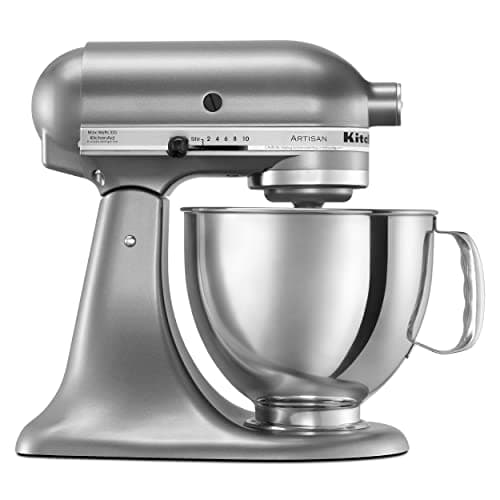
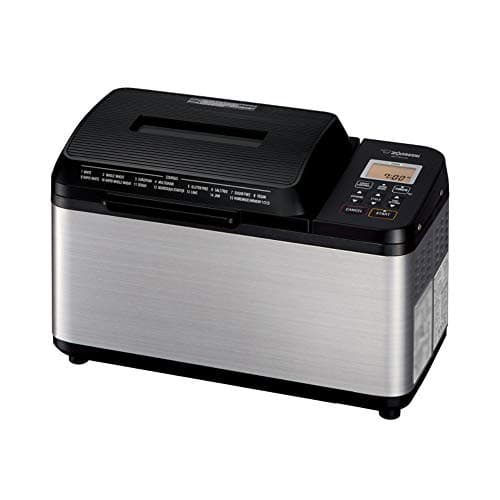
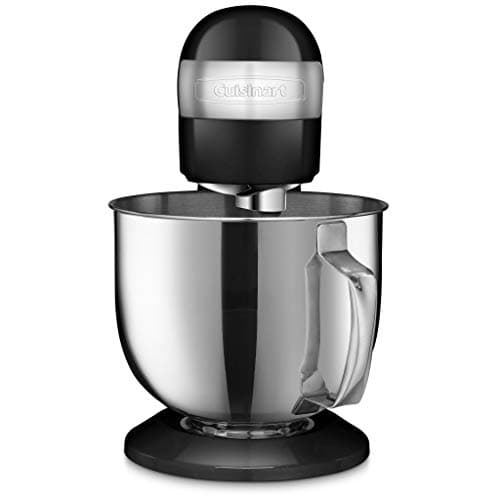
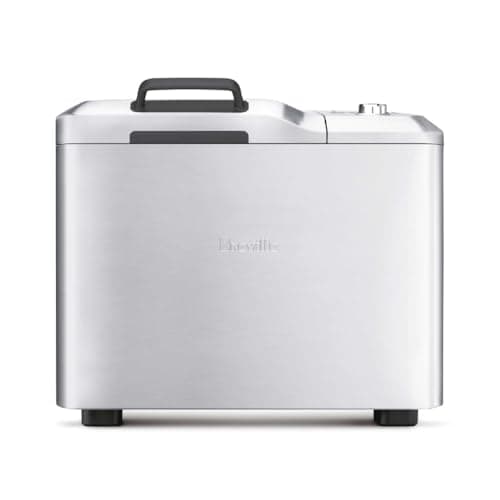
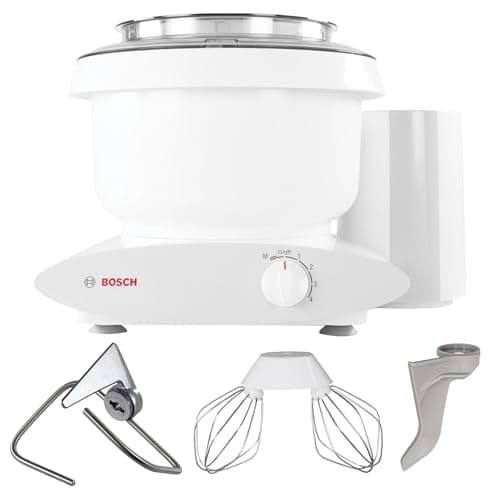
Buy the Bosch Universal Plus if kneading dough is the job you are buying for. Its motor sits beneath the bowl and drives the hook from below, so dough load goes straight into the drive rather than being cantilevered on an overhead arm, and its published 6.5-quart bowl and 5-to-6-pound dough capacity take three to four loaves at once. If kneading is only part of what you do — cakes, frosting, whipped cream too — buy the KitchenAid Artisan instead, which is far more versatile and will knead a loaf or two a week happily. If you want the kneading to happen without you in the room, a bread machine does that on a program, and the Zojirushi Virtuoso Plus is the best-built of them. The budget pick is the Cuisinart Precision Master — the cheapest machine here with a published 500 W rated motor and a 5.5-quart bowl, which is enough to knead ordinary dough properly.
Two appliances, one question
The thing that makes this question hard to search is that two unrelated appliances answer it, and most pages only cover one.
A stand mixer kneads with a hook in an open bowl, under your eye. You can see the dough come together, feel the windowpane, add water or flour mid-knead, and stop when it is right rather than when a timer says so. Then you take the dough out and do everything else yourself.
A bread machinekneads in a sealed pan on a program: knead, rest, knead, first rise — and on a dough-only or pizza-dough course it then beeps and stops without baking. You cannot judge the dough while it works and you cannot intervene much. What you get instead is that it happens entirely without you, including the rise, inside a heated housing — which is genuinely useful in a cold kitchen, and the reason a lot of people who own stand mixers still use the dough course.
So the real question is not which machine kneads better. Both knead well. It is whether you want to be present. If you enjoy the dough, buy a mixer. If dough is a chore between you and bread, buy a machine with a dough course. We put the two side by side in bread machine vs stand mixer, and the dough-cycle guide covers how the program actually runs.
The criteria
1. Drive design, which matters more than wattage.This is the single most useful thing to understand. A bottom-drive mixer loads its motor directly; a planetary tilt-head loads it through a hinge and an arm. That is why a 500 W rated Bosch finishes dough batches that stall machines with the same published rating. Rated wattage is the only comparable published spec among the mixers — no maker publishes torque — so we use it as an ordering, not a promise.
2. Published capacity, where it exists. Bosch is the only maker on this page that publishes a dough capacity: roughly 5 to 6 pounds, which is three to four standard loaves. The other mixers publish a bowl volume and nothing else. The bread machines publish a maximum loaf size instead, which is a usable proxy, because the pan is the limit: a 2-pound machine kneads about 2 pounds of dough.
3. Bowl or pan geometry. A deep narrow bowl keeps a small dough on the hook; a wide bowl lets a small dough escape it and slap around uselessly. This is why a big-bowl machine is not automatically better: the Bosch is poor at small batches for exactly this reason, and a 5-quart planetary is better at a single loaf than at four.
4. Whether it can do anything else.A mixer that kneads also creams, whips and beats. A bread machine that kneads also bakes, and the good ones run gluten-free and custom courses too. If this is your only appliance purchase, count the second job — it is usually the deciding factor.
5. How the dough comes out.A mixer hands you a dough in a bowl. A bread machine hands you a risen dough with a paddle hole in it, unless the paddle collapses — which the Breville's published collapsible paddle does, and which is the reason it is on this page rather than a cheaper machine.
How the five compare on published specs
Manufacturer figures, cited in Sources. Note that neither bread machine publishes a kneading-motor wattage, so the wattage column is blank for both rather than filled with a figure that would not mean the same thing anyway — most of a bread machine's power draw is its heating element.
| Machine | Type | Kneading mechanism | Rated watts | Published capacity |
|---|
| Bosch Universal Plus | Stand mixer | Bottom-drive dough hook | 500 W | 6.5 qt bowl, approx. 5–6 lb dough |
| KitchenAid Artisan KSM150 | Stand mixer | Planetary, tilt-head | 325 W | 5 qt bowl |
| Zojirushi Virtuoso Plus BB-PDC20 | Bread machine | Two paddles, horizontal pan, programmed | Not published | 2 lb loaf |
| Cuisinart Precision Master SM-50 | Stand mixer | Planetary, tilt-head | 500 W | 5.5 qt bowl |
| Breville Custom Loaf BBM800XL | Bread machine | Collapsible paddle, programmed | Not published | 4 loaf sizes, 1 lb to 2.5 lb |
Read the capacity column, not the wattage column, if you are comparing across the two types. A bread machine is capped by its pan and a mixer is capped by its bowl and its drive, and those are the two numbers that decide whether a machine can do your batch.
Which one for your kitchen
Several loaves a week, or stiff dough
The Bosch, without much argument. This is the load that exposes every other machine on the page, and the bottom drive is the design answer rather than a bigger number on the same design. Best stand mixers for bread dough goes deeper on the mechanism, and best for large batches covers the capacity case.
One or two loaves a week plus everything else you bake
The KitchenAid Artisan. A 5-quart planetary tilt-head kneads ordinary dough comfortably at that frequency and does every other mixing job better than the Bosch does. If the budget is tighter, the Cuisinart Precision Master is the same shape of machine with a bigger bowl and the same published rated wattage as the Bosch.
You want dough without standing over it
A bread machine. The Zojirushi Virtuoso Plus is the best-built of them, with two paddles in a horizontal pan that knead a 2-pound loaf's worth of dough evenly; the Breville Custom Loaf gives you more program control, four loaf sizes and a collapsible paddle that leaves a smaller hole. Either one can hand you a risen dough to shape and bake in a real oven, which is the trick most bread-machine owners never discover. Our reviews: Zojirushi Virtuoso Plus and Breville Custom Loaf.
You are not sure a machine is the answer at all
It may not be. Hand kneading works, costs nothing, and for one loaf a week it is not slower than cleaning a mixer bowl. We wrote stand mixer vs hand kneading precisely so this page is not the only answer, and a dough whisk plus ten minutes of folding handles more than people expect.
What we did not feature, and why
Hand mixers are not dough kneading machines, whatever a listing says. Two thin beaters in a 200-to-350 W housing against a bread dough is how hand mixers die; the honest version of that question is at can a hand mixer knead dough.
Spiral mixers and commercial dough mixers are the right tool for a bakery and the wrong purchase for a kitchen: single-purpose, heavy, usually 10 quarts and up, and priced past this whole category. Different product class, not ranked.
Food processorswill bring a dough together in under a minute with a plastic blade, and that is a legitimate technique rather than kneading — the gluten develops during the rest, not in the machine. We cover it in stand mixer vs food processor for dough and did not rank one here because no registry entry of ours is a processor.
Cheaper bread machines knead perfectly well and are ranked on their own merits in best value bread machines. The two here earn their places on published kneading detail — two paddles, a collapsible paddle — not on price.