Skip to content
Plug & Prep

Hub 05 · Guides · Guides & Comparisons

SMEG vs Dash stand mixer

One is a design statement you build a kitchen around; the other is the cheapest, smallest way onto the counter. These two barely compete - here's which buyer each is really for.

By Stephen V.Updated How we pick
#ad

We earn a commission when you buy through our Amazon links, at no extra cost to you. It never changes our rankings, and we say so when the cheaper product is the better buy. How this works.

The SMEG 50s-style mixer and the Dash 3.5-quart barely belong in the same comparison, and that's exactly the point. The SMEGis a premium design object — die-cast body, retro styling, a machine you build a kitchen around — that also happens to bake capably. The Dashis the cheapest, smallest genuine stand mixer you can put on a counter, aimed at a tiny kitchen, a dorm, or a first-timer who bakes now and then. They're both tilt-heads that whip, cream and mix, but they answer opposite questions: "what's the most beautiful mixer I can own?" versus "what's the least I can spend to get one at all?"

The short version: buy the SMEG if design and build genuinely matter to you and you can absorb a big premium for them; buy the Dashif price and size are the hard constraints and your batches are small. This isn't a better-versus-worse contest — it's a what-do-you-value one. Our SMEG SMF03 review and Dash stand mixer review cover each in full, and our SMEG vs KitchenAidcomparison is the more natural SMEG matchup if you're weighing the design mixer against a performance benchmark.

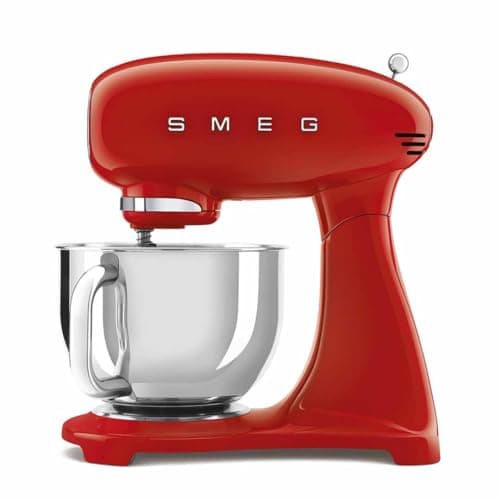
Start with the SMEG's real strength: design and build. Its die-cast aluminum body and zinc base feel more premium than almost any rival, the iconic 50s styling comes in a wide range of colors, and it runs relatively quietly. It ships with four attachments, including a flex-edge beater, and a dishwasher-safe stainless bowl. This is a machine you buy partly as an object, and on that measure it delivers — it's the one people notice on the counter. If your kitchen is styled and the mixer is part of the look, that's a legitimate reason to choose it, and it bakes cakes, cookies and everyday batters perfectly well while it's at it.

But be honest about the trade-offs. On paper the SMEG has an 800-watt motor, yet reviewers consistently report it can struggle on stiff, enriched dough and big meringues— it's not the dough powerhouse the wattage suggests. It's heavy at around twenty pounds, priced well above better-performing mixers, and owners note frequent bowl-scraping and a fiddly pouring shield. You're paying a large premium mainly for the styling and the build, not for kneading power. For a baker choosing on performance per dollar, that's a hard case to make — which is exactly why the SMEG makes sense as a design buy and not a value one.

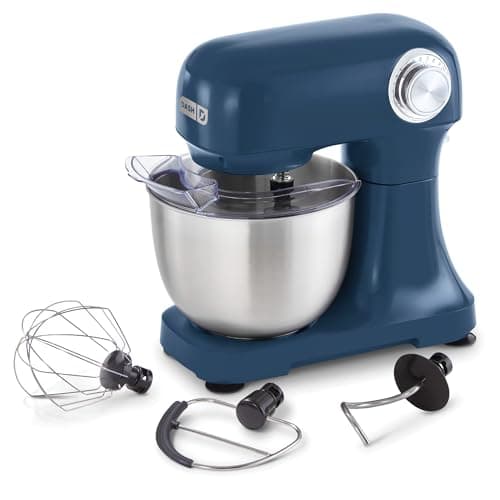
The Dash comes at the market from the opposite end: size and price. At around six pounds and a compact footprint, it's a genuine mini — easy to lift and stow one-handed, small enough for a dorm, an RV or a kitchen with almost no counter or cabinet space, and about as cheap as a real stand mixer gets. It comes with a dough hook, paddle, whisk and splash guard, all dishwasher-safe, and twelve speeds. Its honest limits are exactly what you'd expect: the 3.5-quart bowl and light-duty motor are for small batches, not heavy or high-volume dough; the plastic-forward build feels budget and isn't made to last a decade; and the warranty is short. For small-batch cakes, cookies and whipped cream in a tight space, though, it's a lot of mixer for very little money.

So the decision writes itself once you name what you're buying. With the SMEG, most of the (high) price goes to the die-cast build and the iconic look — a beautiful, well-made machine that bakes adequately and styles a kitchen. With the Dash, the whole appeal is getting a capable little tilt-head onto the counter for the lowest possible price and in the smallest possible space. If you'd enjoy the SMEG every time you saw it and can afford the premium, it's a defensible splurge; if you just want an affordable, compact way to start baking, the Dash is the honest pick. We explain how we weigh looks against performance on our how we pick page.

The short answer

Quick picks

#ProductBest forScorePrice
01
SMEG SMEG 50s-Style Stand Mixer (SMF03)
SMEG 50s-Style Stand Mixer (SMF03)

The design-first stand mixer. SMEG's die-cast body and retro colorways make it the best-looking mixer on most counters, and the build genuinely feels premium. On paper it has an 800-watt motor and a full attachment set — but reviewers consistently note it can lag a KitchenAid or Bosch on stiff, enriched dough, and you pay a steep premium for the styling.

Design-led kitchens
7.8
$599.95Amazon
02
Dash Dash 3.5-Qt Tilt-Head Stand Mixer
Dash 3.5-Qt Tilt-Head Stand Mixer

The mini stand mixer for a tiny kitchen or a first-timer. A 3.5-quart tilt-head with a paddle, dough hook, whisk and splash guard in the box, for well under a hundred dollars. It's light-duty and plastic-bodied — it won't knead heavy dough or last a decade — but for small-batch baking in a small space it's a lot of mixer for the money.

Small kitchens / occasional small batches
6.7
$79.99Amazon

#ad · Live prices from the Amazon Product API, as of Aug 5, 2026. Where we have no verified live price we show none — a gap beats a number that has rotted.

In detail

The picks, in full

01
SMEG SMEG 50s-Style Stand Mixer (SMF03)

Design-led kitchens

SMEG 50s-Style Stand Mixer (SMF03)

800 W rated~5-qt bowl10 speedsTilt-head4 attachments incl. flex edge
7.8/10

The design-first stand mixer. SMEG's die-cast body and retro colorways make it the best-looking mixer on most counters, and the build genuinely feels premium. On paper it has an 800-watt motor and a full attachment set — but reviewers consistently note it can lag a KitchenAid or Bosch on stiff, enriched dough, and you pay a steep premium for the styling.

Motor / dough
7.5
Capacity
8
Build & durability
9
Ease of use
8
Value
6.5

Pros

  • Die-cast aluminum body and zinc base feel more premium than most rivals
  • Comes with four attachments, including a flex-edge beater, plus a dishwasher-safe stainless bowl
  • Iconic 50s-retro styling in a wide range of colors, and runs relatively quietly

Cons

  • Reviewers report the 800 W motor can struggle on stiff, enriched dough and big meringues
  • Heavy (~20 lb) and priced well above better-performing mixers
  • Owners note frequent bowl-scraping and a fiddly pouring shield

Don't buy this if…

you're buying on kneading power per dollar — a Bosch Universal Plus or a KitchenAid bowl-lift out-muscles it for less, and you're paying here largely for the look.

$599.95View on Amazon

Price as of Aug 5, 2026. Prices change — Amazon's at checkout is the one that counts.

#ad · we may earn a commission from this link to SMEG 50s-Style Stand Mixer (SMF03)

02
Dash Dash 3.5-Qt Tilt-Head Stand Mixer

Small kitchens / occasional small batches

Dash 3.5-Qt Tilt-Head Stand Mixer

350 W rated3.5-qt bowl12 speedsTilt-headHook + whisk incl.
6.7/10

The mini stand mixer for a tiny kitchen or a first-timer. A 3.5-quart tilt-head with a paddle, dough hook, whisk and splash guard in the box, for well under a hundred dollars. It's light-duty and plastic-bodied — it won't knead heavy dough or last a decade — but for small-batch baking in a small space it's a lot of mixer for the money.

Motor / dough
5.5
Capacity
5.5
Build & durability
6
Ease of use
8
Value
8.5

Pros

  • Compact and light (~6 lb) — easy to store in a small kitchen or dorm
  • Ships with a dough hook, paddle, whisk and splash guard, all dishwasher-safe
  • Costs a fraction of a full-size stand mixer

Cons

  • 3.5-qt bowl and light-duty motor are for small batches, not heavy or high-volume dough
  • Plastic-forward build feels budget and isn't made to last like a cast machine
  • Short 1-year warranty (2 years only if you register)

Don't buy this if…

you bake bread or double batches — even a budget full-size mixer like the Hamilton Beach 4-qt has the bowl and motor you'll want.

$79.99View on Amazon

Price as of Aug 5, 2026. Prices change — Amazon's at checkout is the one that counts.

#ad · we may earn a commission from this link to Dash 3.5-Qt Tilt-Head Stand Mixer

SMEG vs Dash: how to choose

Design and build

This is the SMEG's entire reason for existing. Its die-cast aluminum body and zinc base genuinely feel premium, the retro colorways are unmatched, and it's built to be seen. The Dash is a functional, plastic-forward little machine that makes no pretense of being a design object — it's built to be cheap and compact. If how the mixer looks and feels matters as much as what it does, the SMEG is in a different league; if you just want a tool that works, the Dash is honest about what it is.

Capability and dough

Both are light-to-moderate baking machines, not heavy-dough tools. The SMEG has the bigger roughly 5-quart bowl and more speeds, and it handles everyday batters and light doughs comfortably — but reviewers note its motor can labor on stiff, enriched dough despite the high wattage. The Dash's 3.5-quart bowl and light-duty motor are strictly for small batches; push either into serious bread and you're past what it's built for. If bread is a priority, neither is your machine — that's a bowl-lift or a Bosch. Between these two, the SMEG has more room and capability, the Dash just enough for small jobs.

Size, weight and storage

The Dash wins outright. At around six pounds and a compact footprint, it's the genuine mini — light enough to lift and stow one-handed and small enough for a dorm, an RV or a cramped kitchen. The SMEG is heavy at around twenty pounds and takes real counter space; it's a machine you leave out as part of the look, not one you tuck away. If fitting a stand mixer into a tiny kitchen is the deciding factor, the Dash is built for exactly that and the SMEG is the opposite of that.

Price and value

The gap is enormous, and it decides most of this. The SMEG costs many times what the Dash does, and most of that premium buys design and build rather than baking capability. The Dash is about the cheapest real stand mixer there is. On pure capability per dollar, the Dash is the value pick by a mile; the SMEG's value only makes sense if you truly want the look and build enough to pay for them — a legitimate preference, but a different calculation from performance.

Which to buy

Buy the SMEGif a beautiful, premium, retro-styled machine is worth a large premium to you, your baking is light-to-moderate, and you want an object you'll enjoy that also bakes. Buy the Dashif price and space are the hard limits — a tiny kitchen, a dorm, a first-timer testing whether they'll bake at all — and your batches are small. If you're actually torn between the SMEG's looks and a mixer that bakes harder for the money, our Dash vs KitchenAid and SMEG vs KitchenAid comparisons put each against the performance benchmark. Read both reviews for the full cons first.
How we picked

We don't run a testing lab

We read the manuals, compiled the published specifications, did the wattage-to-dough math and weighed aggregated owner reviews, then scored each product against a published rubric. The scores are judgments from documented research — they are notmeasurements we took, because we do not have a lab and we're not going to pretend we do. Every spec is the manufacturer's published figure, cited in Sources.

Questions

Frequently asked

Is the SMEG or Dash stand mixer better?
It depends entirely on what you value, because they barely compete. The SMEG is a premium, die-cast design icon that bakes capably; the Dash is the cheapest, most compact genuine stand mixer, built for small kitchens and occasional baking. If design and build matter and you can absorb the premium, the SMEG; if price and space are the constraints, the Dash. See the SMEG review and Dash review.
Is the SMEG stand mixer worth the price over a budget mixer like the Dash?
Only if you value its design and build enough to pay for them. The SMEG costs many times a budget mini, and most of that premium buys the die-cast body and retro styling rather than baking power - reviewers note its motor can struggle on stiff dough despite the high wattage. As a design object that bakes well it delivers; as a performance-per-dollar buy against something like the Dash, it doesn't try to be.
Can the Dash or SMEG knead bread dough?
Only lightly. Both are tilt-heads tuned for batters and light doughs, not heavy bread. The Dash's 3.5-quart bowl and light-duty motor are for small batches, and even the SMEG's higher-wattage motor is reported to labor on stiff, enriched dough. If bread is a priority, neither is the right tool - a bowl-lift or a bottom-drive Bosch is.
Which is better for a small kitchen, the SMEG or the Dash?
The Dash, easily. At around six pounds and a compact footprint, it's a genuine mini you can lift and store one-handed, ideal for a dorm, an RV or a cramped counter. The SMEG is heavy at around twenty pounds and is meant to be left out as a design centerpiece, so it's the wrong pick if space is tight.

Keep reading

Receipts

Sources

We don't run a testing lab, and we don't pretend to. Specs are the manufacturer's published figures, cited above; scores are our judgments from that research. Where we couldn't verify something, we say so on the page rather than quietly leaving it out. Read our full method.