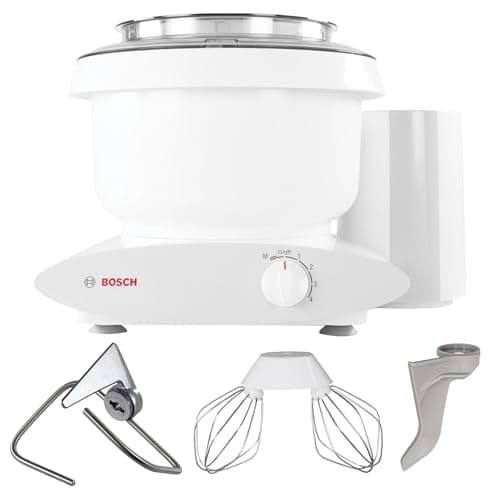
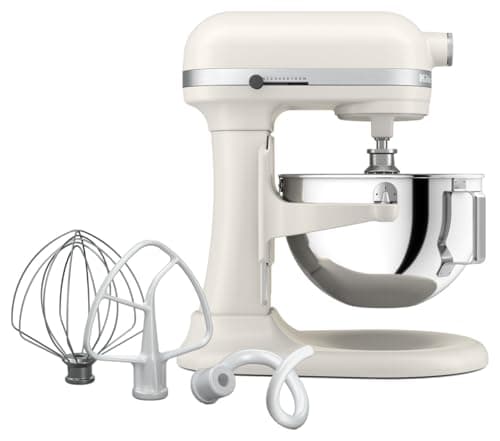
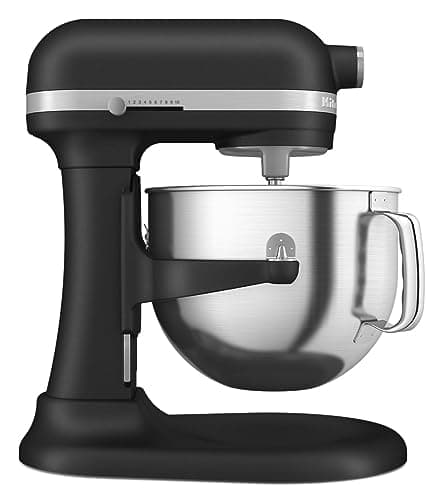
Buy the KitchenAid 7-quart bowl-lift (KSM70SKXX) if dough is why you are buying a mixer: it has the most motor and the most bowl of any bowl-lift machine here, and the locked cradle means the bowl cannot move while a dough hook is dragging a stiff mass around it. If what you want is maximum kneading per dollar and you can live with a different shape of machine, the Bosch Universal Plus is the honest alternative — it is bottom-drive rather than bowl-lift, which means the motor is under a fixed bowl well rather than overhead, and it out-kneads planetary mixers near its price. The budget pick is the KitchenAid 5.5-quart KSM55, the cheapest way into a locked-bowl machine and still a serious one.
A note on the shape of this page, because it matters more than padding it would: there are only two mainstream home bowl-lift machines, and they are both KitchenAids. We rank three products rather than five because we are not going to relabel a tilt-head as a bowl-lift to fill a slot, and the third pick is the one machine that solves the same problem a different way. If you want the wider field, our best stand mixers for bread dough page ranks every architecture against each other.
What a bowl-lift actually changes
On a tilt-head mixer, the motor head hinges backwards to let you get at the bowl, and the bowl itself drops into a locating ring on the base. On a bowl-lift, the head is fixed to the column and the bowl clamps into two arms on a cradle, which you crank upward into the beater with a lever.
The consequence is rigidity. A hinged head has a latch and a pivot, and both are tiny amounts of play. Under the side load of a dough hook pulling a stiff, low-hydration dough around the bowl, that play shows up as the head nodding or the whole machine rocking — which is where people see a tilt-head “walk” across the counter. A bowl-lift has no hinge in the load path: the bowl is bolted into a cradle and the head cannot move. Same dough, much less drama. We cover the walking problem itself in why is my stand mixer walking across the counter.
The second consequence is capacity. Bowl-lift designs scale up more easily, which is why the big home machines and essentially all commercial planetary mixers use them.
What you give up is convenience. You cannot reach into the bowl while it is raised, so adding ingredients means dropping the cradle or using the pouring gap. Swapping beaters is fiddlier. The machines are taller, and a 7-quart bowl-lift may not fit under a standard wall cabinet — measure before you buy. Our full comparison is in tilt-head vs bowl-lift stand mixer.
The criteria
1. Motor, read honestly. Rated wattage on a stand mixer is an input figure, not an output one, and it is a poor cross-brand comparison — a bottom-drive machine puts its power down through a short gear train and does more with the same number. What matters for dough is sustained torque at low speed without the motor heating, and that is what the published dough capacities are a proxy for. We work through the arithmetic in what wattage stand mixer for bread.
2. Bowl capacity versus usable capacity. A 7-quart bowl does not knead 7 quarts of dough. A planetary beater needs the dough to stay in the path of the hook, so usable dough capacity is roughly a third to a half of nominal volume. The practical numbers: a 5.5-quart bowl-lift handles two standard loaves comfortably, a 7-quart handles three to four. Our bowl sizes explained page has the full table, and what size do I need walks through choosing.
3. Planetary or bottom-drive. Planetary machines — both KitchenAids — spin the beater on its own axis while orbiting the bowl, which is excellent for creaming, whipping and batter and good for dough. Bottom-drive machines — the Bosch — drive from underneath, with the dough hook sweeping a fixed bowl, which is superb for dough and less good for small quantities of batter or a single egg white. The difference is structural rather than a matter of quality; see planetary vs bottom-drive.
4. Height and footprint. The thing people discover after delivery. A bowl-lift is taller than a tilt-head of the same capacity even before you raise the cradle, and the lever needs clearance. Measure under your cabinets.
Who should not buy a bowl-lift
Most people, honestly, and it is worth saying on a page that exists to sell them.
If you bake cakes, cookies, meringue and the occasional loaf, a tilt-head is the better machine for you: cheaper, shorter, easier to load, and entirely adequate. The flex only matters under stiff dough, and if you knead a couple of loaves a week a 5-quart tilt-head will do it for years. Our best tilt-head mixers page is the one to read instead, and best stand mixers under $500 covers the band most buyers are actually shopping.
Buy a bowl-lift if any of these is true: you knead stiff bagel, rye or very low-hydration dough regularly; you make double or triple batches; you have had a tilt-head and found its limits; or you want the machine to be the last one you buy. That is a real set of people — it is just not everyone.
How to choose and use a bowl-lift mixer
Measure your cabinet clearance first
A 7-quart bowl-lift is tall, and the lift lever needs room to swing. Measure from the worktop to the underside of the wall cabinet and compare it with the published height. The alternative is a machine that lives on the floor of a cupboard, which means you will not use it. Our storage guide covers the options if clearance is tight.
Start dough on the lowest speed and leave it there
Dough gets kneaded at speed 1 or 2 on a KitchenAid, full stop. Higher speeds do not knead faster — they heat the motor, stress the gearbox and throw dough up the hook. The manual says this and it is the single most ignored instruction in the category. Our dough hook guide has the timings.
Check that the cradle is latched before you start
A bowl-lift bowl has to be seated in both arms and pinned. A bowl that is in one arm and resting on the other will jump when the hook loads up, which is alarming and can bend the cradle. Lift, listen for the lever to seat, and give the bowl a wiggle.
Do not fill it to the brim
Usable dough capacity is roughly a third to a half of the bowl's nominal volume, because the dough has to stay where the hook can reach it. Overfilled, the hook tunnels through the middle and the outside never gets worked, and you will blame the machine for a dense loaf.
Scrape down, because a fixed head will not let you see
With the cradle raised you are looking at the outside of the bowl, not the inside. Stop the machine, drop the bowl, scrape the sides and the bottom with a spatula, and raise it again — particularly when creaming butter and sugar, where unmixed material at the bottom is the classic fault. See why does my mixer leave unmixed ingredients at the bottom.
Adjust the beater height when it arrives
Bowl-lift machines have a screw adjustment that sets how close the beater comes to the bottom of the bowl, and they do not always arrive correct. The dime test — the beater should just move a coin sitting in the bowl — takes two minutes, and our beater height guide walks through it. Getting it right is the difference between a mixer that creams properly and one that leaves a ring of butter at the edge.