Skip to content
Plug & Prep

Hub 04 · Baking Gear · Baking Gear

The best flour sifters

A sifter is a one-job tool, and the job is aerating flour fast enough that you keep doing it. Which means the thing to judge is the mechanism - the crank and the agitator - not the mesh, because the mesh is the part that never breaks.

By Stephen V.Updated How we pick
#ad

We earn a commission when you buy through our Amazon links, at no extra cost to you. It never changes our rankings, and we say so when the cheaper product is the better buy. How this works.

Buy the Norpro 3-cup rotary hand-crank sifter. It is a stainless body with a side crank and twin wire agitators, and that combination is the whole product: two wires sweep the full width of the screen instead of scuffing a circle in the middle, which is what keeps a sifter moving when the flour is slightly damp. That is the failure that makes people give up on sifters and go back to shaking a sieve over a bowl. If your sifting is mostly powdered sugar and cocoa, the Bellemain 3-cup has a finer screen and a double loop agitator that pushes fine powders through without packing them. If you mill your own flour or sift by the pound, the Norpro 8-cup is the same mechanism scaled up. The budget pick is the Toresano 3-cup — the cheapest stainless crank sifter here, and the compromise is brand continuity rather than function.

What a sifter is actually for

Two things, and it is worth separating them because they want different tools.

Breaking up lumps. Flour compacts in the bag, cocoa clumps, powdered sugar sets into pebbles, and baking soda arrives in small hard grains. Any of those going into a batter unbroken turns into a streak or a bitter pocket in the finished cake. This is the job that matters most, and it is why cake flour recipes and any recipe with cocoa in it tell you to sift.

Aerating. Sifted flour occupies more volume per gram than packed flour, which is the reason old recipes say “sift before measuring” — they were written for a cup measure, and sifting standardized how much flour a cup held. If you weigh your flour on a kitchen scale, this half of the job mostly disappears: the weight is the weight whether the flour is fluffed or packed. Our guide to measuring flour by weight covers why that is the bigger upgrade, and how to sift flour covers the technique either way.

Which leaves a narrower but real case for owning one: lump-breaking in anything with cocoa, powdered sugar or cake flour in it, dusting a finished cake, and getting bran out of home-milled wheat.

The criteria

1. The mechanism, not the mesh. Every sifter here uses a fine stainless screen, and we have not ranked any of them on mesh count because none of the four brands publishes one — we are not going to invent a number. What differs, and what you can see in the listing photographs, is how the flour gets pushed through: a rotary crank turning wire agitators, or a squeeze handle driving a sweep. The crank wins because it is continuous. A squeeze handle asks your hand to do the same clench forty times, and that is the sifter that ends up at the back of the drawer.

2. One agitator or two. This is the one real difference between the two 3-cup crank sifters here. The Norpro publishes two wire agitators; the Bellemain and Toresano publish a loop and a double loop respectively. More wire in contact with the screen means more of the screen doing work each turn, which matters most with slightly damp flour — exactly the flour that stalls a single sweep.

3. Stainless, all the way through. All four are published stainless steel, and that is non-negotiable in a tool you cannot put in a dishwasher. Painted tin sifters chip, the bare metal rusts under the paint, and the rust ends up in the flour. Stainless also does not hold the smell of whatever was sifted last, which matters if you sift both cocoa and savoury spice blends.

4. Capacity, which is a storage decision. Three cups is one cake's dry mix. Eight cups is a double batch of cookies with room to spare. The 8-cup Norpro is the better tool if you bake in volume and the worse tool if you bake occasionally, because it is heavy when full and it takes real cupboard space for something you use a few times a month.

What we did not rank, and why

Battery-powered sifters. Norpro publishes a 5-cup battery-operated model and it is live. We left it off because the mechanism it replaces takes about fifteen seconds of effort, and adding batteries to a fifteen-second job adds a thing that fails and a thing that cannot go anywhere near water.

Squeeze-handle sifters. Cheap, everywhere, and the single most common reason people stop using a sifter. The spring action is tiring, the one-handed grip is awkward over a bowl, and the mechanism jams on damp flour faster than a crank.

A fine-mesh sieve. Not a joke entry — a stainless sieve and a spoon does everything a sifter does, washes in the dishwasher, and nests with your colander. If you already own one, you may not need a sifter at all. The honest case for a crank sifter over a sieve is speed and the fact that it does not throw flour over your worktop.

The short answer

Quick picks

#ProductBest forScorePrice
01
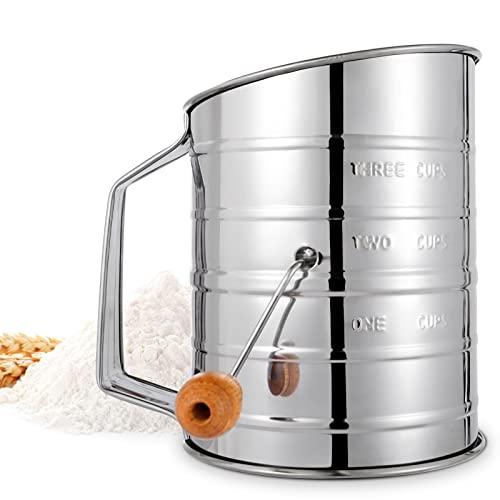
Norpro Norpro 3-Cup Stainless Steel Rotary Hand-Crank Flour Sifter
Norpro 3-Cup Stainless Steel Rotary Hand-Crank Flour Sifter

The sifter to buy if you buy one. A 3-cup stainless body with a side crank and twin wire agitators, which is the combination that actually keeps moving when flour is slightly damp — the failure mode that makes people give up on sifters and go back to a sieve and a spoon.

Most bakers, most recipes
7.9
$17.74Amazon
02
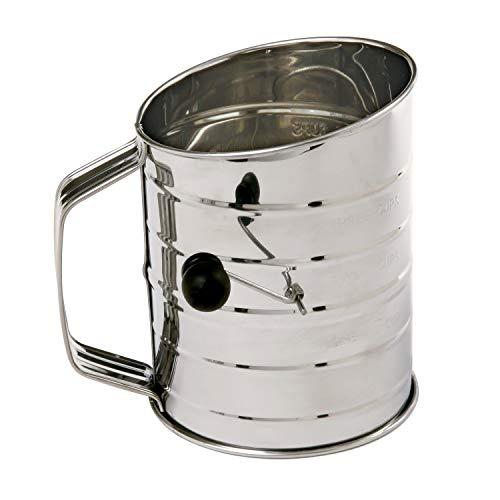
Bellemain Bellemain Stainless Steel 3-Cup Hand-Crank Flour Sifter
Bellemain Stainless Steel 3-Cup Hand-Crank Flour Sifter

The same 3-cup crank format as the Norpro with a double loop agitator and a published rust-resistant stainless build. It is the pick if you want a slightly finer sift on powdered sugar and cocoa rather than raw throughput on flour.

Powdered sugar and cocoa
7.6
$16.14Amazon
03
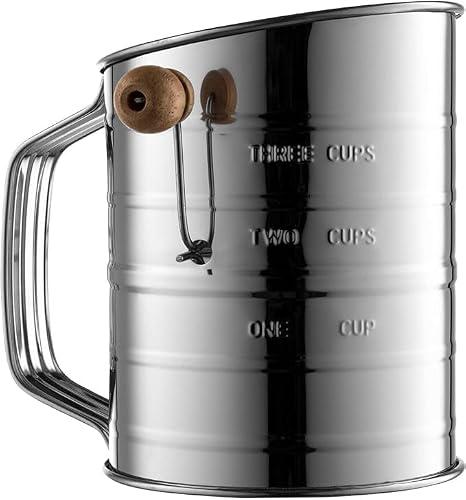
Norpro Norpro 8-Cup Stainless Steel Hand-Crank Flour Sifter
Norpro 8-Cup Stainless Steel Hand-Crank Flour Sifter

Nearly three times the capacity of a standard sifter in the same stainless hand-crank format. The pick for anyone who sifts for a crowd, mills their own flour, or is tired of filling a 3-cup sifter four times for one cake.

Big batches and home-milled flour
8.1
$26.27Amazon
04
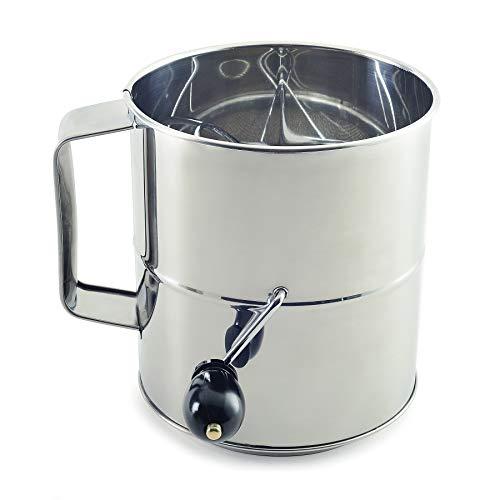
Toresano Toresano 3-Cup Stainless Steel Hand-Crank Flour Sifter
Toresano 3-Cup Stainless Steel Hand-Crank Flour Sifter

The cheapest stainless crank sifter we would actually put in a kitchen: 3 cups, fine mesh, a loop agitator and a published stainless body for about the price of two bags of flour. It is the budget pick, and the compromise is brand continuity rather than function.

The cheapest sifter worth owning
7.4
$12.49Amazon

#ad · Live prices from the Amazon Product API, as of November 22, 2026. Where we have no verified live price we show none — a gap beats a number that has rotted.

In detail

The picks, in full

01
Norpro Norpro 3-Cup Stainless Steel Rotary Hand-Crank Flour Sifter

Most bakers, most recipes

Norpro 3-Cup Stainless Steel Rotary Hand-Crank Flour Sifter

3-cup capacityStainless steelRotary side crankTwin wire agitatorsHand wash
7.9/10

The sifter to buy if you buy one. A 3-cup stainless body with a side crank and twin wire agitators, which is the combination that actually keeps moving when flour is slightly damp — the failure mode that makes people give up on sifters and go back to a sieve and a spoon.

Sifting throughput
8
Mechanism quality
8.5
Capacity
7
Cleaning
7
Value
9

Pros

  • Side crank turns with one hand, so the other hand stays on the bowl
  • Twin agitators sweep the full width of the screen instead of only the center
  • All-stainless body does not hold flour smell or stain the way painted tin does

Cons

  • 3 cups is one cake's worth of dry mix — a double batch means refilling
  • Hand wash only, like every crank sifter: the mechanism traps water and flour paste

Don't buy this if…

…you mill your own flour or sift several pounds at a time — the 8-cup version costs ten dollars more and saves you four refills.

$17.74View on Amazon

Price as of November 22, 2026. Prices change — Amazon's at checkout is the one that counts.

#ad · we may earn a commission from this link to Norpro 3-Cup Stainless Steel Rotary Hand-Crank Flour Sifter

02
Bellemain Bellemain Stainless Steel 3-Cup Hand-Crank Flour Sifter

Powdered sugar and cocoa

Bellemain Stainless Steel 3-Cup Hand-Crank Flour Sifter

3-cup capacityStainless steelHand crankDouble loop agitatorFine mesh screen
7.6/10

The same 3-cup crank format as the Norpro with a double loop agitator and a published rust-resistant stainless build. It is the pick if you want a slightly finer sift on powdered sugar and cocoa rather than raw throughput on flour.

Sifting throughput
7.5
Mechanism quality
8
Capacity
7
Cleaning
7
Value
8.5

Pros

  • Double loop agitator pushes fine powders through without packing them against the mesh
  • Published as rust resistant, which matters on a tool that gets damp and air-dries
  • Crank handle is the full width of the body, so it does not flex under load

Cons

  • Fine mesh is slower than the Norpro on ordinary all-purpose flour
  • 3-cup body, same refill problem as every sifter this size

Don't buy this if…

…your main job is aerating bread flour by the pound — a coarser screen moves it faster.

$16.14View on Amazon

$18.9915% off

Price as of November 22, 2026. Prices change — Amazon's at checkout is the one that counts.

#ad · we may earn a commission from this link to Bellemain Stainless Steel 3-Cup Hand-Crank Flour Sifter

03
Norpro Norpro 8-Cup Stainless Steel Hand-Crank Flour Sifter

Big batches and home-milled flour

Norpro 8-Cup Stainless Steel Hand-Crank Flour Sifter

8-cup capacityStainless steelHand crankHand wash
8.1/10

Nearly three times the capacity of a standard sifter in the same stainless hand-crank format. The pick for anyone who sifts for a crowd, mills their own flour, or is tired of filling a 3-cup sifter four times for one cake.

Sifting throughput
8.5
Mechanism quality
8
Capacity
9.5
Cleaning
6.5
Value
8

Pros

  • 8 cups holds the dry side of most layer-cake and cookie recipes in one load
  • Same stainless construction and crank mechanism as the 3-cup, just scaled up
  • Wide mouth makes it easier to fill from a scale bowl without spilling

Cons

  • Heavy and awkward in one hand once it is full of flour
  • Takes real cupboard space for a tool most people use occasionally

Don't buy this if…

…you sift once a month for one cake — the 3-cup is cheaper, lighter and easier to store.

$26.27View on Amazon

$28.167% off

Price as of November 22, 2026. Prices change — Amazon's at checkout is the one that counts.

#ad · we may earn a commission from this link to Norpro 8-Cup Stainless Steel Hand-Crank Flour Sifter

04
Toresano Toresano 3-Cup Stainless Steel Hand-Crank Flour Sifter

The cheapest sifter worth owning

Toresano 3-Cup Stainless Steel Hand-Crank Flour Sifter

3-cup capacityStainless steelHand crankLoop agitatorFine mesh screen
7.4/10

The cheapest stainless crank sifter we would actually put in a kitchen: 3 cups, fine mesh, a loop agitator and a published stainless body for about the price of two bags of flour. It is the budget pick, and the compromise is brand continuity rather than function.

Sifting throughput
7
Mechanism quality
6.5
Capacity
7
Cleaning
7
Value
9.5

Pros

  • Costs less than every named-brand crank sifter and still has a stainless body and a real mechanism
  • Fine mesh handles powdered sugar as well as flour
  • Light enough to use one-handed over a bowl

Cons

  • Single loop agitator does less work per turn than the Norpro's twin wires
  • No catalog history behind the brand, so there is no spare-parts or replacement story

Don't buy this if…

…you want a tool you can still buy a replacement for in five years — Norpro has published this sifter format for decades.

$12.49View on Amazon

Price as of November 22, 2026. Prices change — Amazon's at checkout is the one that counts.

#ad · we may earn a commission from this link to Toresano 3-Cup Stainless Steel Hand-Crank Flour Sifter

How to choose and use a flour sifter

Buy a crank, buy stainless, buy three cups

For almost everyone that is the answer: a 3-cup stainless rotary crank sifter, about the price of two bags of good flour. Go to 8 cups only if you mill your own flour or bake in double batches, and skip the squeeze handles and the battery models entirely.

Sift onto parchment, not straight into the bowl

Sift your dry ingredients onto a sheet of parchment or a silicone mat, then lift the sheet and pour them in. It is faster than holding a sifter over a bowl, you can see whether anything failed to break up, and nothing lands on the worktop. It also means you can sift before you weigh the wet ingredients, rather than juggling both.

Weigh first, sift second

If the recipe says “1 cup sifted flour” it means sift, then measure, and the result is roughly 115 grams rather than the 125 grams a scooped cup gives you. That 10-gram gap is a real difference in a cake. The fix that removes the ambiguity is to weigh the flour, then sift the weighed flour — the weight does not change, and you get the lump-breaking without the measurement confusion. Our weight-measuring guide has the conversions.

Never wash a crank sifter

Water plus flour inside a mechanism makes paste, the paste dries, and the agitator seizes. Tap the sifter out over the bin, brush the screen with a dry pastry brush, and store it dry. If something genuinely sticky went through it, wash it, then dry it in a 200°F oven with the door ajar until there is no moisture anywhere in the mechanism. This is why none of these four is dishwasher safe and why we have not scored any of them highly on cleaning.

Store it in a bag

A sifter in an open drawer collects dust and crumbs on the screen, and the screen is the part that touches your flour. A zip bag or a lidded container keeps it clean and stops the crank snagging on everything else. The same advice applies to measuring cups and spoons.

Sift cocoa and powdered sugar every time, flour only when told

Cocoa and powdered sugar clump as a matter of physics — they are fine, fatty or hygroscopic powders and they set in the box. Sift those whenever they appear in a recipe. Modern all-purpose flour is pre-sifted at the mill and does not need it unless the recipe is a delicate one (angel food, chiffon, macaron shells) or the flour has been sitting in a humid cupboard. Our flour storage guide covers keeping it dry in the first place.
How we picked

We don't run a testing lab

We read the manuals, compiled the published specifications, did the wattage-to-dough math and weighed aggregated owner reviews, then scored each product against a published rubric. The scores are judgments from documented research — they are not measurements we took, because we do not have a lab and we're not going to pretend we do. Every spec is the manufacturer's published figure, cited in Sources.

Questions

Frequently asked

Do I really need a flour sifter?
Not for flour, most of the time - modern all-purpose flour is sifted at the mill and a whisk through the bowl breaks up what little compaction remains. You need one for cocoa, powdered sugar and cake flour, which clump as a matter of physics, and for home-milled flour, where sifting is how you control the bran. If you own a fine-mesh sieve you can do all of that with the sieve and a spoon; a crank sifter is faster, less messy and easier on your hand.
What size flour sifter should I buy?
Three cups for ordinary home baking - it holds the dry side of a single cake or a batch of cookies, and it is light enough to work one-handed over a bowl. Go to eight cups if you mill your own flour, bake double batches, or find yourself refilling a small sifter three times for one recipe. The 8-cup is the same mechanism and about ten dollars more; the cost is weight and cupboard space.
Can you put a flour sifter in the dishwasher?
No, and this applies to all four picks here. Water gets into the crank mechanism, mixes with residual flour into paste, dries, and seizes the agitator. Tap it out, brush the screen dry, and store it in a bag. If something sticky went through and you have to wash it, dry it thoroughly in a low oven with the door ajar before you put it away.
Is a sifter or a fine-mesh sieve better?
A sieve is more versatile and dishwasher safe; a crank sifter is faster and tidier at the one job. A sieve also goes finer, which is why pastry kitchens use a tamis for the most delicate work. The practical answer: if you already own a fine-mesh sieve and sift twice a year, you do not need a sifter. If you bake with cocoa and powdered sugar regularly, a crank sifter is about fifteen dollars and it is the difference between sifting and deciding not to bother.
Does sifting flour change how much goes in the recipe?
Yes, if you measure by volume. A cup of flour sifted before measuring weighs roughly 115 grams; a cup scooped straight from the bag weighs about 125 grams, and a packed cup more than that. “1 cup sifted flour” means sift then measure; “1 cup flour, sifted” means measure then sift. The way out of that ambiguity is a scale — see measuring flour by weight — after which sifting is only about lumps and aeration, not quantity.

Keep reading

More in this category

More baking gear

All baking gear →

Receipts

Sources

We don't run a testing lab, and we don't pretend to. Specs are the manufacturer's published figures, cited above; scores are our judgments from that research. Where we couldn't verify something, we say so on the page rather than quietly leaving it out. Read our full method.