Skip to content
Plug & Prep

Hub 04 · Baking Gear · Baking Gear

The best Dutch ovens under $100

A hundred dollars is already more than enough for the vessel that makes bakery-crust bread at home. Everything above this band buys looks, colour range and a longer warranty - not a better loaf.

By Stephen V.Updated How we pick
#ad

We earn a commission when you buy through our Amazon links, at no extra cost to you. It never changes our rankings, and we say so when the cheaper product is the better buy. How this works.

Buy the Lodge Essential Enamel 6-quart. It is enamelled cast iron at the diameter a standard boule actually wants, it needs no seasoning, and at our last price refresh it sat comfortably inside this band — the table above carries the live number and its as-of date. The budget pick is the Lodge Combo Cooker, and it is also the one we would recommend to a nervous baker: its shallow skillet becomes the base, so you lower the dough onto an open pan instead of dropping it into a deep, 500°F well, and the deep half inverts on top as the lid. If you bake bigger or wetter doughs, the Tramontina Bestow 6.5-quart is the roomiest vessel in the band and the Lodge Essential Enamel 7.5-quart is the one with real headroom for a 1200-gram dough.

The point of the band is that it is not a compromise. The reason a Dutch oven makes bakery bread is physics that cast iron of any price does equally well: a heavy, preheated vessel with a tight lid traps the dough's own steam for the first twenty minutes, which keeps the crust soft while the loaf springs, then you take the lid off and the dry heat sets a thin, glassy, blistered crust. Nothing in that chain is improved by spending three hundred dollars. Our Le Creuset alternatives page makes the same argument from the other direction.

What the band buys, and what it does not

What you get under $100: enamelled cast iron, 5 to 7.5 quarts, a lid that fits, oven ratings high enough for bread, and in Lodge's case an American foundry with a century of catalogue continuity behind it. That is the complete specification for a bread vessel.

What you do not get: the colour range and the showroom finish of a premium French pot, a lifetime warranty rather than a limited one, lids with self-basting rings, and the resale value. Also, generally, a slightly rougher interior enamel and a wider tolerance on how well the lid seats — neither of which changes the loaf.

The one real functional thing you give up is the very high oven ratings some premium and purpose-built vessels publish. If you bake at 500°F or above routinely, read the published figure for whatever you buy and respect it, and note that bare cast iron like the Combo Cooker has no enamel to craze at all — which is exactly why it is the vessel many high-heat bakers end up using. We go into that in enamelled vs bare cast iron for bread.

Size: diameter, not just volume

The number on the box is volume, and volume is the wrong number to shop on. What decides whether your loaf comes out round or flat is interior diameter.

A standard home loaf of 800 to 1000 grams of dough wants a vessel roughly 9 to 10 inches across, which is where a 5 to 6-quart round lands. Too wide and the dough relaxes outward during the first minutes instead of springing up, giving a flat, wide loaf. Too narrow and the loaf hits the walls and takes the shape of the pot. Our what size Dutch oven for bread guide has the dough-weight-to-diameter table.

That is why the 6-quart Lodge ranks above the 7.5-quart on this page even though the bigger one costs only a little more: for one standard loaf, the 6-quart is the better shape, and the 7.5 is the right buy only if your doughs are genuinely bigger. Going up a size “to be safe” costs you oven spring.

The three shapes in this band

The round enamelled Dutch oven — both Lodges and the Tramontina. The default, and the most useful pot in the kitchen when it is not baking bread: braises, stews, stock, frying. Its one drawback for bread is that you are lowering a slack, proved dough into a deep, extremely hot well, and the walls are close to your knuckles.

The combo cooker — a shallow skillet plus a deep lid, both bare cast iron, which inverts the problem: the dough goes onto an open, flat surface and the deep half goes over the top. Easier and safer to load, no enamel to chip, and it is two pans. The trade-offs are that bare iron needs its seasoning maintained, 3.2 quarts means a smaller loaf, and it is a less good braiser. We compare the two directly in Lodge Combo Cooker vs Dutch oven.

The oval. Not represented here, deliberately. An oval suits a batard, and almost every home recipe makes a round boule. If you bake batards, consider one — but not as your only vessel.

What sits above the band

For completeness, since the question is always “what am I missing?”. Two vessels in our registry sit well above $100: the Challenger Bread Pan, a purpose-built shallow cast iron pan with a bail-handled lid that is genuinely the easiest high-heat loading experience in the category, and the Le Creuset Signature round, which is a beautiful pot. Neither makes a better loaf than the Lodge 6-quart. One makes loading easier; the other makes a nicer kitchen. Both are covered in our full Dutch oven roundup and in Lodge vs Le Creuset.

The short answer

Quick picks

#ProductBest forScorePrice
01
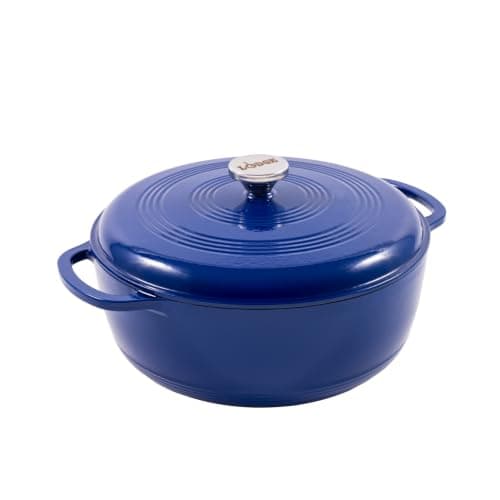
Lodge Lodge Essential Enamel Cast Iron Dutch Oven, 6 Quart
Lodge Essential Enamel Cast Iron Dutch Oven, 6 Quart

The sweet spot for bread. Six quarts is the volume a standard 500 g boule wants, the published 500°F ceiling clears the temperature most no-knead recipes ask for, and the enamel means you skip seasoning entirely. It costs a fraction of a French-made pot and bakes a functionally identical loaf.

Most sourdough and no-knead bakers
8.8
$74.99Amazon
02
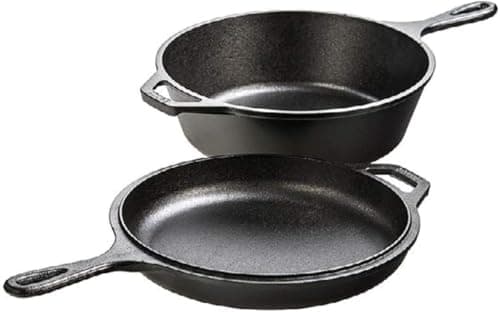
Lodge Lodge Cast Iron Combo Cooker, 3.2 Quart
Lodge Cast Iron Combo Cooker, 3.2 Quart

The bread baker's cult pick, and for a real reason: the shallow skillet becomes the base and the deep pot inverts over it as a lid, so you load a proofed round onto a flat surface at counter height instead of dropping it blind into a deep, 450°F well. Bare cast iron, so there is no enamel to chip.

Loading dough without burning your knuckles
8.8
$59.90Amazon
03
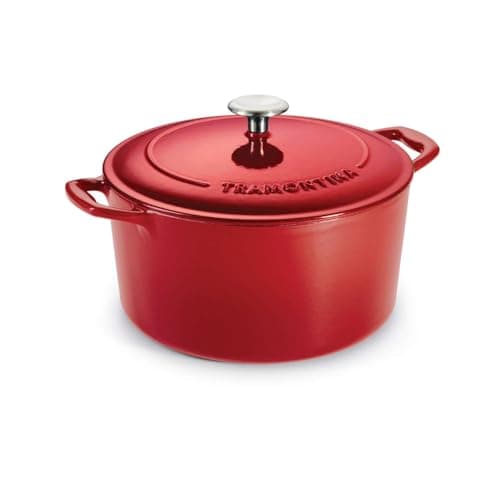
Tramontina Tramontina Bestow Enameled Cast Iron 6.5-Qt Round Dutch Oven
Tramontina Bestow Enameled Cast Iron 6.5-Qt Round Dutch Oven

The cheapest enameled pot here that still comes from a real cookware company with a published spec sheet. You get 6.5 quarts of enameled cast iron and a PTFE-free porcelain interior for roughly what a nice sheet pan costs. The one catch is a real one: Tramontina rates it to 450°F, not 500°F.

A first Dutch oven on a tight budget
8.2
$71.99Amazon
04
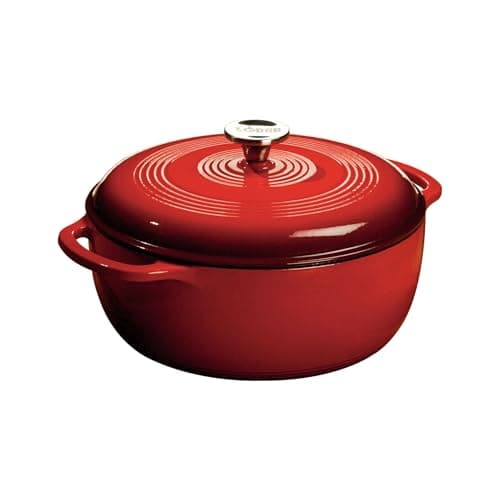
Lodge Lodge Essential Enamel Cast Iron Dutch Oven, 7.5 Quart
Lodge Essential Enamel Cast Iron Dutch Oven, 7.5 Quart

The same pot as our top pick with another quart and a half of headroom — the one to buy if you bake 1 kg loaves or want a pot that doubles as the family braiser. The extra volume is not free: a small loaf in a big pot spreads out rather than climbing, so this is the wrong buy if your loaves are modest.

Large loaves and double-duty braising
8.3
$83.99Amazon

#ad · Live prices from the Amazon Product API, as of November 22, 2026. Where we have no verified live price we show none — a gap beats a number that has rotted.

In detail

The picks, in full

01
Lodge Lodge Essential Enamel Cast Iron Dutch Oven, 6 Quart

Most sourdough and no-knead bakers

Lodge Essential Enamel Cast Iron Dutch Oven, 6 Quart

6-qt capacityEnameled cast iron500°F oven-safeStainless knobInduction ready
8.8/10

The sweet spot for bread. Six quarts is the volume a standard 500 g boule wants, the published 500°F ceiling clears the temperature most no-knead recipes ask for, and the enamel means you skip seasoning entirely. It costs a fraction of a French-made pot and bakes a functionally identical loaf.

Crust & steam
9
Build quality
8.5
Ease of use
8.5
Versatility
9
Value
9

Pros

  • 6-qt round shape gives a standard boule room to spring without spreading into a pancake
  • Published 500°F ceiling covers the preheat most no-knead and sourdough recipes specify
  • Enamel needs no seasoning and will not take on a garlic-and-stew flavor from other cooking

Cons

  • Enamel chips if you knock it or drop a lid on the rim, and a chipped interior cannot be repaired
  • No silicone grip — the loop handles get screaming hot and need two dry mitts
  • Heavier than it looks; lowering it into a low oven is awkward if you have weak wrists

Don't buy this if…

…your recipe preheats the vessel past 500°F — bare cast iron, not enamel, is the tool for a 550°F bake.

$74.99View on Amazon

$89.9017% off

Price as of November 22, 2026. Prices change — Amazon's at checkout is the one that counts.

#ad · we may earn a commission from this link to Lodge Essential Enamel Cast Iron Dutch Oven, 6 Quart

02
Lodge Lodge Cast Iron Combo Cooker, 3.2 Quart

Loading dough without burning your knuckles

Lodge Cast Iron Combo Cooker, 3.2 Quart

3.2-qt deep pot10.25 in skillet lidBare seasoned cast ironMade in USA12.85 lb
8.8/10

The bread baker's cult pick, and for a real reason: the shallow skillet becomes the base and the deep pot inverts over it as a lid, so you load a proofed round onto a flat surface at counter height instead of dropping it blind into a deep, 450°F well. Bare cast iron, so there is no enamel to chip.

Crust & steam
9
Build quality
9
Ease of use
9
Versatility
8
Value
9

Pros

  • Load the loaf onto the flat skillet, then cap it — far safer and more accurate than lowering dough into a deep pot
  • No enamel means nothing that can chip, and bare cast iron is not limited by an enamel temperature rating
  • Two pans in one: the skillet sears and bakes cornbread, the pot handles braises and soup

Cons

  • Needs seasoning maintenance — Lodge's own instruction is hand wash, dry, oil, every time
  • 3.2 qt suits one modest boule; a big 1 kg loaf will touch the sides
  • Bare cast iron will take on and give back strong flavors if you also braise in it

Don't buy this if…

…you want a zero-maintenance pot you can leave wet in the sink — this one rusts if you do, and enamel is the answer instead.

$59.90View on Amazon

Price as of November 22, 2026. Prices change — Amazon's at checkout is the one that counts.

#ad · we may earn a commission from this link to Lodge Cast Iron Combo Cooker, 3.2 Quart

03
Tramontina Tramontina Bestow Enameled Cast Iron 6.5-Qt Round Dutch Oven

A first Dutch oven on a tight budget

Tramontina Bestow Enameled Cast Iron 6.5-Qt Round Dutch Oven

6.5-qt capacityEnameled cast iron450°F oven-safePTFE/PFOA-free enamelInduction ready
8.2/10

The cheapest enameled pot here that still comes from a real cookware company with a published spec sheet. You get 6.5 quarts of enameled cast iron and a PTFE-free porcelain interior for roughly what a nice sheet pan costs. The one catch is a real one: Tramontina rates it to 450°F, not 500°F.

Crust & steam
7.5
Build quality
7.5
Ease of use
8.5
Versatility
8.5
Value
9

Pros

  • Usually the lowest-priced enameled pot on this page from a brand that actually publishes specifications
  • 6.5 qt is generous — more headroom for a big loaf than the 6-qt Lodge
  • Off-white porcelain enamel interior is made without PTFE or PFOA and shows you how browning is going

Cons

  • Rated to 450°F, which is below the 475-500°F preheat many no-knead recipes call for
  • Enamel on budget cast iron is typically thinner and chips more readily than Lodge's or Le Creuset's
  • Tramontina's own listings disagree on dishwasher safety, so treat it as hand-wash to be safe

Don't buy this if…

…your recipe preheats to 475°F or above — buy the Lodge, which publishes a 500°F ceiling, rather than exceeding this pot's rating.

$71.99View on Amazon

Price as of November 22, 2026. Prices change — Amazon's at checkout is the one that counts.

#ad · we may earn a commission from this link to Tramontina Bestow Enameled Cast Iron 6.5-Qt Round Dutch Oven

04
Lodge Lodge Essential Enamel Cast Iron Dutch Oven, 7.5 Quart

Large loaves and double-duty braising

Lodge Essential Enamel Cast Iron Dutch Oven, 7.5 Quart

7.5-qt capacityEnameled cast iron500°F oven-safeStainless knobInduction ready
8.3/10

The same pot as our top pick with another quart and a half of headroom — the one to buy if you bake 1 kg loaves or want a pot that doubles as the family braiser. The extra volume is not free: a small loaf in a big pot spreads out rather than climbing, so this is the wrong buy if your loaves are modest.

Crust & steam
8
Build quality
8.5
Ease of use
7.5
Versatility
9
Value
8.5

Pros

  • 7.5 qt comfortably takes a 1 kg loaf without the dough touching the walls
  • Same published 500°F ceiling and stainless knob as the 6-qt version
  • Big enough to be the household's main braising pot, so it earns its shelf space twice

Cons

  • A small boule spreads sideways in a pot this wide instead of springing upward
  • Noticeably heavier than the 6-qt — a real consideration lifting it in and out of a hot oven
  • Takes longer to come up to temperature, so preheats stretch out

Don't buy this if…

…you bake standard 500 g boules — the 6-qt gives those loaves tighter walls to climb, which means a taller loaf.

$83.99View on Amazon

$99.9016% off

Price as of November 22, 2026. Prices change — Amazon's at checkout is the one that counts.

#ad · we may earn a commission from this link to Lodge Essential Enamel Cast Iron Dutch Oven, 7.5 Quart

How to buy and use a sub-$100 bread vessel

Shop diameter first, then price

Nine to ten inches of interior diameter for a standard 800 to 1000-gram dough. Within this band that means a 6-quart round, or the Combo Cooker for a smaller loaf. Only go to 7.5 quarts if you know your doughs are bigger, because a vessel that is too wide gives a flat loaf.

Preheat the vessel empty, and preheat it properly

The whole mechanism depends on thermal mass, so the pot has to be as hot as the oven. Put it in cold, bring it up with the oven, and give it a further 30 to 45 minutes at temperature after the oven says it is ready. A thermostat tells you about the air, not about three kilograms of iron — an oven thermometer is the cheap way to know what is actually happening in there.

Respect the published temperature ceiling

Enamel crazes and can chip if you exceed what the maker publishes, and the published figures in this band are lower than the 500°F-plus some sourdough recipes assume. Read the number for the pot you buy and bake at or under it; a loaf baked at 450°F for slightly longer is a fine loaf. Bare cast iron has no enamel to damage, which is the Combo Cooker's structural advantage at high heat.

Load on parchment, or use the combo cooker upside down

A sling of parchment under the dough lets you lower it in without touching the walls, and it lifts the loaf out afterwards. The alternative is the Combo Cooker method: dough onto the shallow pan, deep half on top as a lid. Either way, keep a long oven glove on both hands — the lid is the thing people burn themselves on.

Lid on for the spring, off for the crust

Twenty minutes covered, then uncover for the rest. Covered, the dough's own moisture keeps the surface pliable so the loaf can expand; uncovered, dry heat dehydrates that surface into a thin, blistered crust. Taking the lid off too early costs you volume; leaving it on costs you crust.

Do not thermal-shock it, do not scour it

Never put a 450°F pot under cold water — that is how enamel crazes and how cast iron cracks. Let it cool on the stove, then wash with warm water and a soft brush. No wire wool on enamel. For bare iron, hot water, a stiff brush, dry on the hob and a wipe of oil, which is the whole seasoning routine and takes a minute.
How we picked

We don't run a testing lab

We read the manuals, compiled the published specifications, did the wattage-to-dough math and weighed aggregated owner reviews, then scored each product against a published rubric. The scores are judgments from documented research — they are not measurements we took, because we do not have a lab and we're not going to pretend we do. Every spec is the manufacturer's published figure, cited in Sources.

Questions

Frequently asked

Do you need to spend more than $100 on a Dutch oven for bread?
No. The mechanism that makes Dutch oven bread work - a heavy preheated vessel with a tight lid trapping the dough's own steam, then dry heat to set the crust - is delivered identically by cast iron at any price. What more money buys is colour range, finish, a longer warranty, self-basting lid rings and resale value. The one thing worth checking before you economise is the published oven temperature ceiling, because premium and purpose-built vessels sometimes publish higher ones.
What size Dutch oven is best for one loaf of sourdough?
Around 9 to 10 inches of interior diameter, which is a 5 to 6-quart round, for a dough of 800 to 1000 grams. Shop diameter rather than volume: too wide and the dough spreads sideways in the first minutes instead of springing up, which gives a flat loaf. Going bigger to be safe is the most common mistake in this purchase.
Is a combo cooker better than a Dutch oven for bread?
Easier and safer to load, and better at very high heat. The shallow skillet is the base, so the dough goes onto an open flat surface rather than being lowered into a deep 500F well, and bare cast iron has no enamel to craze. The trade-offs are that it holds a smaller loaf, the seasoning needs maintaining, and it is a worse braising pot. For bread alone it is arguably the best buy in this band; as a one-pot-does-everything purchase, the enamelled round wins.
Will a cheap enamelled Dutch oven chip?
It can, and the two causes are thermal shock and metal utensils. Never put a hot pot into cold water or onto a wet surface, let it cool on the hob before washing, and use wood or silicone inside it. Chips on the outside rim are cosmetic; a chip on the cooking surface exposes bare iron, which will rust and should then be kept oiled or retired to non-acidic cooking. This is a handling issue far more than a price issue.
Can you use a Dutch oven lid as the base instead?
With a combo cooker, yes — that is the design. With a standard enamelled Dutch oven, no: the lid is shallow, usually has a knob that will not sit flat, and is not made to take the thermal load as a baking surface. If the deep-well loading worries you, either use a parchment sling or buy the Combo Cooker, which solves it properly. Our Combo Cooker vs Dutch oven comparison goes through both methods.

Keep reading

More in this category

More baking gear

All baking gear →

Receipts

Sources

We don't run a testing lab, and we don't pretend to. Specs are the manufacturer's published figures, cited above; scores are our judgments from that research. Where we couldn't verify something, we say so on the page rather than quietly leaving it out. Read our full method.