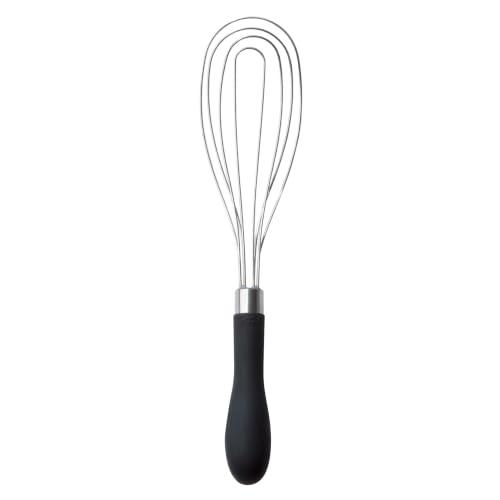
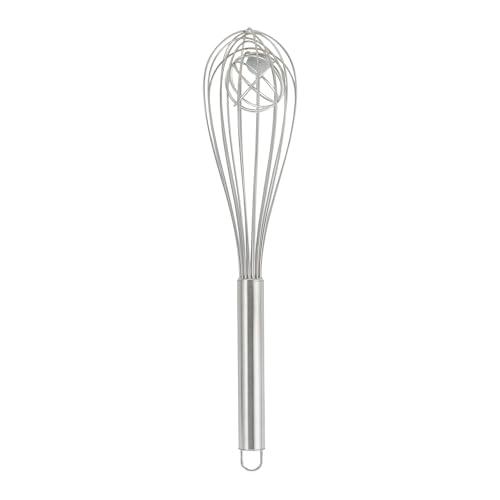
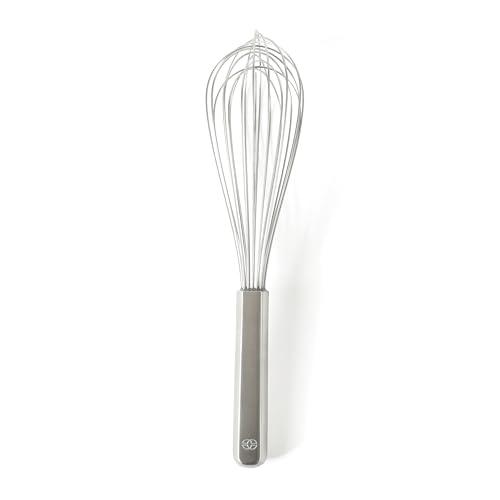
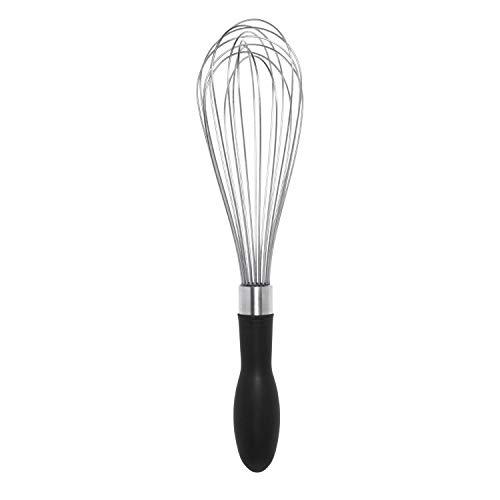
Buy the OXO Good Grips 11-inch balloon whisk. It has the widest head here, which means the most air moved per stroke, and it has the one feature that actually decides whether you finish whipping cream by hand: a soft non-slip handle. It is also dishwasher safe, which the wood-handled whisks at this price are not. If the job is roux, pastry cream or pan sauce, buy the OXO flat whisk instead — a balloon head skates over the top of a shallow pan and leaves the custard scorching in the corner. For meringue and whipped cream by hand, the Mrs. Anderson's double balloon with an aerator ball is a genuine specialist and costs less than the plain OXO. The budget pick is the Calphalon Prime 8-inch balloon — under ten dollars, from a brand with a real cookware catalogue, and the right size for the small-bowl work most whisking actually is.
Shape is the spec
There are three whisk shapes worth owning and they are not interchangeable.
A balloon whisk is a wide, round cage of thin wires. Its job is incorporating air: egg whites, cream, a sabayon, anything where the volume is the point. The wide cage also makes it the best tool for combining dry ingredients in a bowl, which is the job that replaces a sifter for ordinary flour. It is bad in a pan, because the round cage touches the floor of a saucepan at one point.
A flat whisk — sometimes a roux whisk — is a single rank of wires bent into a flat paddle. Its job is contact with a flat surface: roux, gravy, lemon curd, pastry cream, anything you cook and stir in a shallow pan where the mixture catches on the bottom edge. It moves very little air, so it is the wrong whisk for meringue.
A dough whisk — the Danish hook, which we rank separately in our Danish dough whisk review and argue about in is a dough whisk worth it — is a stiff flat coil for wet bread dough, where a wire whisk clogs instantly.
If you buy one whisk, buy a balloon. If you cook as well as bake, the flat whisk is the second one, and it is the one most kitchens are missing.
The criteria
1. The handle, which is the part that fails. Whisking cream to soft peaks by hand takes three to five minutes of continuous work. A bare round metal handle gets slippery, concentrates pressure in your palm and makes that a miserable five minutes; a soft, flattened, non-slip handle makes it a chore you will actually do. This is the reason both OXO whisks rank above cheaper metal-handled alternatives, and it is the single thing we would spend money on in this category.
2. Wire count and stiffness. More and thinner wires move more air; fewer and thicker wires push heavier mixtures without collapsing. A whisk that splays apart when you lean on a thick batter is a whisk with too-thin wires for the job, which is why we have not ranked the very cheapest unbranded balloon whisks even though they look identical in a photograph.
3. Length, matched to your bowls. An 11 or 12-inch whisk in a 1-quart bowl bangs the sides and throws batter; an 8-inch whisk in a big mixing bowl takes twice as many strokes. Most kitchens want one long whisk and one short one, which is exactly what the OXO balloon and the Calphalon 8-inch are doing on this page.
4. Whether it can go in the dishwasher. Both OXO whisks are published dishwasher safe. The Mrs. Anderson's double balloon, with its loose aerator ball and two nested cages, is the opposite: it traps batter where you cannot reach and needs real attention at the sink. That is the trade for its one genuine advantage.
When a whisk is the wrong tool
Honestly, often. A whisk is the right tool up to about two egg whites or a cup of cream. Past that, or for creaming butter and sugar, your arm is the bottleneck and a hand mixer does in forty seconds what the whisk does in five minutes — we compare them directly in hand mixer vs whisk. For a full batch of meringue or a bread dough, you want a stand mixer; see whipping egg whites in a stand mixer for the technique.
What a whisk keeps is everything small and everything where washing a mixer is more work than the job: two eggs for an egg wash, a cornstarch slurry, dry ingredients in a bowl, a vinaigrette, the half cup of cream that goes on one slice of pie. That is most days.
How to choose and use a wire whisk
Buy a balloon first, a flat whisk second
An 11 or 12-inch balloon whisk with a soft handle covers aerating and combining. A flat whisk covers everything that happens in a pan. Those two, bought once, are the whole category for a home kitchen; the aerator-ball whisk is a third purchase for someone who makes meringue by hand and knows it.
Whisk with your wrist, not your shoulder
The efficient motion is a fast, loose wrist in a tight circle or a side-to-side figure eight, with the whisk head staying in contact with the bowl. Big arm-driven stirring is slower, tires you out in a minute, and moves less air. Tip the bowl toward you so the mixture pools at the low edge and keep the whisk in the pool.
Use a bowl that matches the whisk
A deep, round-bottomed bowl is what a balloon whisk is designed for — the curve keeps the mixture under the wires. A wide flat-bottomed bowl leaves a dead zone in the corner that the cage never reaches. Stainless or glass both work; our glass vs stainless guide covers the difference, and the short version for whisking egg whites is that neither should be plastic, because plastic holds fat.
Start cold for cream, room temperature for whites
Cream whips because the fat is solid, so cold bowl, cold whisk, cold cream — fifteen minutes in the freezer for the bowl and whisk is a real help by hand. Egg whites are the opposite: they foam better at room temperature, and the one thing that will stop them foaming at all is a trace of fat or yolk. Our whipped cream guide has the stage-by-stage description.
Do not use a wire whisk on bread dough
It clogs within two turns and then you are picking dough out of a wire cage with a toothpick. Wet, slack dough wants a Danish dough whisk; proper kneading wants a dough hook or your hands.
Check the join where wires meet handle
That ferrule is where a whisk dies — water gets in, the glue or crimp lets go, and the wires loosen. Wash with the handle up rather than soaking the whisk bowl-down in a sink full of water, and dry it before it goes in the drawer. It is also why we would rather have a sealed moulded handle than a hollow metal tube with a crimped end.