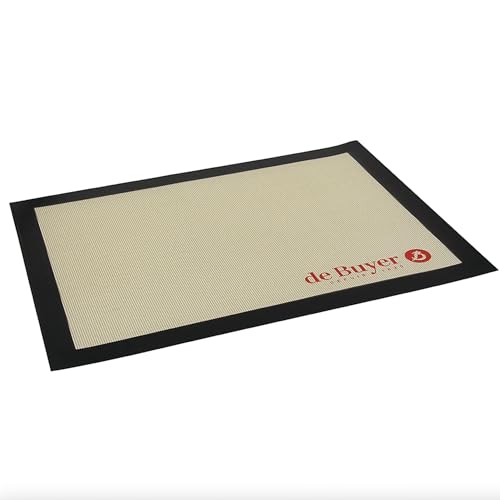
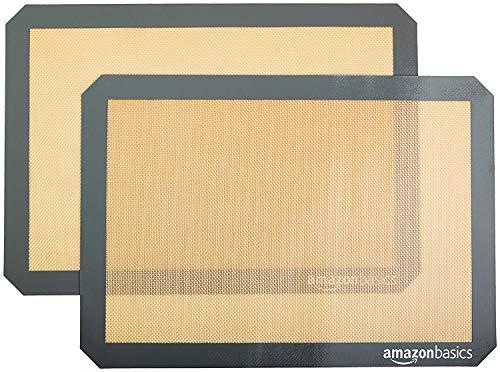
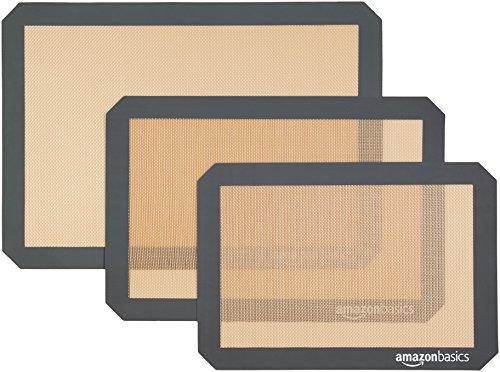
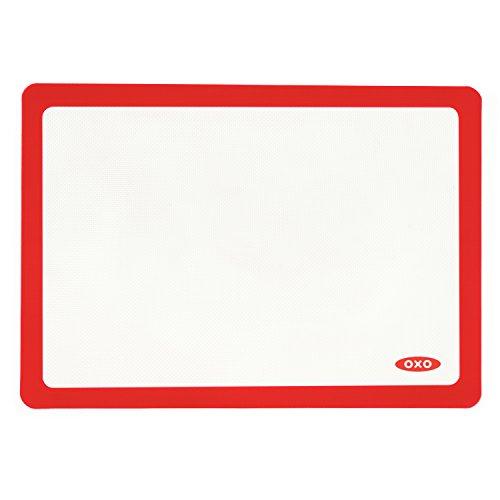
Buy the OXO Good Grips silicone baking mat if you want the nearest thing to a Silpat without the Silpat price: the same fibreglass-mesh-inside-silicone construction, a half-sheet fit, and a named brand with a published warranty behind it. If you bake laminated pastry or choux, the de Buyer AIRMAT is the one genuine upgrade here rather than a substitute — it is perforated, so steam vents from under the dough instead of sitting there and softening the base. The budget pick is the Amazon Basics 3-pack, which costs less than a quarter of a single Silpat and is the right answer if what you want is a nonstick surface on three sheet pans tonight. In between, the Amazon Basics 2-pack matches the two half sheets most kitchens own and Mrs. Anderson's is the single-mat option from a baking brand.
What a Silpat actually is
Worth being precise, because the name has become a generic term the way Thermos did.
Silpat is a product of Sasa Demarle, a French company that commercialised the fibreglass-mesh-reinforced silicone baking mat for professional kitchens. The mesh is the actual engineering: a woven glass-fibre scrim inside the silicone, which stops the mat stretching, curling and going floppy over hundreds of cycles, and which keeps it dimensionally stable so it still lies flat in year five.
That is what you are paying for. Not a better release — silicone is silicone, and everything on this page releases a cookie the same way. The premium is for longevity and flatness over time, plus the professional sizes (Silpat publishes a full-sheet size for commercial ovens, which is the one on this page) and a catalogue that will still exist in a decade.
So the honest framing of the alternatives question is: how much do you care about year five?
What you give up, and what you do not
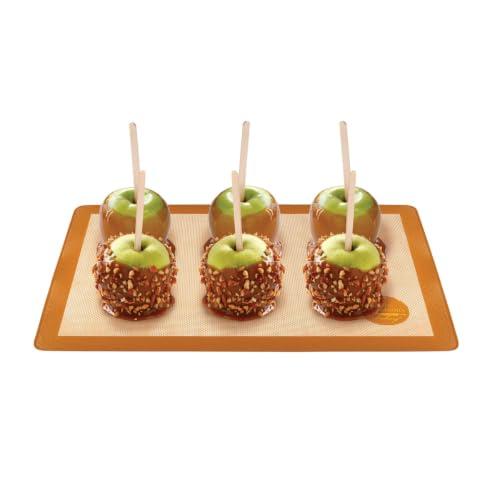
You do not give up release. Every mat here is silicone and every one of them releases cookies, meringue, caramel and toffee without greasing. If nonstick is the whole requirement, the cheapest mat on this page does the job.
You do not give up oven safety, within reason. Read the published figure for whatever you buy and stay under it — our silicone mat roundup lists the published ceilings side by side. None of these mats belongs under a broiler, and that includes the Silpat.
You do give up guaranteed flatness over time. Unreinforced or lightly reinforced mats develop a memory: a mat stored rolled stays curled, a mat that has been creased keeps the crease, and a curling corner lifts the edge of whatever you are baking. This is the real difference, it shows up after a year or two of regular use, and it is why a cheap mat is a consumable and a Silpat is equipment.
You may give up size options. Several cheap mats are sized for a “half sheet” that is not quite your half sheet. Measure your pan — our baking sheet sizing guide covers the standard dimensions — and buy to it, because a mat that is 2 millimetres too wide rides up the sides and a mat that is an inch too small leaves a bare strip that browns differently.
The case for the perforated mat
The de Buyer AIRMAT is the one pick here that is not trying to be a cheaper Silpat. It is perforated, and what the holes do is let steam out from underneath the dough.
On a solid mat — silicone or otherwise — the base of a pastry sits on an impermeable layer, and the moisture it releases has nowhere to go. For a cookie that does not matter. For a laminated dough, a choux shell or a tart base it does: you get a slightly pale, slightly soft bottom where the recipe wanted a crisp one. A perforated mat vents that moisture and lets the oven's dry heat touch the base.
The flip side is that anything thin and liquid runs through the perforations, so it is the wrong mat for tuiles, lace cookies, brittle or caramel. Which is a decent argument for owning one of each rather than choosing.
The honest third option: parchment
Worth saying plainly on a page about alternatives. For a lot of baking, the alternative to a Silpat is not a cheaper mat — it is a sheet of parchment paper, which costs pennies, releases just as well, can be cut to any pan, does not need washing or storing flat, and vents steam better than a solid mat because it is porous.
Silicone wins on repeat use, on sticky sugar work where parchment can wrinkle, and on consistency of browning for cookies — and it is reusable, which matters if you bake weekly. Parchment wins on convenience, on any pastry where you want a crisper base, and on anything you need to lift out of a pan. We put the two head to head in parchment paper vs silicone baking mats, and the real answer for most kitchens is both.
How to choose a Silpat alternative
Measure the pan before you buy the mat
A mat has to sit flat inside the rim of your pan with no part riding up the sides. Measure the internal base of your sheet pan and buy to that number, not to the words “half sheet”. If you are buying pans too, our baking sheet roundup gives the real dimensions.
Buy a multipack if you bake cookies
Cookie baking is a rotation: one tray in, one cooling, one being loaded. One mat makes you wait for the pan to cool and then wash and dry the mat between batches. Two or three cheap mats beat one expensive mat for this, which is the strongest practical argument against buying a single premium mat as your first purchase.
Store them flat or loosely rolled, never creased
This is the whole longevity question. A mat left creased keeps the crease; a mat stored tightly rolled for months develops a curl that lifts a cookie edge. Flat in a drawer, flat under a sheet pan, or rolled loosely in a tube. Reinforced mats resist this better, which is exactly what the Silpat premium buys.
Respect the published temperature, and never broil
Every mat here publishes a maximum; none of them is a broiler liner, and a mat under a broiler element will scorch and may fail. If you bake bread at very high temperatures, a mat is the wrong surface anyway — use a stone, a steel or a Dutch oven.
Wash with hot soapy water, not abrasives
Hot water, a drop of detergent, a soft cloth. Scouring pads scratch the silicone and give grease somewhere to sit, which is how a mat develops that permanent tacky film. If a mat does go tacky, a hot soak with a little bicarbonate and then a proper rinse usually recovers it; baking a tacky mat empty does not.
Keep the perforated mat for pastry only
If you buy the AIRMAT, label it or keep it separate. Pour a thin caramel or a lace-cookie batter onto it and it will go through the holes onto the pan, which is a genuinely annoying clean-up and not the mat's fault.