Skip to content
Plug & Prep

Hub 04 · Baking Gear · Baking Gear

The best bread lames and scoring tools

The blade in every one of these tools is the same cheap double-edge razor. What you are actually buying is a handle that holds it at an angle you chose, keeps your fingers off it, and does not need babying afterwards.

By Stephen V.Updated How we pick
#ad

We earn a commission when you buy through our Amazon links, at no extra cost to you. It never changes our rankings, and we say so when the cheaper product is the better buy. How this works.

Buy the Baker of Seville. It is the one lame on this page that publishes a way to change the blade's angle: a thumb screw clamps a standard double-edge razor blade either flat or bowed into a curve, so a single tool cuts the straight slash a baguette wants and the curved undercut that lifts an ear on a sourdough boule. It is machined stainless with no wood and no leather, and the maker publishes it as dishwasher safe. If what you score is patterns and straight slashes, you do not need any of that: the budget pick is the Saint Germain SGW-500, a wood-handled lame with ten blades and a leather cover for a fraction of the price, and it cuts a flat score identically. In between, the Fox Run 5197 is the beechwood-handled classic and ships with fifteen blades, and the Breadtopia lame is the plain plastic-resin workhorse from a sourdough supplier that sells replacement blades for about a dollar.

The blade is not the product

This is the thing to understand before you spend anything.

A lame — French for “blade”, pronounced lahm— is a handle that holds a standard double-edge safety razor blade. Baker of Seville publishes that its tool “accept[s] standard double edge blades”; Breadtopia publishes that its lame “uses inexpensive replaceable double edge blades”; Saint Germain publishes that “blades are easily replaceable with standard razor blades”. In other words, every tool on this page cuts with the same mass-produced consumable you can buy a hundred of for the price of a coffee.

That has two consequences, and they decide the whole purchase. First, none of these tools cuts better than another once the blade is in. A fresh razor blade is a fresh razor blade. Second, everything you are paying for is the handle: how it holds the blade, whether it lets you set an angle, how safe it is to pick up, and what it needs from you afterwards.

So the useful question is not “which lame is sharpest”. It is: do I need a curve, and how much handling do I want to do?

Curved or straight is the one real spec in this category

Bakers argue about scoring patterns. The mechanical difference that actually changes the loaf is whether the blade goes in vertically or at a slant.

A straight, near-vertical cut opens a seam that springs apart evenly. That is what you want for a baguette's diagonal slashes, for a cross on a round loaf, and for every decorative pattern — leaves, wheat sheaves, the lattice people post pictures of. It is also what you want on rye, on anything enriched, and on any dough you are not confident about, because a vertical cut is predictable.

A shallow, slanted cut — blade held at roughly 30 to 45 degrees, so it undercuts a flap of skin — is how you get an ear: that raised ridge of crust along the score that looks like it peeled back during the bake, because it did. Oven spring pushes the loaf up under the flap and lifts it. You can do this with a straight blade held at an angle, but a blade that is physically bowed into a curve makes it far easier, because the curve does the slanting for you and you can keep your hand in a natural position.

That is why the Baker of Seville is ranked first and why it costs what it costs. Its published dual-position system means the blade sits flat when you want a pattern and bowed when you want an ear, and it is the only tool here where that is a setting rather than a side effect. The Fox Run and Saint Germain lames thread a blade onto a rod or stick, which puts a shallow bow in it that you cannot really adjust; the Breadtopia's blade can be rotated on its strip, which changes the presentation angle a little but is not the same thing as choosing a curve.

Blades are a consumable, and the supply is a real difference

A razor blade that scores wet dough goes dull faster than people expect — flour and water are abrasive, the blade gets wiped on a towel, and a blade that drags instead of slicing is the single most common cause of a torn, ragged score. Treat the blade as a consumable you change on a schedule rather than when it fails.

That makes the blade supply published in the box a genuine spec: Fox Run publishes 15, Saint Germain publishes 10, Breadtopia publishes 5, and the Baker of Seville is published two ways (its Amazon listing says 6 replacement blades; its own website says 3 total). We have printed that conflict in the entry rather than quoting the flattering number, because we cannot verify either.

Resupply matters more than the starting count, and here the cheap tools look better than the expensive one. Because they all take the same standard double-edge blades, you can buy a bulk pack of safety-razor blades and never think about it again — and Breadtopia sells replacement blades as a named product for roughly a dollar, which is the most transparent resupply path of the four. Saint Germain goes further and claims on its listing that replacement blades are covered under warranty for life; that is a seller claim with no published terms behind it, so we have scored it as a claim and not as a warranty.

The handle decides the care, not the cut

Three handle materials here, and they ask three different things of you.

Solid stainless (Baker of Seville) is the low-maintenance option: nothing to keep dry, nothing to oil, published as dishwasher safe. It is also the heaviest and the most slippery when wet, which is the trade.

Wood (Fox Run's beechwood, Saint Germain's hand-crafted handle) is the nicest thing to hold with floury hands — warm, grippy, no cold metal. Fox Run publishes the care instruction in plain words: hand wash only. Soaking a wooden handle, or running it through a dishwasher, is how these tools die.

Plastic resin (Breadtopia) is the unglamorous middle: it takes no care at all, it is light, and Breadtopia deliberately made it easy to see and pick up, which on a floury counter with a bare blade attached is a real safety feature rather than a marketing line.

What nobody in this category publishes

Worth stating plainly, because it shaped how this page is ranked.

No blade thickness, no steel grade, no edge geometry. Not one of these four brands publishes a figure for the blade itself, which is consistent — the blade is somebody else's product. Where a brand does publish a material, it is for the holder: Baker of Seville publishes “solid stainless steel”, Fox Run publishes stainless and beechwood, Breadtopia publishes hard plastic resin with a stainless strip, Saint Germain publishes a wood handle with a stainless stick.

Lengths are package dimensions, not spec sheets. Fox Run is the exception and publishes a 7.25 in base. The other three figures on this page — 8 in, 7.3 in, 7.5 in — come from Amazon's listed package dimensions, so we have labeled them “listed” rather than presenting them as maker specifications.

No sterilization or food-contact certification. Nobody publishes an NSF listing or equivalent for a home lame, and we have not implied one.

We also have not ranked any of the dozens of near-identical unbranded lames that dominate this category — magnetic ones, retractable ones, three-packs — because there is no brand to hold to a claim and no published figure to compare. That is the same standard that kept bread slicing guides off our bread knife page.

Where scoring sits in the bake

Scoring is the last decision you make before the loaf goes in, and it can only reveal what the dough already is. A slack, under-fermented dough will not grow an ear no matter how well you cut it, and an over-proofed one deflates when you break the skin.

Upstream of the cut: a mix in a bowl with enough headroom for the dough to double (our mixing bowl roundup covers why most sets are too small for bread), a bulk ferment you can actually read in a straight-sided proofing container, shaping with a bench scraper, and a final cold proof in a banneton that firms the skin — which is the part that makes a clean score possible at all. Our guide to scoring sourdough covers depth, pattern and timing in detail, and this page is the tool half of that advice.

Downstream: the loaf goes into a preheated Dutch oven or onto a hot surface, comes out onto a cooling rack, and gets cut with a long serrated knife once it is cold. A lame is the cheapest tool in that whole chain and the one that most changes how the loaf looks.

The short answer

Quick picks

#ProductBest forScorePrice
01
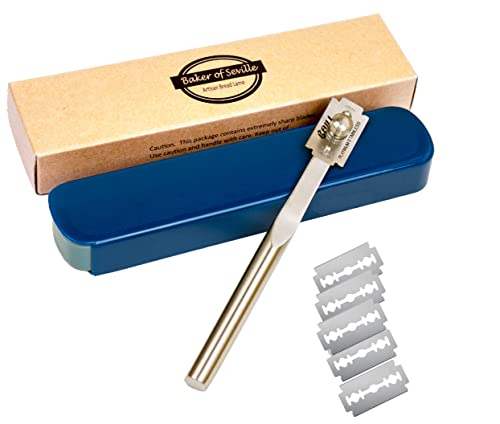
Baker of Seville Baker of Seville Bread Lame (The Wand)
Baker of Seville Bread Lame (The Wand)

The only lame here that publishes a way to change the blade's angle: a thumb screw clamps a standard double-edge blade either flat or bowed, so one tool scores a straight slash and a curved ear. Solid machined stainless, published as dishwasher safe, and the maker's own site promises to make any failure right for life.

Curved scoring and an ear on sourdough
8.5
$22.10Amazon
02
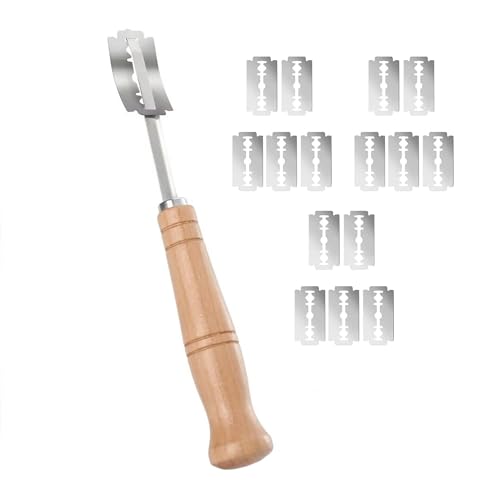
Fox Run Fox Run Bread Lame 5197 (Beechwood Handle, 15 Blades)
Fox Run Bread Lame 5197 (Beechwood Handle, 15 Blades)

The most blades for the money, on the shape most bakers picture when they think of a lame: a beechwood handle with a stainless rod that threads a double-edge blade into a shallow bow. Fox Run publishes the base length and a blunt care instruction — hand wash only.

A wood-handled lame with a long blade supply
8.3
$13.49Amazon
03
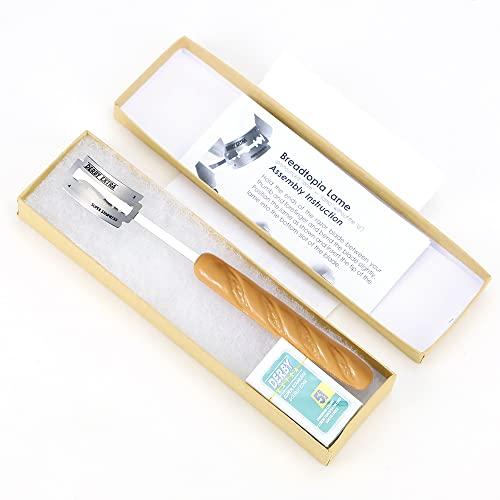
Breadtopia Breadtopia Bread Lame with 5 Blades and Storage Box
Breadtopia Bread Lame with 5 Blades and Storage Box

The lame from a sourdough supplier rather than a housewares brand: a hard plastic resin handle with a stainless strip that holds a double-edge blade, designed to be easy to see and pick up on a floury counter. Breadtopia stocks replacement blades as a named product for about a dollar, which is the detail that matters over years.

A cheap, replaceable workhorse
8.1
$12.95Amazon
04
Saint Germain Bakery Saint Germain Bakery Bread Lame SGW-500 (Leather Cover, 10 Blades)
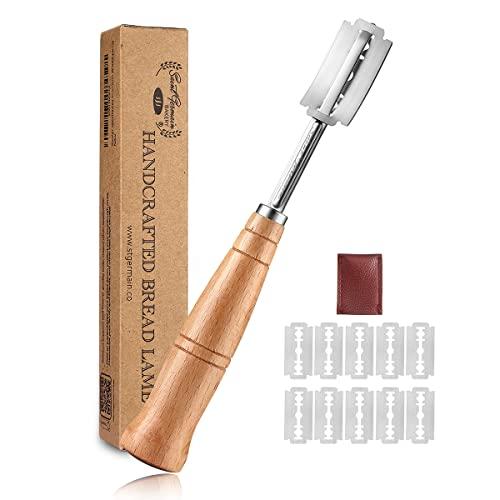
Saint Germain Bakery Bread Lame SGW-500 (Leather Cover, 10 Blades)

The budget pick, and the one most people should start with: a wood handle, a stainless stick for the blade, ten standard razor blades and a hand-made leather cover, for a fraction of what the stainless lames cost. The listing also claims replacement blades are covered under warranty for life.

A first lame, at the lowest price
8.1
$8.99Amazon

#ad · Live prices from the Amazon Product API, as of November 23, 2026. Where we have no verified live price we show none — a gap beats a number that has rotted.

In detail

The picks, in full

01
Baker of Seville Baker of Seville Bread Lame (The Wand)

Curved scoring and an ear on sourdough

Baker of Seville Bread Lame (The Wand)

Solid stainless steel bodyCurved or straight blade positionsThumb-screw blade lockStandard double-edge bladesHard-shell case
8.5/10

The only lame here that publishes a way to change the blade's angle: a thumb screw clamps a standard double-edge blade either flat or bowed, so one tool scores a straight slash and a curved ear. Solid machined stainless, published as dishwasher safe, and the maker's own site promises to make any failure right for life.

Blade control
9.5
Grip & safety
8.5
Build & durability
9.5
Blade supply
8
Value
7

Pros

  • Published dual-position system switches between a straight slash and a curved ear with no tools
  • All-stainless construction with no wood or leather to keep dry, and published as dishwasher safe
  • Thumb screw clamps the blade rather than threading it onto a rod, so the blade cannot rotate mid-score

Cons

  • Several times the price of a wood-handled lame that scores a straight slash just as well
  • Blade count is published two ways — the Amazon listing says 6 replacement blades, the maker's own site says 3 total
  • Neither the maker nor the listing publishes an overall length (Amazon's package dimensions list 8 in)

Don't buy this if…

…you only score straight slashes and patterns — the curve is the whole reason this costs more, and a budget lame does flat scoring identically.

$22.10View on Amazon

Price as of November 23, 2026. Prices change — Amazon's at checkout is the one that counts.

#ad · we may earn a commission from this link to Baker of Seville Bread Lame (The Wand)

02
Fox Run Fox Run Bread Lame 5197 (Beechwood Handle, 15 Blades)

A wood-handled lame with a long blade supply

Fox Run Bread Lame 5197 (Beechwood Handle, 15 Blades)

7.25 in published baseBeechwood handleStainless rod and blade15 blades includedHand wash only
8.3/10

The most blades for the money, on the shape most bakers picture when they think of a lame: a beechwood handle with a stainless rod that threads a double-edge blade into a shallow bow. Fox Run publishes the base length and a blunt care instruction — hand wash only.

Blade control
7.5
Grip & safety
8
Build & durability
7.5
Blade supply
9.5
Value
9

Pros

  • Fifteen blades in the box, which at normal home use is years of scoring
  • Beechwood handle is warm and grippy with floury hands, and does not get slick like bare metal
  • Fox Run publishes the mounting procedure and the 7.25 in base dimension rather than leaving both blank

Cons

  • Threading the rod through both slots of a razor blade is the fiddliest blade change on this page
  • Published as hand wash only, and the wood should not be soaked
  • No published way to set the blade's angle — you get whatever bow the threading gives you

Don't buy this if…

…you want to switch between a flat slash and a deliberate curve — the angle here is a side effect of how the blade threads, not a setting.

$13.49View on Amazon

Price as of November 23, 2026. Prices change — Amazon's at checkout is the one that counts.

#ad · we may earn a commission from this link to Fox Run Bread Lame 5197 (Beechwood Handle, 15 Blades)

03
Breadtopia Breadtopia Bread Lame with 5 Blades and Storage Box

A cheap, replaceable workhorse

Breadtopia Bread Lame with 5 Blades and Storage Box

Hard plastic resin handleStainless blade strip5 double-edge bladesStorage box included7.3 in listed length
8.1/10

The lame from a sourdough supplier rather than a housewares brand: a hard plastic resin handle with a stainless strip that holds a double-edge blade, designed to be easy to see and pick up on a floury counter. Breadtopia stocks replacement blades as a named product for about a dollar, which is the detail that matters over years.

Blade control
8
Grip & safety
8
Build & durability
7.5
Blade supply
8.5
Value
8.5

Pros

  • Plastic resin handle takes no care at all — no wood to keep dry, no leather to protect
  • Breadtopia sells replacement blades as a named product at about a dollar, so resupply is not a guess
  • The blade can be rotated on its strip, which lets you angle a cut without changing the tool

Cons

  • No real case, only the box it ships in, which Breadtopia itself names as the storage
  • Breadtopia publishes no overall length or handle dimension (Amazon's package listing shows 7.3 in)
  • Five blades is the smallest supply here

Don't buy this if…

…you want a tool that looks like equipment — this is deliberately plain, and the wood-handled lames are the ones people keep on the counter.

$12.95View on Amazon

Price as of November 23, 2026. Prices change — Amazon's at checkout is the one that counts.

#ad · we may earn a commission from this link to Breadtopia Bread Lame with 5 Blades and Storage Box

04
Saint Germain Bakery Saint Germain Bakery Bread Lame SGW-500 (Leather Cover, 10 Blades)

A first lame, at the lowest price

Saint Germain Bakery Bread Lame SGW-500 (Leather Cover, 10 Blades)

Wood handleStainless blade stick10 standard razor bladesLeather protective cover7.5 in listed length
8.1/10

The budget pick, and the one most people should start with: a wood handle, a stainless stick for the blade, ten standard razor blades and a hand-made leather cover, for a fraction of what the stainless lames cost. The listing also claims replacement blades are covered under warranty for life.

Blade control
7
Grip & safety
8
Build & durability
7
Blade supply
9
Value
9.5

Pros

  • Cheapest tool on this page and it still ships with ten blades and a cover
  • Takes the same standard double-edge razor blades as everything else here, so resupply costs pennies
  • Leather cover makes it safe to keep in a drawer rather than loose with a bare blade

Cons

  • The lifetime blade warranty is a listing claim with no published terms document behind it
  • Wood and leather both want keeping dry — this is not a tool to leave in the sink
  • No published blade-angle adjustment, and no published material grade beyond a stainless steel stick

Don't buy this if…

…you want a documented spec sheet — the published detail here is the thinnest of the four, and the all-stainless Baker of Seville is the opposite.

$8.99View on Amazon

Price as of November 23, 2026. Prices change — Amazon's at checkout is the one that counts.

#ad · we may earn a commission from this link to Saint Germain Bakery Bread Lame SGW-500 (Leather Cover, 10 Blades)

How to choose and use a bread lame

Buy for the score you actually want

If you bake round sourdough and want an ear, buy the tool that lets you bow the blade on purpose. If you bake baguettes, tin loaves, rye and decorative patterns, a flat blade in a cheap handle is the correct tool and the extra money buys you nothing. Nobody needs two lames.

Score cold dough, and do it fast

A dough straight from a cold overnight proof has a firm skin that parts cleanly. Room temperature dough drags and sticks to the blade regardless of which handle is holding it. Make the cut in one confident movement — hesitation drags, and a dragged score closes back up in the oven.

Depth: about a quarter inch, and commit

Shallow scores seal shut and the loaf tears somewhere you did not choose. Roughly a quarter-inch cut through the skin is the usual target for a lean sourdough, slanted at 30-45 degrees if you want an ear and near-vertical if you want an even opening. Our scoring guide walks through patterns and depth by loaf type.

Change the blade more often than feels necessary

A blade is worth pennies and a loaf is worth two days. If the blade is pulling the skin instead of parting it, change it. Dry the blade after every bake — a wet blade left in a damp handle rusts, and rust is what ruins the wooden-handled lames.

Store it covered, every time

This is the one safety rule that matters. A bare razor blade loose in a drawer is a genuine hazard, which is why the case or cover is a real feature: Baker of Seville publishes a hard-shell storage case, Saint Germain a leather cover, Breadtopia names the box it ships in, Fox Run supplies a base. Use whichever you have, and change blades with the handle resting on the counter rather than in mid-air.

If you do not want to buy one at all

Say it plainly: a razor blade held in your fingers scores bread perfectly well, which is how bakeries did it for a century, and a very sharp paring knife will do a cross on a boule. The lame exists to keep your fingers away from the blade, to let you cut at a consistent angle, and to make the blade replaceable. If those three things are not worth the cost of the cheapest tool here, skip it and spend the money on a container you can read the bulk ferment in, which will do far more for the loaf.
How we picked

We don't run a testing lab

We read the manuals, compiled the published specifications, did the wattage-to-dough math and weighed aggregated owner reviews, then scored each product against a published rubric. The scores are judgments from documented research — they are not measurements we took, because we do not have a lab and we're not going to pretend we do. Every spec is the manufacturer's published figure, cited in Sources.

Questions

Frequently asked

What blades does a bread lame use?
Standard double-edge safety razor blades, the same kind used in a traditional wet shave. Baker of Seville publishes that its lame accepts standard double-edge blades, Breadtopia publishes that it uses inexpensive replaceable double-edge blades, and Saint Germain publishes that blades are replaceable with standard razor blades. None of the makers states that blades are interchangeable between brands, so if you own a specific lame, buy the shape it ships with - but the blades themselves are a commodity you can buy in bulk for pennies apiece.
Do I need a lame, or will a knife do?
A knife will do, and a loose razor blade will do better. What a lame buys you is three things: your fingers stay away from the edge, the blade sits at a repeatable angle so your scores look the same twice, and the blade is replaceable so you are never scoring with a dull one. If you bake a loaf a month, a sharp paring knife and a steady hand are enough. If you bake weekly and care how the crust looks, the cheapest lame on this page is a sensible purchase.
Curved or straight blade - which should I buy?
Straight for patterns, baguette slashes and anything you want to open evenly; curved for an ear on a round sourdough. A bowed blade undercuts a flap of skin at roughly 30 to 45 degrees, and oven spring then lifts that flap into the ridge people call an ear. You can get the same effect with a straight blade held at an angle, which is why a budget lame is not a compromise for most bakers - but if the ear is the point, buy the tool that makes the curve a setting rather than an accident.
How deep should I score sourdough?
About a quarter of an inch through the skin for a lean sourdough, in one decisive movement. Too shallow and the score seals during oven spring, so the loaf tears somewhere random; too deep and you cut into the structure and the loaf spreads. Score cold dough straight from the fridge - a firm skin parts cleanly where room-temperature dough drags and sticks.
How often should I change the blade?
Sooner than you think. Wet dough and flour dull an edge quickly, and a blade that drags rather than slices is the usual reason a score looks ragged. Blades cost pennies, so change one the moment it stops parting the skin cleanly, and dry it after every bake - a wet blade left in a damp handle rusts, and rust is the thing that kills a wooden-handled lame.
Can a bread lame go in the dishwasher?
Only the all-stainless one. Baker of Seville publishes its lame as dishwasher safe. Fox Run publishes hand wash only for its beechwood-handled 5197, and the same common-sense rule applies to the Saint Germain's wood handle and leather cover. Breadtopia publishes no care instruction for its plastic-resin handle, so we have not invented one — wiping it and drying it takes a second and removes the question. Remove the blade before washing anything.

Keep reading

More in this category

More baking gear

All baking gear →

Receipts

Sources

We don't run a testing lab, and we don't pretend to. Specs are the manufacturer's published figures, cited above; scores are our judgments from that research. Where we couldn't verify something, we say so on the page rather than quietly leaving it out. Read our full method.