Skip to content
Plug & Prep

Hub 04 · Baking Gear · Baking Gear

The best mixing bowls for baking

Nobody shops for mixing bowls until a bowl walks across the counter under a hand mixer, or a doubled dough climbs over the rim. Both are capacity and stability problems, and both are published specs you can check before buying.

By Stephen V.Updated How we pick
#ad

We earn a commission when you buy through our Amazon links, at no extra cost to you. It never changes our rankings, and we say so when the cheaper product is the better buy. How this works.

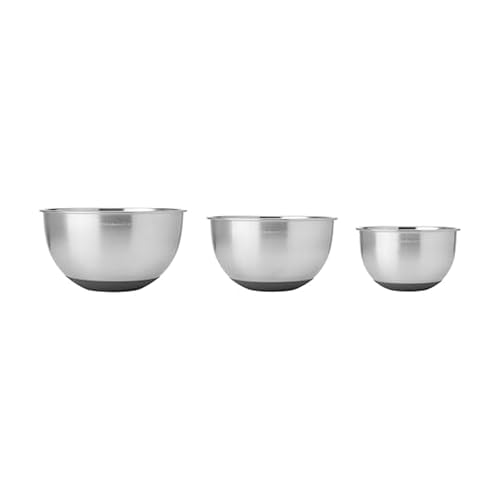
Buy the OXO Good Grips 3-piece stainless set. OXO publishes the two things that actually matter while you are mixing: non-skid bottoms that stabilize the bowl even when it is tilted, and a plastic exterior that shields your hands from extreme temperatures — so the bowl stays still under a hand mixer and you can hold it over simmering water or in an ice bath. Then add the Winco MXB-800Q 8-quart, because no three-piece set sells a bowl big enough to bulk-ferment a dough or mix a double batch, and this one costs less than most sets cost per bowl. If you want glass, the Pyrex Essentials set is published as microwave, freezer and dishwasher safe, which is a job stainless cannot do at all. The KitchenAid set is the same three capacities with the same published nonslip bases for usually less money, minus the insulated exterior. And the budget pick is the Umite Chef 5-bowl set with airtight lids: five graduated sizes and a lid for each, for the price of a single premium bowl.

Three decisions, in this order

Mixing bowls look like a commodity, and for stirring pancake batter they are. For baking, three published specs separate them, and they matter in this order.

1. How big is the biggest bowl? This is the one people get wrong. Every three-piece set on this page tops out at 5 quarts, and a 5-quart bowl is a single batch with no headroom. Dough does not stay the size you mixed it.

2. What can the bowl do when it is not mixing? Stainless is unbreakable, light, and absolutely not microwavable. Glass goes in the microwave and the freezer and lets you see the batter, and it breaks. A bowl with a lid becomes a storage container, which saves you decanting a marinade or a rested dough into something else.

3. Does it stay put? Run a hand mixer in a lightweight metal bowl on a hard counter and the bowl rotates away from the beaters, which is why people end up wedging it against their body. A published non-slip base fixes it. Two sets here publish one; the big Winco basin does not.

Everything else — finish, color, brand — is preference. Note what is not on that list: wall thickness. Not one of these five makers publishes a gauge or a thickness figure, so you cannot compare heft on paper, and we have not pretended otherwise in the rankings.

Why a 5-quart set is not a dough bowl

Here is the arithmetic that explains the Winco's place on this page.

A standard single sourdough loaf is roughly 900 to 1000 grams of dough. At the start of bulk fermentation that is a little over a quart; properly doubled, it is around two and a half quarts — the numbers we use on our dough proofing container page. So one loaf fits a 5-quart bowl with room to fold, and that is genuinely fine.

Two loaves does not. Double that dough and you are at five quarts at full rise, in a bowl that holds five quarts level with the rim, with a wet dough you need to reach into and fold. The same problem shows up with a double batch of cookie dough, a large pavlova, or anything where you cream butter and sugar and then fold in dry ingredients without throwing flour across the kitchen. An 8-quart bowl is the cheap fix, and a single foodservice basin is far cheaper than buying a bigger set.

The honest caveat: the Winco is one bowl, it has no lid, no handle and no non-slip base, and Winco publishes no gauge for it. It is a wide, light, inexpensive basin with a reinforced rim. For bulk fermentation, where the bowl sits still for hours under a cover, none of that matters. For whipping cream with a hand mixer, it does — use a set bowl for that.

Stainless, glass or plastic

We have a longer glass versus stainless comparison, but the short version decides most purchases.

Stainless is the default for a reason: it is light enough to hold and pour one-handed, it will not chip or shatter, it goes from a hot-water bath to an ice bath without complaint, and OXO and KitchenAid both publish that their stainless interiors resist odors and stains. The limits are real and absolute, though. Stainless cannot go in the microwave. You cannot see the contents from the side. And a thin bowl rings and skids unless the base is treated.

Glass earns its place on the jobs stainless cannot do. Pyrex publishes its Essentials bowls as freezer, microwave and dishwasher safe, so one bowl melts the butter, chills the cream, holds the batter and goes to the table. Glass also weighs enough to stay put on its own, and seeing layers and streaks through the side wall is genuinely useful when you are folding. The trade is that glass breaks, a sudden temperature change is a real risk rather than a theoretical one, and this set tops out at 2.5 quarts — these are prep bowls, not dough bowls.

Plastic we have not ranked, deliberately. It is the lightest and the cheapest, and it is also the material that scratches, stains, holds oil and grease in the scratches, and — the reason it is wrong for baking — will not let an egg white whip properly if the surface is holding any fat. If you own plastic bowls, keep them for dry ingredients and salads.

The non-slip base is the feature nobody knows to want

If you have ever chased a bowl around a worktop with a hand mixer running, this is the fix, and it is published rather than inferred: OXO publishes “non-skid bottoms stabilize Bowls while mixing, even when tilted”, and KitchenAid publishes nonslip bases that “help keep the bowls stable while mixing”. The Umite Chef set publishes non-slip bases too.

The phrase even when tilted is the part worth paying for. Tilting the bowl toward the beaters is exactly how you get everything incorporated instead of leaving a ring of unmixed butter at the top, and a bowl that slides the moment it tilts forces you to work flat. It is the same problem that makes people buy a stand mixer, solved for a few dollars.

OXO adds one more published feature nothing else here has: plastic exteriors that shield hands from extreme temperatures. That is the difference between holding a bowl over simmering water to melt chocolate and needing a towel, and between whipping over an ice bath for five minutes and losing the feeling in your fingers. If you temper chocolate or make Swiss meringue, that single feature is why this set is ranked first.

What about the bowl your stand mixer came with?

It is not a general-purpose mixing bowl, and treating it as one is how people end up with one bowl and a sink full of improvisation.

A stand mixer bowl is shaped for the beater path, it is usually tall and narrow, it often has a handle in the way, and while it is in the machine it is unavailable for anything else. Real baking needs two or three bowls at once: dry ingredients in one, wet in another, egg whites in a third. That is the actual argument for a graduated set, and it is why a set plus one big basin beats any single expensive bowl.

If you are still choosing the machine, our stand mixer hub and bowl buying guide cover that decision; this page is about the bowls you will reach for regardless of which mixer you own.

Lids: what they are for, and what they are not

The Umite Chef set is the budget pick here largely because of its published airtight lids. A lid turns a mixing bowl into a fridge container, which matters more than it sounds: a rested pie dough, a marinating chicken, an overnight poolish or a bowl of trimmed fruit all otherwise get decanted into something else.

What a lid is not is permanent. Plastic lids are the part of any bowl set that fails first — they warp in a dishwasher, lose their seal, and go brittle. Hand wash them, expect to replace them eventually, and do not pay a premium for them. The bowls will outlive the lids by decades.

What none of these makers publish

Four gaps, named here because a spec table that fills them in would be inventing figures.

No gauge or wall thickness, from any of the five. This is the single figure the foodservice world does publish — we checked a 26-gauge Vollrath economy set this run specifically for it, and could not confirm the listing as purchasable, so it is not on the page. Among what you can buy here, heft is something you will discover in your hand.

No bowl diameters. Capacities are published; the rim diameter that decides whether a whisk can move freely, or whether the bowl fits over your largest saucepan as a bain-marie, is not. Amazon's package dimensions are the nearest thing available (13.25 in listed for the Winco, 12.2 in for the KitchenAid set, 11.25 in for the Pyrex set) and those are shipping figures, not bowl specs.

No oven ceiling for the glass. The Pyrex listing title says “preheated oven” safe and the feature bullets publish freezer, microwave and dishwasher safety plus a “limited warranty” with no terms attached. No temperature figure is published for these bowls, so if you plan to bake in one, read the care leaflet in the box rather than trusting this page.

No thermal-shock specification. “Do not put a hot glass bowl on a wet counter” is universal glassware advice, and no maker here quantifies how big a temperature change is too big. Treat any sudden swing as a risk.

Where bowls sit in the kit

Bowls are the cheapest upgrade in a baking kitchen and the one most people under-buy. They are the step before everything: you weigh into them, you whisk in them, you cream butter and sugar in them, and a big one is where a dough spends its first few hours before it ever sees a loaf pan or a Dutch oven. If you want the long-form version of this decision, our stainless bowl set review covers the budget set in detail and how to choose mixing bowls covers sizes and materials from first principles.

The short answer

Quick picks

#ProductBest forScorePrice
01
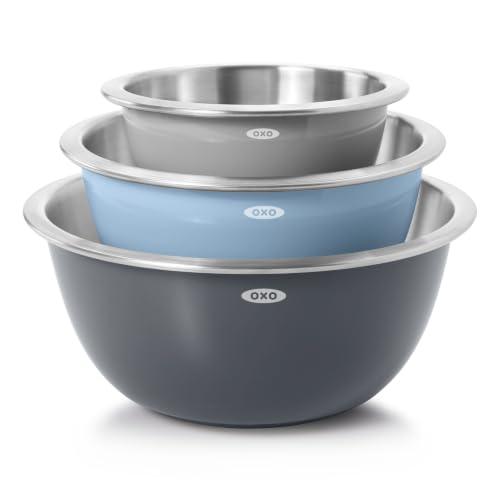
OXO OXO Good Grips 3-Piece Stainless Steel Mixing Bowl Set (1.5/3/5 qt)
OXO Good Grips 3-Piece Stainless Steel Mixing Bowl Set (1.5/3/5 qt)

The set that answers the two problems you actually have while mixing: OXO publishes non-skid bottoms that stabilize the bowl even when tilted, and plastic exteriors that shield your hands from extreme temperatures. That is a bowl that stays put under a hand mixer and one you can hold over a double boiler or an ice bath.

Mixing with a hand mixer, and holding hot or cold
7.9
$55.99Amazon
02
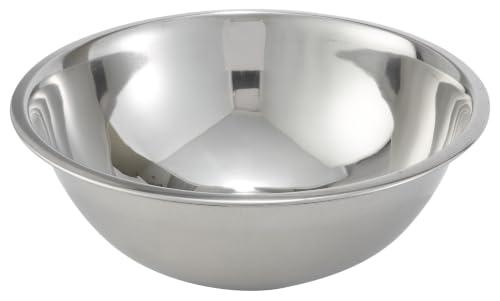
Winco Winco MXB-800Q 8-Qt Stainless Steel Mixing Bowl
Winco MXB-800Q 8-Qt Stainless Steel Mixing Bowl

The bowl no three-piece set includes: a single 8-quart foodservice basin with a reinforced rim, for less than most sets cost per bowl. This is the bulk-fermentation and double-batch bowl, and it is what stops you splitting a dough because your biggest bowl is 5 quarts.

Bulk fermentation and double batches
7.8
$12.74Amazon
03
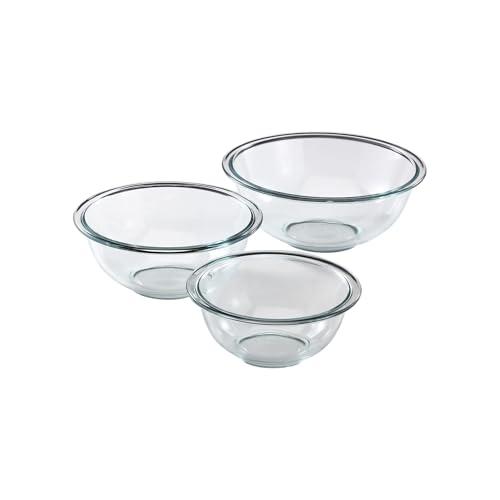
Pyrex Pyrex Essentials 3-Piece Glass Mixing Bowl Set (1/1.5/2.5 qt)
Pyrex Essentials 3-Piece Glass Mixing Bowl Set (1/1.5/2.5 qt)

The glass set, and the one that does jobs stainless cannot: Pyrex publishes 1-qt, 1.5-qt and 2.5-qt tempered glass bowls that are freezer, microwave and dishwasher safe, so the same bowl melts the butter and chills the cream. Heavy enough to stay put, and you can see the batter through the side.

Melting, chilling and microwave work
7.8
$17.99Amazon
04
KitchenAid KitchenAid Stainless Steel Mixing Bowls, Set of 3 (KM175OSSSA)
KitchenAid Stainless Steel Mixing Bowls, Set of 3 (KM175OSSSA)

The same three capacities as the OXO set with the same published nonslip bases, from the brand whose stand mixer is probably already on the counter. What it does not publish is an insulated exterior — these are plain stainless, which is lighter, usually cheaper and happy in the dishwasher.

A plain stainless set at a lower price
7.7
$49.99Amazon
05
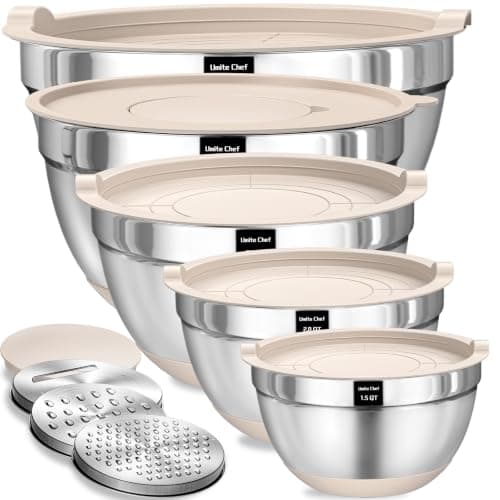
Umite Chef Umite Chef Stainless Mixing Bowl Set (with Lids)
Umite Chef Stainless Mixing Bowl Set (with Lids)

A do-everything set of nesting stainless bowls with airtight lids, for the price of a single premium bowl. Five graduated sizes cover prepping, mixing and proofing, the lids turn any bowl into a storage container, and non-slip bases keep them steady while you whisk. Nothing here is heirloom-grade, but it's the practical backbone of a baking kitchen.

Everyday mixing and prep bowls
8.2
$25.88Amazon

#ad · Live prices from the Amazon Product API, as of November 23, 2026. Where we have no verified live price we show none — a gap beats a number that has rotted.

In detail

The picks, in full

01
OXO OXO Good Grips 3-Piece Stainless Steel Mixing Bowl Set (1.5/3/5 qt)

Mixing with a hand mixer, and holding hot or cold

OXO Good Grips 3-Piece Stainless Steel Mixing Bowl Set (1.5/3/5 qt)

1.5, 3 and 5 qtStainless interior, plastic exteriorNon-skid bottomsNests for storageDishwasher safe
7.9/10

The set that answers the two problems you actually have while mixing: OXO publishes non-skid bottoms that stabilize the bowl even when tilted, and plastic exteriors that shield your hands from extreme temperatures. That is a bowl that stays put under a hand mixer and one you can hold over a double boiler or an ice bath.

Stability
9.5
Capacity range
7
Material versatility
7
Build & durability
9
Value
7

Pros

  • Published non-skid bottoms stabilize the bowl while mixing, even when tilted — the fix for a bowl that walks under a hand mixer
  • Published insulated plastic exterior means you can hold the bowl over simmering water or in an ice bath without numb hands
  • Stainless interiors are published as not retaining odors or colors, so the same bowl does onions and meringue

Cons

  • The most expensive set here by a wide margin
  • The plastic exterior rules out the oven, the broiler and the microwave entirely
  • Tops out at 5 qt, which is a single batch of bread dough with no headroom for bulk fermentation

Don't buy this if…

…you need a bowl that goes in the oven or the microwave — the plastic exterior is the whole point of this set and also its hard limit.

$55.99View on Amazon

$69.9920% off

Price as of November 23, 2026. Prices change — Amazon's at checkout is the one that counts.

#ad · we may earn a commission from this link to OXO Good Grips 3-Piece Stainless Steel Mixing Bowl Set (1.5/3/5 qt)

02
Winco Winco MXB-800Q 8-Qt Stainless Steel Mixing Bowl

Bulk fermentation and double batches

Winco MXB-800Q 8-Qt Stainless Steel Mixing Bowl

8 qt capacity13.25 in listed diameterStainless steelReinforced rimNo published gauge
7.8/10

The bowl no three-piece set includes: a single 8-quart foodservice basin with a reinforced rim, for less than most sets cost per bowl. This is the bulk-fermentation and double-batch bowl, and it is what stops you splitting a dough because your biggest bowl is 5 quarts.

Stability
6
Capacity range
9
Material versatility
7
Build & durability
7.5
Value
9.5

Pros

  • Eight quarts is genuine headroom — a doubled sourdough or a double batch of cookie dough fits with room to fold
  • A reinforced rim is the part that keeps a thin foodservice bowl from going out of round
  • Costs a fraction of a three-piece set, so it is an easy addition rather than a replacement

Cons

  • Winco publishes no gauge or wall thickness for this bowl, so you cannot compare its weight on paper
  • No non-slip base, no lid and no handle — a light bowl this wide will skid if you run a hand mixer in it
  • One size only, which makes it a supplement to a set rather than a set

Don't buy this if…

…what you need is a nest of graduated prep bowls — this is one big basin and nothing else.

$12.74View on Amazon

Price as of November 23, 2026. Prices change — Amazon's at checkout is the one that counts.

#ad · we may earn a commission from this link to Winco MXB-800Q 8-Qt Stainless Steel Mixing Bowl

03
Pyrex Pyrex Essentials 3-Piece Glass Mixing Bowl Set (1/1.5/2.5 qt)

Melting, chilling and microwave work

Pyrex Essentials 3-Piece Glass Mixing Bowl Set (1/1.5/2.5 qt)

1, 1.5 and 2.5 qtTempered glassMicrowave safeFreezer and dishwasher safeLimited warranty
7.8/10

The glass set, and the one that does jobs stainless cannot: Pyrex publishes 1-qt, 1.5-qt and 2.5-qt tempered glass bowls that are freezer, microwave and dishwasher safe, so the same bowl melts the butter and chills the cream. Heavy enough to stay put, and you can see the batter through the side.

Stability
7.5
Capacity range
6
Material versatility
9.5
Build & durability
7
Value
9

Pros

  • Published microwave safe, which makes it the bowl for melting butter and chocolate without a second pan
  • Published freezer safe, so a bowl of cream or a bowl of dough goes straight into the cold
  • Glass weighs enough to sit still, and you can see layers and streaks through the side wall

Cons

  • The largest bowl is 2.5 qt — these are prep and mixing bowls, not dough bowls
  • Tempered glass is still glass: it breaks if dropped, and a sudden temperature change is a real risk
  • No non-slip base, and a wet glass bowl is slippery to hold at an angle

Don't buy this if…

…you want one set that covers bread dough as well as prep — the 2.5-qt top size cannot hold a doubled loaf.

$17.99View on Amazon

Price as of November 23, 2026. Prices change — Amazon's at checkout is the one that counts.

#ad · we may earn a commission from this link to Pyrex Essentials 3-Piece Glass Mixing Bowl Set (1/1.5/2.5 qt)

04
KitchenAid KitchenAid Stainless Steel Mixing Bowls, Set of 3 (KM175OSSSA)

A plain stainless set at a lower price

KitchenAid Stainless Steel Mixing Bowls, Set of 3 (KM175OSSSA)

1.5, 3 and 5 qtStainless steelNonslip basesNesting storageDishwasher safe
7.7/10

The same three capacities as the OXO set with the same published nonslip bases, from the brand whose stand mixer is probably already on the counter. What it does not publish is an insulated exterior — these are plain stainless, which is lighter, usually cheaper and happy in the dishwasher.

Stability
8.5
Capacity range
7
Material versatility
7
Build & durability
8
Value
8

Pros

  • Published nonslip bases, which is the one feature that matters most when a hand mixer is running
  • Published as odor- and stain-resistant stainless, and dishwasher safe for all three bowls
  • Usually priced under the OXO set for the same three capacities

Cons

  • No insulated exterior, so a bowl over a double boiler gets too hot to hold bare-handed
  • KitchenAid publishes no gauge, wall thickness or bowl diameter for the set
  • Same 5-qt ceiling as every three-piece set here

Don't buy this if…

…you temper chocolate or whip over an ice bath often — the OXO's insulated exterior is worth the difference for exactly that.

$49.99View on Amazon

$74.9933% off

Price as of November 23, 2026. Prices change — Amazon's at checkout is the one that counts.

#ad · we may earn a commission from this link to KitchenAid Stainless Steel Mixing Bowls, Set of 3 (KM175OSSSA)

05
Umite Chef Umite Chef Stainless Mixing Bowl Set (with Lids)

Everyday mixing and prep bowls

Umite Chef Stainless Mixing Bowl Set (with Lids)

5 bowls: 1.5–5 qtStainless steelAirtight lidsNon-slip basesNesting storage
8.2/10

A do-everything set of nesting stainless bowls with airtight lids, for the price of a single premium bowl. Five graduated sizes cover prepping, mixing and proofing, the lids turn any bowl into a storage container, and non-slip bases keep them steady while you whisk. Nothing here is heirloom-grade, but it's the practical backbone of a baking kitchen.

Accuracy
7.5
Build quality
7.5
Ease of use
8.5
Versatility
8.5
Value
9

Pros

  • Five graduated sizes (1.5 to 5 qt) cover almost any prep, mix or proof
  • Airtight lids turn each bowl into a fridge storage container
  • Non-slip bases keep the bowl steady while you whisk or fold

Cons

  • Plastic lids can warp or lose their seal over time, so hand-washing is safer
  • Thinner-gauge bowls can dent if dropped
  • Stainless isn't microwave-safe, unlike a glass set

Don't buy this if…

…you specifically need microwave- or oven-safe bowls — stainless is neither, so a glass or ceramic set fits that job better.

$25.88View on Amazon

$37.9932% off

Price as of November 23, 2026. Prices change — Amazon's at checkout is the one that counts.

#ad · we may earn a commission from this link to Umite Chef Stainless Mixing Bowl Set (with Lids)

How to choose and use mixing bowls

Own three sizes, and one that is too big

A small bowl for eggs and melted butter, a medium one for dry ingredients, a large one for the mix itself, and one basin that looks absurdly large until the first time a dough doubles in it. Three graduated bowls plus an 8-quart is a complete set for well under the price of a premium three-piece.

Weigh in the bowl, not into it

Put the bowl on the scale, press tare, and add ingredients one after another, taring between each. It removes every measuring cup from the process and it is the single biggest accuracy gain available to a home baker — see measuring flour by weight. This is also an argument for a lighter bowl: a heavy glass bowl eats into the capacity of a small kitchen scale.

Match the bowl shape to the job

Whipping cream or egg whites wants a deep, narrow bowl so the beaters stay submerged and the whisk moves through the whole volume. Folding wants a wide bowl so you can turn the mixture over with a spatula without compacting it. If you only have one shape, go deep and fold carefully.

Degrease anything that will meet an egg white

Fat kills meringue. Before whipping whites, wipe the bowl and the beaters with a little vinegar or lemon juice on a paper towel and dry them. This is also why we have not ranked a plastic bowl: scratched plastic holds fat where you cannot wipe it out.

Never microwave the stainless, and be careful with the glass

Metal does not belong in a microwave. Glass does — Pyrex publishes it — but handle it like glassware: no hot bowl onto a wet surface, no cold bowl into a hot oven, and no running a chipped bowl. Inspect the rim occasionally.

Wash lids by hand, bowls however you like

Every bowl on this page is published dishwasher safe. The lids are the weak point: hand wash them, do not stack hot dishes on them, and accept that they are the part you will eventually replace. The bowls themselves should outlast the kitchen.
How we picked

We don't run a testing lab

We read the manuals, compiled the published specifications, did the wattage-to-dough math and weighed aggregated owner reviews, then scored each product against a published rubric. The scores are judgments from documented research — they are not measurements we took, because we do not have a lab and we're not going to pretend we do. Every spec is the manufacturer's published figure, cited in Sources.

Questions

Frequently asked

What size mixing bowl do I need for bread dough?
Bigger than the dough by a factor of three. A standard single sourdough loaf is roughly 900 to 1000 g of dough - a little over a quart at the start and about two and a half quarts once doubled - so a 5-quart bowl handles one loaf with room to fold. Two loaves, or a double batch of anything, needs about 8 quarts, which is why a single large foodservice basin is on this page alongside the three-piece sets. Every three-piece set here tops out at 5 quarts.
Stainless steel or glass mixing bowls?
Stainless for mixing, glass for everything else. Stainless is lighter, unbreakable, tolerates an ice bath or a hot-water bath, and both OXO and KitchenAid publish that their interiors resist odors and stains - but it cannot go in a microwave and you cannot see the contents. Glass can be microwaved and frozen (Pyrex publishes both), weighs enough to sit still on its own, and lets you watch the batter through the side; it also breaks, and a sudden temperature change is a genuine risk. Most kitchens end up with both, which is the honest answer.
Why does my bowl move around when I use a hand mixer?
Because the bowl is light and the counter is smooth, and the beaters push against the mixture, which pushes back against the bowl. A published non-slip base fixes it: OXO publishes non-skid bottoms that stabilize the bowl even when tilted, and KitchenAid and Umite Chef both publish nonslip bases. The cheap workaround is a damp tea towel folded under the bowl, which works on any bowl including the 8-quart basin here.
Can I bulk-ferment sourdough in a mixing bowl?
You can, and plenty of bakers do, but a round bowl makes it hard to read the rise. Bulk fermentation is a volume judgement - dough is ready when it has risen by a set proportion, not after a set time - and a curved bowl gives you no straight wall to measure against. A big bowl plus a piece of tape at the starting level works. A straight-sided container with molded graduations works better, which is what our dough proofing container roundup is about.
Are mixing bowls with lids worth it?
Yes for the bowls, no as a reason to pay more. A lid turns a bowl into a fridge container, which saves decanting a rested dough or a marinade into something else, and the Umite Chef set here publishes airtight lids across five sizes - which is most of why it is the budget pick. Just expect the lids to be the first thing that fails: plastic lids warp in a dishwasher and lose their seal, so hand wash them and treat them as consumable.
How many mixing bowls do I actually need?
Three for most baking, plus one oversized bowl if you make bread. A real recipe has you holding dry ingredients, wet ingredients and sometimes whipped whites at the same time, and the bowl attached to your stand mixer is unavailable while the machine is running. That is the argument for a graduated nesting set rather than one expensive bowl - and nesting means three or five bowls take one bowl's worth of cupboard.

Keep reading

More in this category

More baking gear

All baking gear →

Receipts

Sources

We don't run a testing lab, and we don't pretend to. Specs are the manufacturer's published figures, cited above; scores are our judgments from that research. Where we couldn't verify something, we say so on the page rather than quietly leaving it out. Read our full method.